

As the world’s climate continue to change and the weather becomes evermore unpredictable, the need for an ideal enclosure to protect the printed circuit board (PCB) has just became more important.
Phoenix Contact has just the solution. Introducing the Environment Case System (ECS)!
The applications for this enclosure are endless. From a control unit on the exterior building to a sub electronic board on the top of a lamp post, the ECS is a suitable enclosure for even adverse weather condition.
5 Features of the Environment Case System
So what benefits do you get with the Environment Case System (ECS)?
- Since it is designed for most outdoor use, the ECS is able to withstand operating temperatures of -40˚C to +85˚C, UV exposure, and it is even able to reduce pressure build up that occurs when an environment has temperature swings through an optional pressure compensation membrane. Therefore, providing an IP67 rating which is dust proof and jet water resistant.

Environment Case System – Pressure compensating membrane
- It has tamper protection via a cable binder to indicate proof if the closure has been opened after installation.

Environment Case System – Anti-tamper
- It is robust and hardy. Tests have been carried out with more than 100KG force applied with no distortion or damage.
- Pole-mount accessories facilitates easy installation on a pole rather than requiring a wall to drill and secure the enclosure to.

Environment Case System – Pole Mount
- Although the ECS is a standard product, the enclosure can be semi-customise of cut-outs is possible on any flat surface.
Market Applications for ECS
With such a lineup of features, what applications can you use the Environment Case system for?
- Telecommunication locations
- Outdoor building automation
- Green energy such as wind and solar energy
- Unmanned utility vehicle
- Testing & monitoring equipment
- Agriculture equipment
Contact us now at marketing@phoenixcontact.com.sg for a sample to secure your PCB from any harsh environment.


 Phoenix Contact strives to deliver excellence in both product quality and customer service.


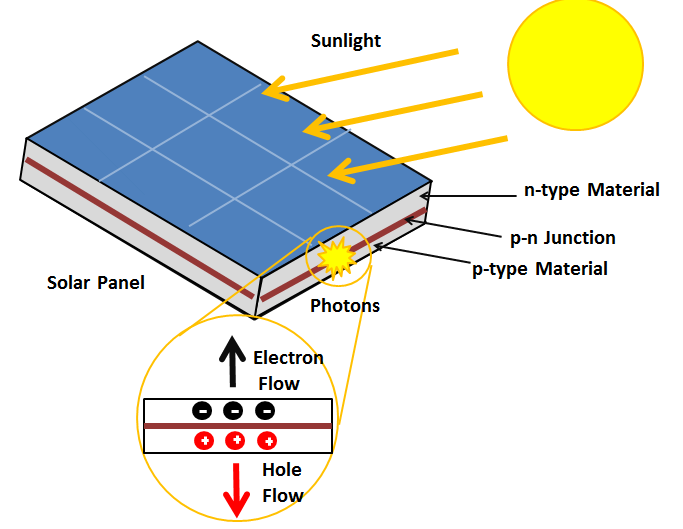
 The main function of a solar module is to convert solar energy into electrical energy. A Solar module consists of a number of silicon cells which when illuminated by the sun, will produce photons that can generate electrical current. A set of Solar Panels in one system is called an Array. Generally the most widely used solar modules are crystalline type either Monocrystalline or Polycrystalline. While thin film solar modules are still rarely used (in Indonesia). A solar cell can produce a voltage of approximately 0.5 volts. So a 12 volt solar cell consist of about 36 cells.PLTS Off-grid will consist of several solar modules according to their capacity. For example, a 10 kWp PLTS will consist of 50 units of 200 Wp solar modules or 100 units of 100 Wp solar modules. These solar module is arranged in series and parallel with certain configuration.
 In a solar power plant, solar panels can be arrayed in parallel to produce a larger current. Combiner boxes are used to connect the positive foot of solar panels to one another. Similarly, for negative legs. The positive foot end of the solar panel is connected to the positive charge controller leg and so is the negative leg. The resulting solar panel voltage will be used by the charge controller to charge the battery.
 Have you heard of Phoenix Contact’s QUINT POWER range of power supplies?


