
Tag Archives: signals

PSD Signal Towers

From |

Clear signalling at all times, in all places

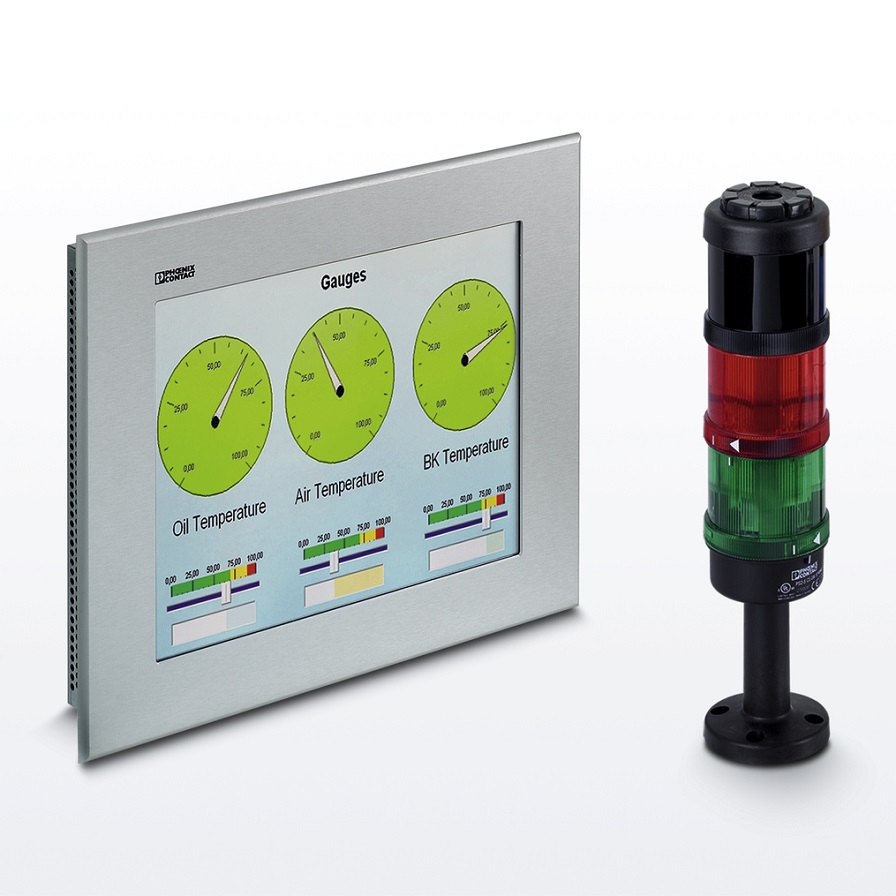
Reducing downtime and costs is the only way to ensure a competitive advantage. Unmistakable signalling status of the machine or system states is a crucial requirement. These modular signal towers of the PSD (Phoenix Signalling Devices) product range are characterized by their wide range of alarm signals in optical as well as acoustic modules.

If you require central monitoring of the machine or system status, even in an environment without network infrastructure, you are able to choose between two cost-effective alternatives. The PSD signal tower allows for the connection of a wireless interface and also enables direct or subsequent evaluation on the PC.

The PSD signal tower is also flexible when it comes to system expansion and conversions due the modular design.
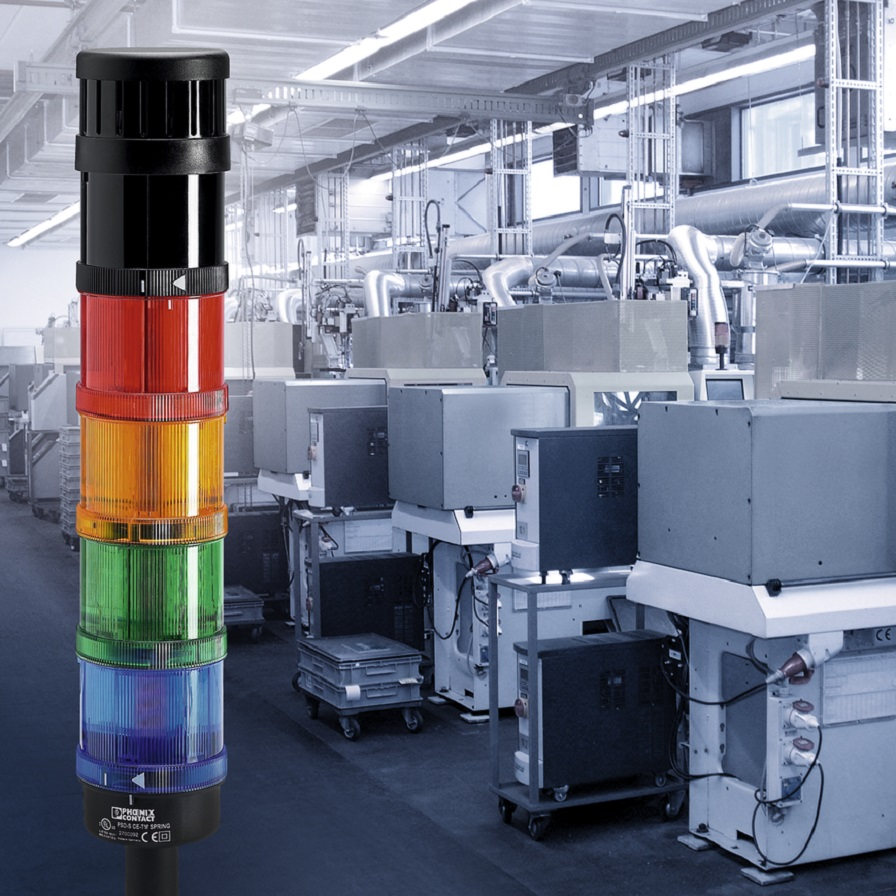
Advantages of the PSD signal towers from Phoenix Contact:

Clear status indication

The optical elements are available in a choice of 5 colours with various different signal types.

Clear audible indication

The acoustic elements are available in siren, buzzer and voice output.

Fast installation

A signal tower can be erected or extended without using any tools in a matter of seconds by simply placing the individual signal elements on top of each other and turning the bayonet locking system. This automatically establishes an electrical connection between the elements. The control lines are then connected to the screw or spring-cage terminal blocks in the base elements.

Service life

Minimum LED service life of 50,000hrs which adds up to an estimated lifespan of 6 years if it is in operation for 24hrs a day, 356 days a year.

Various mounting options

The signal tower portfolio is completed by a wide range of mounting elements, which ensure optimum mounting of signal towers according to the conditions. You are able to choose from surface mounting or tube mounting.

High degree of protection

IP65, when installed.

Central monitoring and control

Using the WIN (Wireless Information Network) system, it is possible to simultaneously monitor the status of up to 50 machines at a central point by transmitting the status via wireless elements integrated into the signal towers (slaves) to a receiving element (master) that is connected to the USB port of a PC.

A slave element has a wireless range of up to 300m. The distance of the slave element from the master can be increased by up to 900m with the help of integrated repeater and routing devices.
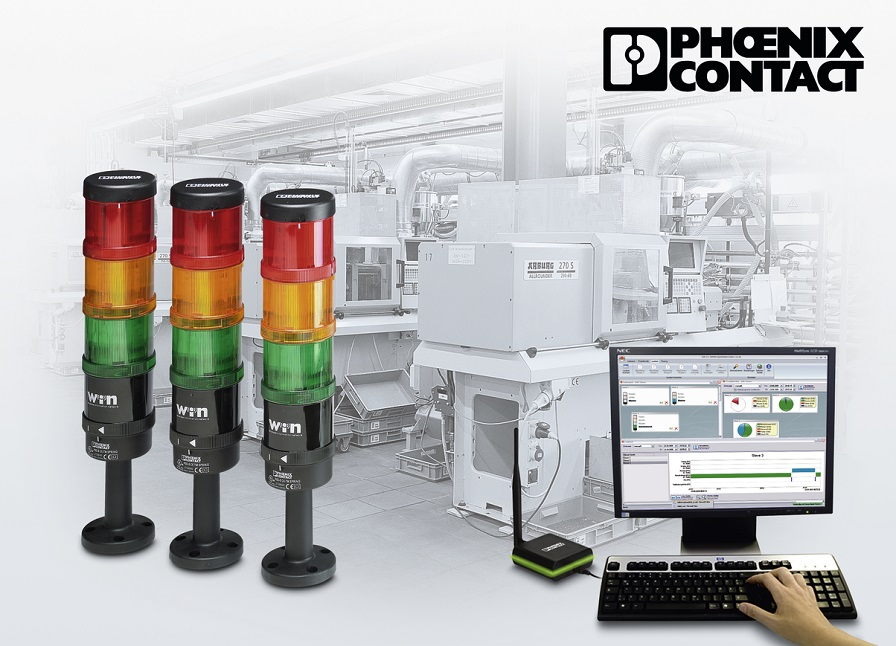
Advantages of our WIN system:

  • Simultaneous monitoring of a large number of machines
  • Central monitoring is possible, even in area without network infrastructure (example, Ethernet)
  • Can be operated parallel to other wireless applications
  • High wireless range
  • No programming or parameterization required
  • Graphical evaluation of machine status
  • Retrospective analysis of machine status
  • Error messages alarm via e-mail

Optimum detection of machine status

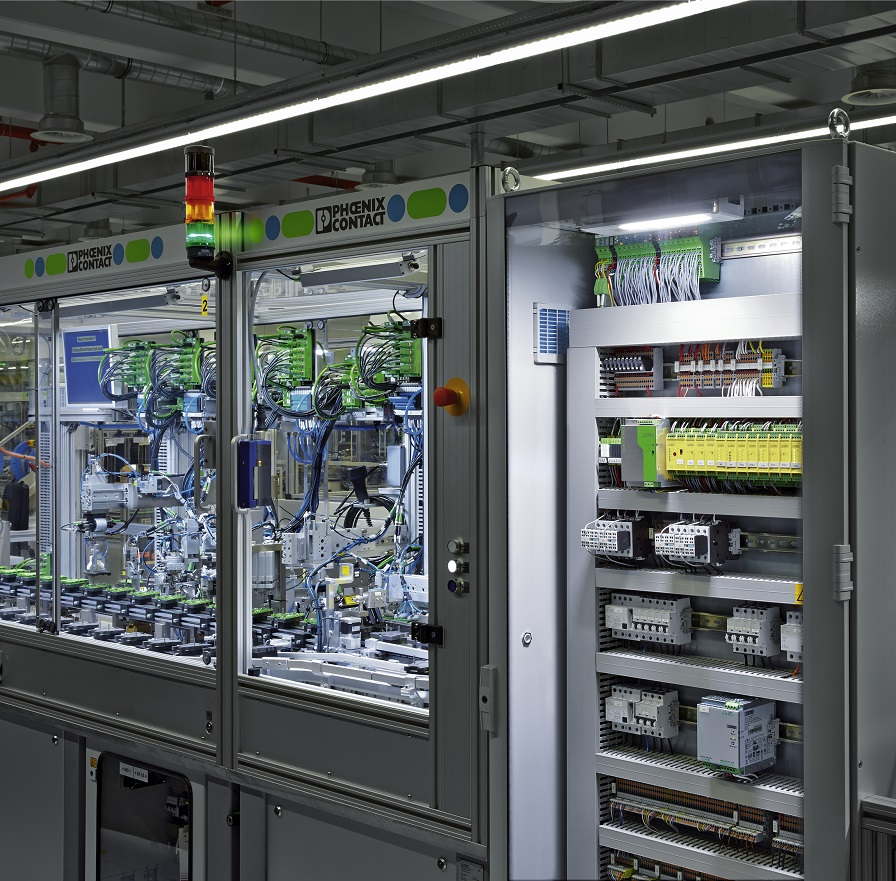
The signal towers are used to indicate the status of the machines or systems, including operating states, start up, normal operating, warnings, error alarm messages, pending critical states, acknowledgement requests, etc. There are also a numerous other applications, such as the status display of access controls and cabinet systems.
Interested to find out more? Get in touch with us at marketing@phoenixcontact.com.sg!

Mini Analog Pro Signal Duplicator

From |

Do you have applications where you need to feed 4-20mA current from a transmitter to both DCS input and a digital display indicator? If yes, then most likely you will need a signal duplicator (current splitter). The module splits the current from 1 input 4-20mA to 2 output current.

While it is true that current is flowing with the same value if we put load in series, but one must observe the total load resistance in 1 loop. This includes if we draw long cables from transmitter to DCS and digital display. There is a maximum resistance value that a transmitter can be connected with. This is why we still need a signal duplicator module.

Phoenix Contact Mini Analog Pro Signal Duplicator has an output load resistance of maximum 500 Ohms per channel which is sufficient for most applications. Moreover, it has a Repeater Power Supply function, which means this module can be used for a 2 wire or 4 wire transmitter. It is also HART transparent if you are using SMART Device.

Another interesting feature is the module has NFC ready, this means huge benefits for users to set the module behavior. In the past, we need to rely on datasheets and then do manual setting via dip switch. This is no longer needed, just pick up your Phone and put it near to the module, then all the setting can be done via Apps.

Want to find out more? Feel free to contact us at marketing@phoenixcontact.com.sg!

Choosing the Right Signal Conditioner

From |

Basic 4-20mA current loopSensors and other devices with 4-20mA current loop output are very popular in industrial fields. We can find them from Process Control to data logging systems. A basic current loop has parts as stated below:

  • Sensor: a device which draws current from its power source in direct proportion to the value it measures (level, pressure, etc.).
  • Power source: supplies DC power to sensors or any device in the loop.
  • Reading devices: a PLC, a controller or data logger which reads the current value provided from the sensor and uses it for the next step of controlling or data logging.

In order to isolate, convert, filter and amplify or duplicate control signals we use signal conditioners. Signal conditioner makes a simple 4-20mA current loop into a field loop and control loop like below:

The devices in both the field loop and the control loop need to be powered. They can be powered by a DC Auxiliary power supply or by another active device in the loop. That being said, we have many types of Signal Conditioners (According to how it is powered or can it supply power for other device) that can be used in this scenario.

Types of sensors

The most common 4-20mA sensors in industrial fields are 4-wires sensors and 2-wire sensors. The difference lies in how they powered.

A 4-wire sensor is an active device which has a separate power supply for itself (from DC or AC power supply).

4-wire sensor

4-wire sensor

On the other hand, a 2-wire sensor is a passive device which draws power from a DC auxiliary power supply in the loop or from other active devices in the loop (like a repeater power supply signal conditioner)

2-wire sensor

2-wire sensor

Types of 4-20mA Signal Conditioners:

  • Passive Signal Conditioner: A passive signal conditioner doesn’t need a separate power supply for itself. It draws power from the field loop or control loop. This means there are 2 types: one powered by a field loop and one powered by a control loop. As passive signal conditioners can cause a drop in voltage in the loop, if there are too many passive devices in loop it could lead to inaccuracies in the measured values. In the picture below is a field loop powered signal conditioner with 2-wire sensor, where the devices in the field loop are powered by an auxiliary power supply.

  • Active Signal Conditioner: This type of signal conditioner is powered by a separate power supply so it doesn’t cause voltage drops in the loop. It can also provide power for the control loop. For example, an active mini MCR Pro signal conditioner can drive up to a 600 Ohm load in a control loop. The field loop still needs an auxiliary power supply when using a 2-wire sensor. Pictured below is an active signal conditioner and 4-wire sensor. In the control loop is a passive analog input controller.

  • Repeater Power Supply Isolator: This type of signal conditioner is powered by a separate power supply and it can supply power for the sensor’s loop and also for the control loop (with a maximum load of 600 Ohms). It can be used for 2, 3 or 4-wire sensor without the need of a power supply for the field loop.

So depending on the type of application, we can choose the right 4-20mA signal conditioner. Based on information about the type of sensor, whether the field loop has an auxiliary power supply as well as if the control loop has a passive or active controller, we can choose the suitable 4-20mA signal conditioner.

If you have any questions, feel free to contact us!

Radioline Signal Strength

From |

FAQ About Radioline

Question: Which wireless technology is used in the Radioline devices?

Answer: A proprietary wireless protocol is used in the Radioline wireless system. The wireless technology is called Trusted Wireless and is specifically designed for the reliable transmission of data and signals over long distances. The new Version 2.0 offers adjustable data rates, encryption, extended diagnostics, and parallel operation of multiple networks.


Question: Is Trusted Wireless really suitable for industrial use?

Answer: The frequency hopping spread spectrum enables reliable data transmission even in industrial environments and in the event of interference.


Question: What range can be achieved with the Radioline wireless system?

Answer: Depending on the set data rate and the antenna used, the following ranges can be achieved with a line of sight:

  • 4 GHz: up to 5 km
  • 868 MHz: up to 20 km
  • 900 MHz: up to 32 km

The above specifications is according to the product design, but sharing with you the test made in point to point configuration, having trees and structure as obstructions between two points.

At no line of sight, Radioline still transmits and receives analog and digital signals. Thus, Radioline works!

Phoenix Contact Bluetooth

From |

Wireless connectivity replacing rotary slip ring technology

The Rotary Slip Ring is the oldest technology used to transfer power and signals between stationary and rotating structures/equipment. The Rotary Slip Ring allowed free rotation even when the rotating side was at high speeds. Many machines that involve rotation movement, for example in the cable, packaging, paper & tissue industries have utilized slip ring to transmit & receive power and signals.

Rotary Slip Ring is made up of stacks of several rings which are normally made from copper in the rotary side, with a carbon brush touching the ring on the fixed side. This combination allows electricity to flow between the fixed side and the rotating side.

Rotary Slip Ring technology was the only solution in the past for transferring power & signals from rotating equipment, but at the same time, it also brought about the consequences of higher maintenance effort & cost.

The carbon brushes will erode during the operation and need to be replaced regularly. Any impurities such as dust and oil on the surface of the ring will caused greater resistance or even will prevent electrical current from flowing.

Signal transmission requires a stable and constant flow of electrical current. Due to this reason, the digital signal will have a pulse effect when impurities are present and analog signal will have a voltage/current drop.

Factoryline Bluetooth EPA in combination with ILC series can become the solution to these problems. Signal transmission from the rotary slip ring can easily be retrofitted with a short implementation time. Customers can forget about maintenance and the analog & digital signal will flow seamlessly 24/7.

The Bluetooth EPA modules enable fault-free parallel operation with other WLAN systems, thanks to efficient use of frequency gaps. In addition to the automatic coexistence mechanism of Bluetooth, the EPA modules also offer the following:

  • Low emission mode: for low interference emissions when establishing connections
  • Black channel listing: allows configuration of up to three WLAN channels whose frequency ranges will not be used by the EPA module

The Ethernet port adapter is the simple solution for enabling the Bluetooth capability of industrial automation devices with Ethernet connection quickly and easily. The IP65 turnkey solution is installed directly in the field and connected to the automation device via an M12 Ethernet cable.

Your advantages:

  • Compact IP65 module with integrated antenna
  • M12 connections for Ethernet and power
  • Easy installation in the field

Axioline E – fast, robust, easy

Axioline E is the I/O system with a block design for field installation. Open to all Ethernet-based communication protocols and available in two different housing versions, Axioline E offers maximum flexibility.

The SPEEDCON fast locking system ensures quick and

easy installation, thereby minimizing assembly times. Axioline E is particularly robust when it comes to mechanical loads, EMI, and environmental influences. The M12 power connector simplifies installation thanks to the reduced number of terminal points and 2 x 12 A in just one cable.

Extend Axioline E in a distributed and flexible way in the field using IO-Link I/O boxes.

If you would like to find out more, feel free to contact us!

Benefits of Signals

From |

Nowadays, information is necessary in improving productivity. Data collection from devices is one consideration point which Phoenix Contact specializes in. As many of you may know, several of our products have been integrated with signal indicators, such as power supply, Ethernet switch, surge protection etc.

A case in point for the benefits of signals would be for redundancy power supply units

Question: Why are signals so important in this particular system?

Answer: Because of dual PSU redundancy system, we always have spare power source in the event that we face problems from one of two power supply units. The purpose of the other device, which remains fully functional, is to provide a backup supply of energy to the system when the other unit fails. So the signal that indicates the non-functioning status of the failed unit can be sent to other systems which are integrated with this system via dry contact or analogue signals.

Case Study

Imagine systems such as QUINT and ORING [Fig – I], under normal circumstances, if the voltage between two PSU is the same level, the ACB function should be activated to balance supplied current to load.

Fig. 1: System diagram when PSU 2 AC power fails

Fig. 1: System diagram when PSU 2 AC power fails

The signals are meant to display that the redundancy and ACB are functioning normally, and it should be indicated via terminal 13/14 and 23/24 to ORING device, connected via wiring. The indicators also show activity from the PSU side. They include terminal 13/14 and the QUINT V4 model not only includes 13/14, but also includes OUT 1 and OUT 2, indicating the current which they supply to load. All signals have been integrated to DCS or SCADA system.

Fig. 2: HMI indication when PSU 2 AC power failed

Fig. 2: HMI indication when PSU 2 AC power failed

Every time when the system detect a fault, all system indicators would be displayed through the monitoring system in the user monitoring screen, triggering SMSes or emails to let operators know and respond to that alarm without any need to send someone to go on site and open the cabinet to investigate what the problem is. Moreover, we can use the data logging and monitoring systems to record any incoming signals in an archive; in case that we need to how frequently and when faults happen.

In this scenario, the verification step is eliminated because the root cause will be indicated instantly via the monitoring system. To collect all the data from this system we only need 6 digital inputs and 4 analogue inputs. It is not too much IO in case we have to compare the benefit against the investment cost.

“Prevention is better than cure”

If you have any queries, feel free to contact us!