

Tag Archives: plc

PLCnext – An Intern’s Perspective

From |

Many of you may be familiar with our next gen PLC called PLCnext, but how easy is it to actually make the switch? Today, I would like to share with you from a fresh perspective – that of a Phoenix Contact intern who has been learning to use PLCnext Technology for a mere two months.

As someone who has taken a few programming-related modules in university, I thought I had at least heard of most of the programming languages. However, when I first started learning about PLCnext, I was introduced to IEC 61131-3.

Credits to Marvel Studios

IEC 61131-3 is the standard for dealing with programmable logic controllers (PLC). The software used to configure PLCnext controllers, called PLCnext Engineer, mainly uses 3 PLC programming languages:

  • Function Block Diagram (FBD)
  • Ladder (LD)
  • Structured Text (ST)

Once again, I had never worked with any of these languages before in my programming modules. FBD was relatively easy to pick up, as the default function blocks in PLCnext Engineer provided more than enough functionalities for my internship project. The FBD editor was also extremely user-friendly. It also had the capability to change variables on the fly using Debug Mode, which made troubleshooting a real breeze.
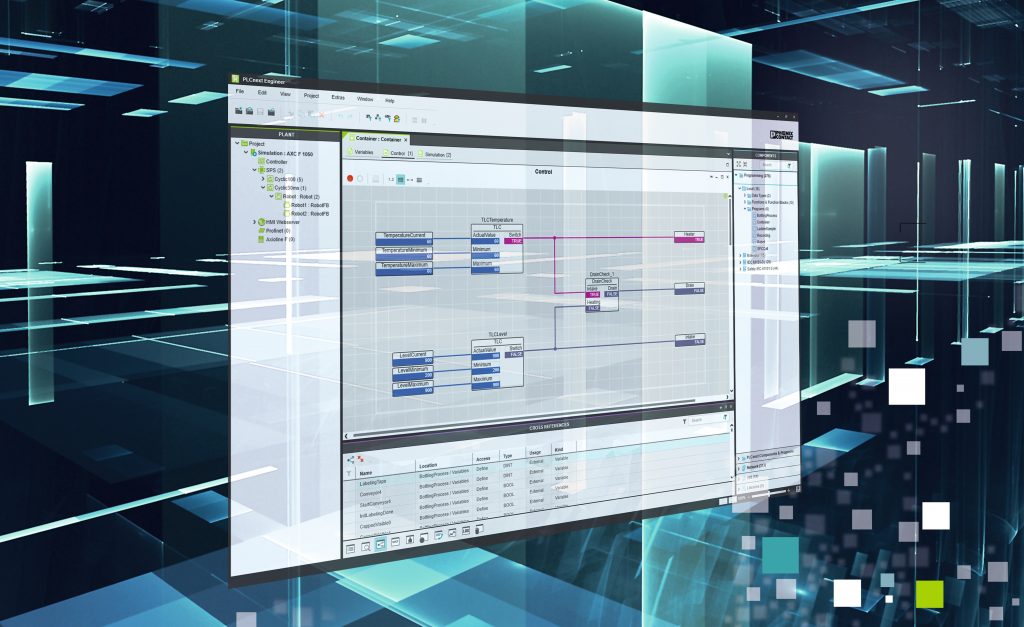
A very beautified picture of FBD code

And yet, FBD was not a language I was familiar with. If you have learnt a new language before, you may have experienced times when you cannot express yourself or cannot translate your thoughts from your native language to the new language you are learning. Thankfully, that is where the prowess of PLCnext Technology comes in.
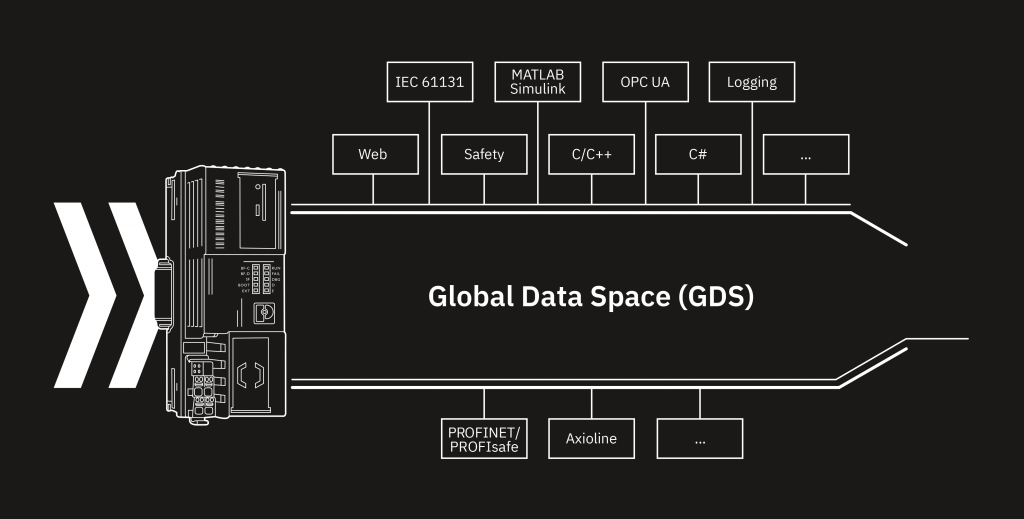
To make things short and sweet, PLCnext Technology essentially allows the use of different languages for programming of PLC logic. Instead of using IEC 61131-3 languages for the main program logic, languages such as C, C++, C# and MATLAB Simulink can be mapped to the IEC 61131-3 code. This is possible through a Global Data Space (GDS) which maps input and output ports of IEC 61131-3 languages with that of the other languages being used.

What this essentially means is that many people who are familiar with different programming languages can work on the same project! PLCnext Technology bridges this gap between programming languages, making automation that much easier.

That being said, some (extremely) basic knowledge of at least one of the IEC 61131-3 languages are required. However, this was easily picked up after I was loaned the AXC F 2152 Starter Kit to practice.
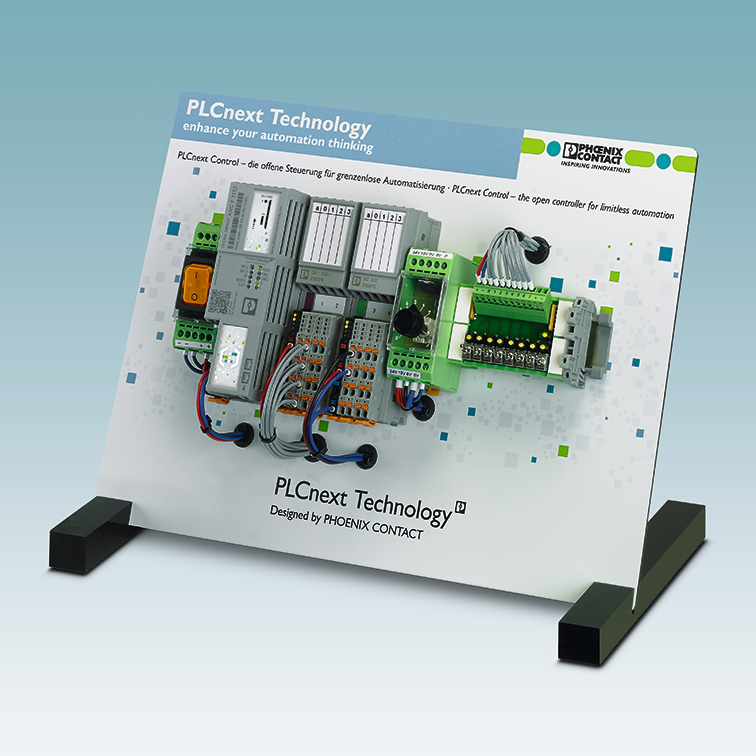
The AXC F 2152 Starter Kit

Two months into my internship, and I have already learnt enough to build a small-scale prototype of my final project. While I will not be delving into the details here, the important part is that majority of the logic is coded in C++, instead of IEC 61131-3 languages.
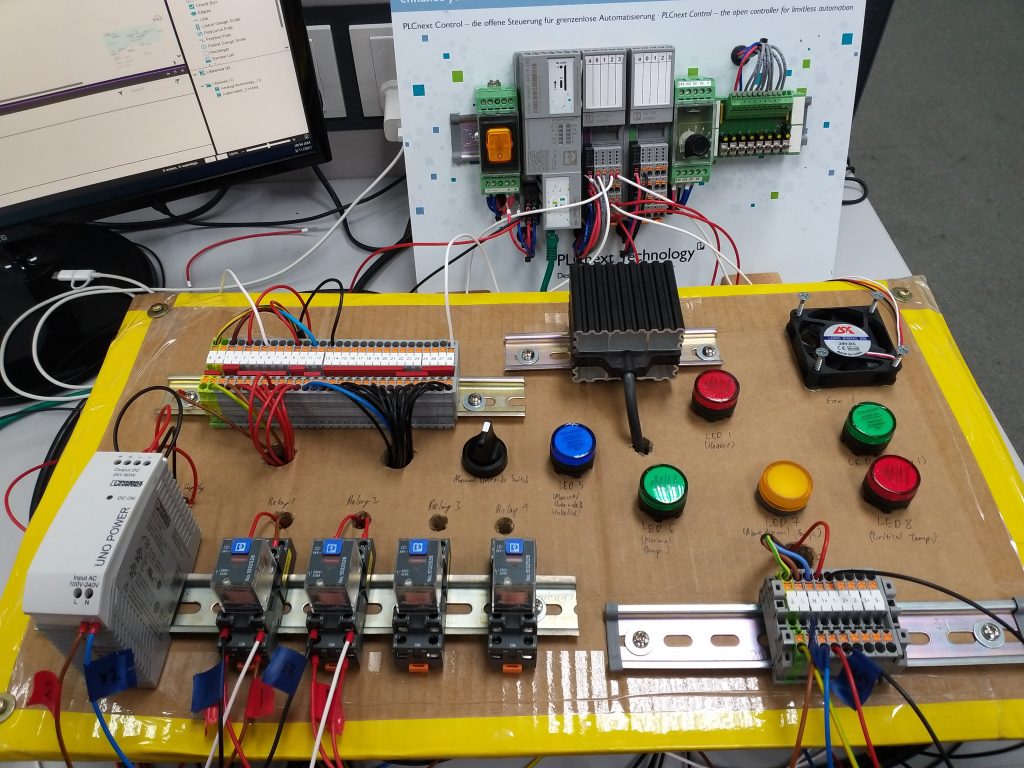
“This isn’t even my final form!”

If an intern can whip up something like this from scratch in two months, I am sure you can too!

Phoenix Contact PLC Interface Relay

From |

Phoenix Contact PLC Interface Relay is one of the most, if not the most widely used slim type relay in the market. This can be attributed to the fact that Phoenix Contact is the pioneer of this slim relay and it addresses the requirements of the industry. Besides that, there are numerous features that this range of relay has that differentiate Phoenix Contact from similar competitors.

  • The relay is fully made in Germany. On top of that, the production process is fully automated by machines in an environment with tight quality control. This ensures consistency, precision and high quality.
  • The relay’s internal circuitry is made from a single lead frame. This means that there is no soldering and therefore, no single or odd weak point of potential failure. Consistency is also guaranteed as soldering is mostly done by humans and thus will be susceptible to quality control issues.
  • Furthermore, the single lead frame technology has better heat dissipation and distribution technology over competitor’s product that uses PCB technology. This is because PCB technology tends to have concentrated heat spots that will weaken the relay over time. Phoenix Contact’s design allows for lower overall panel temperature for the end user.
  • The relay is fully encapsulated and certified RT III grade and water and bath tested. This ensures that the relay will survive and operate even after exposure to water and high moisture and humidity. There are other brands in the market that does not have such degree of protection in the relay.
  • The quality used for our components are also rated above the industry standards. Phoenix contact use diodes that are rated at 1300V compared to the 1000V that is typically used by others. This will ensure even higher threshold to withstand unexpected incoming surge.
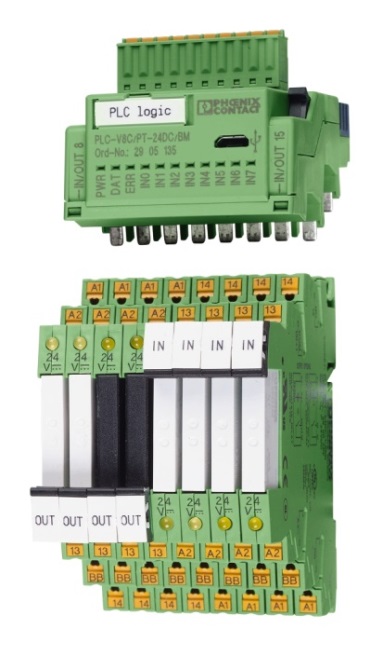
  • On top of these advantages, the Phoenix Contact PLC Interface relay is also versatile as it can be transformed into a PLC with integrated relay by adding a module called PLC Logic. This solution can be used for applications that require simple automation.

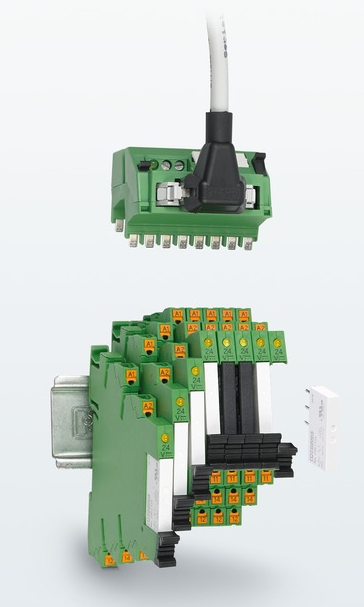
  • The PLC Interface relay can also be used as a system cabling solution that will benefit users in terms of reducing manpower installation time and also reduces space required in the electrical panel. This can be achieved by plugging in a system cabling adapter on the PLC Interface Relay.

Interested to find out more? Get in touch with us at marketing@phoenixcontact.com.sg!

The Next Gen PLC

From |

Discover the next generation of PLC TECHNOLOGY

With an imminent changing of generations, one can expect “Generation Y” to outnumber “baby boomers” in the coming years. Where the automation industry is concerned, this means that the Gen Y users who are more familiar with high level languages (e.g C, C++ and C#) will increase gradually while on the other hand, the users of traditional IEC 61131 programming language will decrease in years to come. Therefore a user-selectable environment is needed to cater to the development of both types of users from various generations. With the PLCnext technology, program sequences from different programming languages can now be combined into a few different tasks or one single task. High-level language programs therefore become automatically deterministic like a classical PLC program.

PLCnext Technology forms the basis of the new, open control platform from Phoenix Contact. This solution is future-proof, flexible, and perfectly suited for the requirements of the Industrial Internet of Things (IIoT) and Industry 4.0, both for existing users who perform IEC 61131 programming and for users using high-level programming languages.  PLCnext technology is the basis of a new, technologically leading generation of Phoenix Contact controls dedicated to the automation business of the future.

Interested to see how this works? Feel free to request a demonstration from us by leaving us an email at marketing@phoenixcontact.com.sg!

https://www.youtube.com/watch?v=ckcMJQ3S5VM&t=12s

ReSy 104 : Upgrading Control Systems in Power Industry

From |

Nowadays, in the age of Smart Grids, power systems are getting more complicated in order monitor and avoid system down time. End users /operators require the ability to control everything from big substations to small hangover substations; even to each MV cabinet or recloser located in remote areas such as at a consumer site or along power lines.
So do you meet these requirement within a  reasonable cost especially in existing substations, MV cabinets where installation space is very limited.

Solution with ReSy 104 + PLC

The ReSy 104 remote control communication library is based on the IEC 60870-5-104 protocol.

The remote control system enables communication between the control center and substation via a standard TCP/IP network. You can also use transmission via DSL, SHDSL, GPRS, EDGE, and 3G.

With PLC for Fieldbuses and Ethernet, Phoenix Contact offers a flexible system structure that covers a wide range of application options in a centralized or distributed format. Thanks to a compact design and numerous supported protocols, Phoenix Contact PLC is ideal for applications where compact size and high-quality is required at a competitive price.

How Phoneix Contact's ReSy 104 RTU works.

Fig 1 : How Phoneix Contact’s 104 RTU works.

By combining ReSy 60870-5-104 + PLC Phoenix contact can offer possible applications for

  • IEC 60870-5-104 enables data transmission via a standard network, which can communicate with multiple devices and services simultaneously.
  • Full function PLC with able to communicate with field device via numerous built in protocol such as Modbus , Profibus, Profinet, etc…
  • High standard of security and encryption for reliable data transmission with the FL MGUARD series of security devices from Phoenix Contact
  • Smooth communication between devices from various manufacturers. The supplied interoperability list states which functions are supported.
  • The remote control station can be connected redundantly to two or more higher-level control systems or remote control heads via the ReSy+ library
  • Acquisition of basic data types, such as messages, commands, plus counter values with and without time stamp.
  • Event-oriented communication ensures the active transmission of current events.
  • Historical data backup ensures that data is logged with a time stamp.

ReSy Solution

Fig 2 : Possible solution with ReSy 104 + PLC

To find out more about our ReSy 104 solutions, just leave us your contact and we will get in touch with you shortly.

Data Exchange Between Enterprise and Automation Control Level

From |

Phoenix Contact's ILC for easy data exchangeAt present, control applications focus not only on reliability but also flexibility. Following current automation trends in automation 4.0, many vendors will need to improve market share in this market segment.

Interface data between third-party functions might be considered to develop parallel to improve the product quality. For controller device, we can classify its interface levels into field level and enterprises level.

Usually, there are no issues when various controller vendors need to transfer data between one to another at the field control level.  This is because there are many common protocols like MODBUS, PROFIBUS and etc to exchange data easily between third-parties. However, it is a different story when there is a need to exchange some data at a higher level like in an enterprise system.

A couple of constrains when designing interface system is the data exchange rate and also the time lag which occurs. In order to maintain a high quality data exchange rate, it is often deemed necessary to utilize high-end hardware and software, resulting in a very expensive solution.

Easiest Controller for Data Exchange between Enterprise and Automation Control Level

Phoenix Contact’s controllers, right up from our basic series, have a library which is able to connect directly to a RDBMS database by providing query string patterns like common SQL script. In comparison, other controllers require additional equipment or other APIs to collect data from controller first before sending it to the target database.

Easily enable data transfer from the sensor directly to a DB with Phoenix Contact’s Controllers.

Reference product

System overview

System overview

For more information on Phoenix Contact’s Controllers, leave us a message and I will get in touch with you soon.

Industrial PC Becomes a Control System

From |

Now, a standard industrial PC can handle any control task. The PC Worx RT Basic software PLC from Phoenix Contact transforms any industrial PC into a fully fledged control system. Programming, visualization, and control can therefore be combined in just one device.

Continue reading