Category Archives: Industry 4.0

Introducing IIOT to your Clients – The PT Functional Terminal Blocks

From |

When you introduce IIOT to your client, one of the first questions your client will ask you is “What is IIOT?” (Yes, we get that a lot).

Confusion in IIOT

The typical look our clients are giving us when we talk about IIOT

Many manufacturers are baffled when they were asked to implement IIOT in their plant.

Well IIOT is not as complex. Here’s a sentence to explain what IIOT is:

“Using smart machines to consistently capture data in order to improve inefficiencies.”

See. It’s not that hard, is it?

When we further explain the sentence above, “smart machines” are simply referring to intelligent products like PLC or sensors that are able to help you in generating or gathering data.

Smart Machines

Smart Machines are getting smarter by the day

Smart machines allow data to be aggregated and analyzed in real time. With more accountability and control over equipment, workers can better predict maintenance issues and make faster decisions.

Not forgetting the ultimate motive “to save cost”.

Rain Money

Feel like a million bucks when you automated your business, and save half the installation cost. (Courtesy: Red Granite Pictures)

If you’re wondering how we can save you the effort and cost in installing IIOT systems, read on

What is Industrial Automation: How IIOT & Automation are related(Part 3)

From |

In the last two articles, we discuss the basic definition of automation as well as the advantages of running an automated system.

For this final article, we will be looking at the different types of Automation Systems and also case studies of the clients who have automated their manufacturing and production plants with great success.

Through this final part on automation, we hope that if you will consider automating your business and if you require assistance, help is on your side!

Read more on the Types of Automation System and Actual Case Studies here

What is Industrial Automation: How IIOT & Automation are related(Part 2)

From |

In the last post, we explained the basics of Industrial Automation and why industries are shifting towards this new concept.

This week, we will be diving on the advantages of Automation and the hierarchies of an automation system, to provide fundamental knowledge regarding this concept that is taking over at a fast pace.

Why are industries turning towards Automation? (Advantages of Automation System)

Because of the evident benefits that businesses have seen when they migrated towards automation, there is no reason not to adopt these technologies.

Curious to know how automation can help your business like the countless of other businesses? Read on

Putting the Power in Power Industry – IIOT and its impact

From |

*A first of a series of technical articles for IIOT in Power Engineering industry. Join our mailing list to find out more as we explore specific applications!

More Data, Better Decisions

Soon, the cities of tomorrow will be turning towards smart grid

The Advent of Smart Grid:

With the rise in electrical costs and the stringent regulations/deregulation of energy markets, there has been an increased in the advocacy of turning towards the Smart Grid to overcome the challenges of today’s energy markets.

Evidently, the building blocks of implementing the Smart Grid are already underway in various countries.

Initiatives such as:

  • Relying on renewable energy
  • The erecting of small micro-grids to provide power to smaller residential areas
  • Limitless choices for consumers to choose their energy suppliers
  • The different ways of how energy is being manufactured (whether its solar, wind or coal)

To harmonize this plethora of choices requires sturdy flow of information to ensure grid reliability.

Therefore, for the full potential of the Smart Grid to be realized, Power Generation, Transmission and Distribution needs to be equipped with digital control and monitoring, and the capability of telecommunications.

With these, all stakeholders in the smart grid will gain access to valuable information needed to ensure optimization of Smart Grid.

Empowering the cities of tomorrow

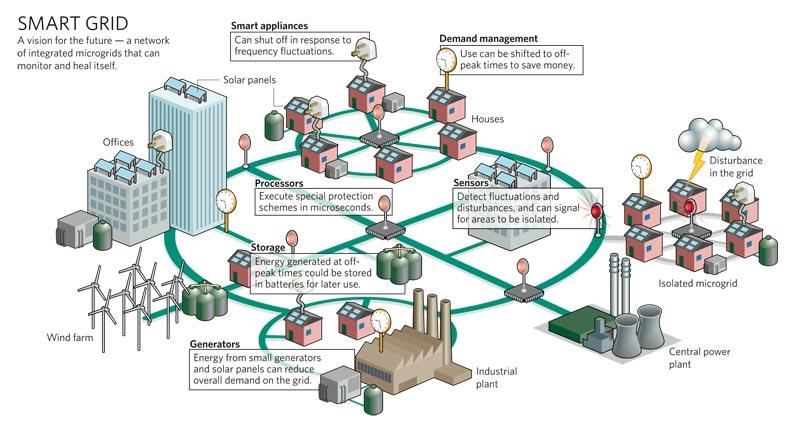
An example of a city powered by data and electricity – The Smart Grid

Courtesy: Fluke Corporation

IOT and Smart Grid:

As such, IOT has been proven to be useful. IOT is about integrating connectivity to all kinds of items.

This is essentially needed to achieve what has been discussed earlier.

In addition, IOT focuses on the potential of big data analysis. When utilized in the Power Industry, there will be the prospect of predictive analytics and allowing for proactive instead of reactive operations.

Empowering companies with data.

Understand data. Manage cost and electricity outputs. See breakdowns occurring real time

This allows for:

  • Capital expenditure and maintenance costs to be decreased.
  • Energy demand to be managed more effectively.
  • More robust energy mix among other benefits.

However, the issue here is that implementing IOT to the commercial or common industrial sphere is much easier compared to implementing IOT to critical infrastructures such as the power grid.

The market realizes this and has aptly come up with the term, Industrial Internet of Things (IIOT), focusing on implementing IOT in critical infrastructures.

Some additional focus of IIOT includes:
1) Cyber security

2) Easy retrofitting

3) Reliable industrial telecommunications

4) And in Power Industry: IEC61850

IIOT empowering data to cities

The power industry of tomorrow. Powered by IIOT

IIOT in power industry and its primary application?

Power Generation: Predictive maintenance of equipment, planning for optimal power generation
Power Transmission: Minimizing operational loss
Power Distribution: Visibility of last mile (LV) data

Distributed Energy Resources: Establishment of Virtual Power Plants (VPP)
Customer Premises: Dynamic Pricing, automated demand-response energy

At Phoenix Contact, we have products that cater to IEC61850 International Standards, perfect to facilitate IIOT.

We also specialize in cyber-security and Industrial Communications.

All of these are supplied in enclosures that can be easily retrofitted on existing assets like switchgears and transformers. Who says IIOT means forking out on new hardware?

Our products are built to ensure that your current business is given a boost.

Future-proof your business. Sign up to our newsletter to receive regular updates on IIOT and automation, as well as exclusive product demo on site.

What are you waiting for?

Contact us at marketing@phoenixcontact.com.sg to find out more!

More than just Providing Data: Implementing IIOT in Water Management

From |

The Industrial Internet of Things (IIoT) is creating huge opportunities in the water and wastewater industries, adding value to both the utility and the consumer.

Connected machines are reshaping the way these utilities operate, allowing them to make smarter and more informed decisions. By driving up innovation, water utilities are driving down cost.

Water Treatment plant

Diagram of how a water treatment plant conducts its everyday activity

Relationship between Data and Water Management

Treating water and wastewater requires chemical processes that can now be monitored more accurately using digital data collection.

These digital transformations are taking the guesswork out of chemical processing and allow utilities to optimize a number of chlorine dollars spent to maintain safe levels — saving time, money and empowering operators to make fewer mistakes.

Spurred on by IIOT and Big Data collection, SaaS applications are also implemented which could provide analysis on the wastewater process and accurate calculations on the wastewater clarifier tank performance.

Technologies such as these could also allow businesses to receive alerts and notifications when a failure might arise, predicting when a sludge will overflow and be released.

Phoenix Contact Cloud based solutions

Real-time data, accessible anywhere, anytime before failure happens.

Problems and Prediction – Pre-empting probable issues

This kind of problem causes environmental issues and fines that can run into millions of dollars. It will also be able to predict a thickening failure, which is when the effluent doesn’t settle correctly and creates a costly sludge blanket in the tank.

Predictive analytics are also solving monitoring problems that were not previously possible for utilities.

For example, there are a large number of pumps that are commonly found within water facilities, and digitized data is making it possible for companies to accurately predict when these pumps might fail — ahead of time.

Colliding old and new technology

Even water pumps are fitted with digital technology for data retrieval

It’s similar to the predictive analytic technology used in jet engine checks between airline flights. This cloud-based application easily connects to pumps and helps companies avoid costly and inconvenient failures, allowing engineers to schedule controlled maintenance rather than reactive maintenance.

Partnerships between technology companies and utility companies are facilitating innovation.

Safety procedures are also being monitored and enforced more closely by keeping track of them using digitized technology.

By working closely with our clients, we realize that more informed data could also be used as a reminder to employees regarding protocol procedures when dangerous chlorine leaks are detected. The safety procedure is sent to a worker’s device to be confirmed before access to the contaminated area is granted.

The safety procedure is sent to a worker’s device to be confirmed before access to the contaminated area is granted.

Public swimming pools in danger of chlorine

Public swimming pools are at risk of chlorine contamination which would have adverse effects on health.

At Phoenix Contact, we offer industrial platforms that enable asset performance management on an industrial scale. For water utilities, our products can help organize time-series data to monitor asset functionality.

Water Integrator Resources

Software and Hardware to manage your Water Management needs

Building close relationships with utility companies would facilitate innovation and allow us to develop solutions to become cleaner and more efficient at a rapid pace.

It truly is a transformative time in the industry, and the results couldn’t be more pure — better drinking water for everyone.

For more information on the products used for water management, visit the link here, or get in touch with us at marketing@phoenixcontact.com.sg.

The Smart Grid: How automation empowers the future of Electricity

From |
Smart Grid plans for the future and beyond

Exemplary model of the future Smart Grid – Automation in Electricity

The “smart grid” is a rapidly growing set of technologies, processes, devices and applications that affect and enhance the traditional electric grid.

These advances are partially driven by exponentially growing demands worldwide for energy as expressed in a commonly repeated statistic that “global electricity demand is expected to increase 75% by 2030.”

What’s happening with the smart grid also reflects developments made in communications, from Internet to cellular to wireless, as well as higher expectations from consumers regarding energy availability, rising energy costs and access to their energy information.

A smarter grid will also help integrate renewable energy including wind and solar into the energy mix.

Defining the Smart Grid

To understand the smart grid, you first need to get familiar with the 125-year-old electric grid. Most people don’t think about where the electricity they’re using comes from or how it gets to their homes and offices.

The electric grid consists of several main touchpoints in an overall system that gets electricity from creation to the end user:

The main touchpoints for electricity include:

  1. Generation — the creation of electrons that make up electricity.
  2. Transmission — moving high-voltage power from generators at power plants through transmission lines, reducing it down to 12,000 volts.
  3. Distribution — where transformers convert power to the 110 volts running in residentials
  4. Retail — the metering, monitoring, and measuring of power usage that results in a bill to the consumer from a utility company.
  5. Customer/Consumption — the end user experience with the power.
Conventional Power Grid

Diagram of how a conventional grid looks like

Smart grid technologies and innovations occur at — and can affect — any and all steps of the electricity ecosystem. Some are more focused on the utility side while others address the customer.

Smart Grid Developments

In the “old days” up until the last 10 to 15 years, utility workers — meter readers — were deployed into neighborhoods to read and write down data retrieved from energy meters in people’s back yards.

The first major change to this process came in the form of Automatic Meter Reading (AMR), through which meters communicate via a one-way signal to a truck that is driven through neighborhoods to collect data.

AMR collection

Collecting data used to be arduous and manual. Requiring long man-hours.

With advancement in technology, there’s the Advanced Metering Infrastructure (AMI) going beyond just reading meters and sending data to utilities — it also sends information back to the home and to the consumer.

AMI systems, automatic data across channels

With AMI, information can be transmitted to individual homeowners as well as utility offices for record purposes.

Smart meters aren’t effective without some kind of communications method to transmit data such as cellular, Wi-Fi or other wireless protocols.

Unlike cellular systems such as GSM and GDMA, Phoenix Contact’s wireless system isn’t optimized for tens of users but instead for tens of thousands of “users” that are in actuality devices, such as meters and sensors.

Our system is designed for extremely long-range and broad coverage so utility companies can deploy these communication networks more cheaply and reach more devices more effectively.

Other interesting developments in the Smart Grid would be the availability of web portals and dashboards that present aggregated power usage data in ways that are understood even by laypersons.

Such software and services, connecting to the Internet display real-time data about the power consumption via a short-range wireless system.

Information like these was never thought of before and it can assist in regulating power consumption in homes or in industrial plants, saving tons from electricity wastage.

Eventually, with systems like this along with “time-of-day pricing,” you will know exactly how much money you’re spending down to the minute, and you’ll be able to modify your behavior to use your appliances at different times.

Or better yet, you’ll benefit from an automated system that regulates usage for you based on your usage habits and peak usage times to run certain appliances at “cheaper” times of the day.

Global Smart Grid Adoption is Going Strong

Smart grid adoption is happening across the globe. Examples are:

  • Toronto, Ontario, Canada— Ontario was the first province in Canada to introduce what is referred to as “time-of-use pricing.” The system is said to have 100% smart meter deployment.
  • Texas, U.S.— The electricity market in the state of Texas has been deregulated, and the state has close to a 100% saturation of smart meters along with an automated system to give customers their energy usage data through smart grid technology and web portals.
  • Scandinavia— At 100% penetration, citizens of Sweden and Finland are seeing the benefits of the smart grid, including in-home smart technologies.

While the United States may be spending the most money on smart grid tech innovation and deployment, other countries making significant headway with implementation include Australia, New Zealand and parts of Europe, including Germany, Spain, the United Kingdom and France.

In Asia, while Japan and South Korea are already heavily invested in the smart grid, China is poised to become a major investor. Asia and Latin America are seen as emerging smart grid markets as they roll out smart meter programs in India and Brazil.

Japan is moving towards smart electrical grids

Electric cables in Japan

In future, for Smart Grid technology to further grow exponentially, the following implementations need to be considered:

  • Data connection between demand (when you turn a light on) and generation (energy being created in a power plant). If you can get more granular data about usage, you can better forecast energy needs and usage, which then can be applied to create more efficient energy generation.
  • Electricity storage. When there’s low energy demand, excess energy should be able to be stored and then accessed or discharged during peak usage periods. For an example of storage on a small scale, consider an electric vehicle — when turned off and plugged in, it’s storing energy to be used during the day when the car is running.
  • Automated energy efficiency for consumers. Businesses do not usually have the time or inclination to proactively make their offices, factories and other environments more energy-efficient. In order to reduce energy usage and shift grid load, we need more services that automatically make smarter energy choices.
  • The private market needs to step up to the plate. Instead of relying on government-sponsored programs, the private sector needs to develop products and/or services that can be easily packaged and delivered to consumers. For example, a telecom company could add an energy efficiency program to its offerings, adding a commercial layer to the smart grid so it becomes more accessible to consumers.

Regardless of where the innovations are coming from, smart grid infrastructure serves utilities and consumers by leveraging information technology to bring advanced communications to a previously “dumb” network.

By putting a greater emphasis on information retrieval, aggregation, reporting and analysis, the potential to save on energy and modify energy consumption behavior can benefit everyone.

Feel free to contact us at marketing@phoenixcontact.com.sg to find out more!

Industry 4.0: Turning Ideas into Revolution

From |

In the previous post, we discussed a little on the origins of IIOT (Industrial Internet of Things) and case studies of how IIOT have helped various industries.

A point to note, is that IIOT was not an initiative that sparked a revolution today. In fact, IIOT is part of a concept which derived from the German idea of “Industrie 4.0”, or rather, the Fouth Industrial Revolution.

Advent of Industry 4.0

The “Industry 4.0” initiative was constructed as a strategic plan by Germany back in 2006 to promote computerization in manufacturing.

In July 2010, the German’s government cabinet decided to accelerate the strategy by introducing the High-Tech Strategy 2020, which aims to focus the country’s research and innovative policy on inspiring projects related to scientific and technological developments over a span of ten to fifteen years.1

Source: https://www.hightech-strategie.de/de/The-new-High-Tech-Strategy-390.php
Factory in Germany

Germany has certainly come a long way.

The High-Tech strategy can be summarized as moving Germany forward, to become a worldwide innovation leader. By strengthening Germany’s position as a leading industrial and exporting nation, Germany believes that innovative solutions are factors that drive prosperity and increases their quality of life.

Hence, by leveraging on the idea of Industry 4.0, Germany could achieve their long-term goal of High-Tech Strategy 2020.

Back to Industry 4.0

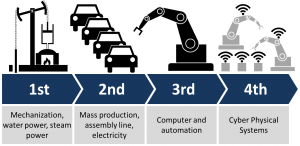
Industry 4.0 is a vision of integrated industry implemented by leveraging computing, software, and Internet technologies. The 4.0 refers to the idea of a fourth industrial revolution:

  • First: production mechanization using water and steam power
  • Second: mass production (Henry Ford often cited as the innovator)
  • Third: digital revolution (e.g., machine tool numerical control, programmable logic controllers, direct digital control, and enterprise resource planning)
  • Fourth: Industry 4.0 leveraging cyber-physical systems, embedded computing, Internet of Things technologies.

The German strategy highlights cooperation between industry and science to promote closer links between knowledge and skills. In the final report for Industrie 4.0 entitled “Recommendations for Implementing the Strategic Initiative INDUSTRIE 4.0”, it describes using Internet of Things technologies, communications, and web services in manufacturing.

It makes it possible to create networks incorporating the entire manufacturing processes, converting factories into smart environments for tomorrow.

Vision for Industry 4.0
Industry 4.0

Industry 4.0 – The future of industrialization, empowered by technology and the internet

The vision of Industry 4.0 is to achieve higher productivity, efficiency, and self-managing production processes where people, machines, equipment, logistics systems, and work-in-process components communicate and cooperate with each other directly.

The main goal is to produce low-cost mass production to achieve make-to-order manufacturing of quantity by leveraging embedded processing and communications. Production and logistics processes are integrated intelligently, creating a real-time lean manufacturing ecosystem that boasts efficiency and flexibility.

This will help facilitate smart value-creation chains that include all of the life-cycle phases of the product – from the initial product idea, development, production and usage, to maintenance and recycling. This allows the business to constantly make improvements, based on informed decisions.
Automation and Big Data

Industrialization towards 21st century and beyond.

Data derived from the supply chains make it possible to optimize production steps and the entire value chain. For example, comprehensive real-time information enables companies to react during production such as anticipating the availability of certain raw materials based on price, quality, and other factors for optimal efficiency.

Data extrapolated could also be shared across company boundaries, to save resources and energy.

The digitization of industry is forecasted to foster new business models and present great opportunities for small- and medium-size enterprises. Currently, majority of the companies are already adopting this idea.

Benefits of utilizing Industry 4.0

Asynchronous Manufacturing

Gone are the days of factory lines.

  • Asynchronous manufacturing

Traditional assembly manufacturing lines are synchronous, with predefined workflows based on production work orders running in enterprise business systems. Production steps are centrally communicated to each manufacturing station synchronized by the assembly line.

In Industry 4.0 however, is based on asynchronous manufacturing, with components in the production flow using auto identification technology to inform each machine and operator what needs to be done to produce the customized end product at each step of the production process.

Flexible Machines, Adaptive to change

Just like Humans, Machines have to be flexible.

  • Highly Flexible Machines

The usage of highly adaptable and flexible machines is another aspect of Industry 4.0. This achieves a highly flexible, lean, and agile production process enabling a variety of different products to be produced in the same production facility.

Profitable mass customization allows the production of small lots (even as small as single unique items) due to the ability to rapidly configure machines to adapt to customer-supplied specifications and additive manufacturing.

Data is King

Manual Data Entry, a thing of the past. Slower data processing = less productive

  • Analytics

Other than relying on flexible and adaptable machines, Industry 4.0 systems capture a wide range of data that can be used to improve performance and productivity through analytics.

Analytics are used in a number of ways, including real-time predictive maintenance, which helps manufacturing companies avoid interruption in production by machine failures—directly improving asset utilization. With analytics, businesses can make informed decisions on production operations, improving productivity and energy efficiency.

Technology and civilization

Technology, empowering the future and beyond

  • Technology

The application of the Industry 4.0 vision is turning into a reality with technological advances driven by the Internet of Things which includes open software platforms, open communications, and powerful embedded processors.

Industry 4.0 uses the term cyber-physical systems (CPS) to describe the interaction of physical and computing, including embedded intelligence at all levels, including machines, sensors, actuators, production parts, subassemblies, and products being produced.

CPS is composed of physical entities, such as mechanisms controlled or monitored by computer-based algorithms. A current example of the application of CPS is mechatronic drive systems that use processors and communications embedded in motor drives to accomplish coordinated operations in a packaging machine without physical gearing. This saves significant cost, providing greater flexibility and improved reliability.

Proliferation of Industry 4.0

The fundamental reason behind shifting towards Industry 4.0 is the realization that pursuing low labor costs is no longer a strategy. Staying competitive and flexible can only be accomplished by adopting the latest technology – in this case, banking on automation.

Historically, if we were to refer to the Second Industrial Revolution, Henry Ford pioneered the assembly line method of producing automobiles.

Automobiles were only available to the affluent back in the days but by manufacturing an affordable car by means of simplifying the process from 12 hours to a mere 93 minutes, Ford, with its Model T, commanded a 48 percent share of the automobile market.

Competitors knew that they had to implement such technology of assembly lines or be at risk of bankruptcy if they could not compete.

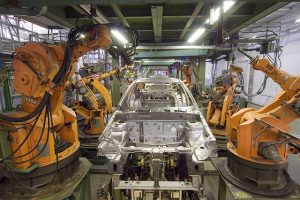
With Ford’s revolutionary strategy in 1914, the U.S continued to contribute to 48 percent of the world’s automobile throughout the 60’s. By 1997 however, Japan took over, producing 21 percent of automobiles. The success of the Japanese automotive manufacturers was attributed to advanced manufacturing methods, aggressive automation and widely use of robotics (Currently, Japan has 323 robots per 10,000 people).2

Source: https://ifr.org/worldrobotics
Robots in Japan

Robots are solving the issue of manpower in Japan

At that time, U.S automakers had access to similar technologies and methods but did not pursue them until compelled by economic factors.

In 2014, Japan had 13 percent share, just below Germany at number 1 at 23 percent. U.S remains at 9%, a shadow of its former self, considering the 48 percent in 1960.3

Source: Harvard Atlas of Economic Complexity

Because of this example, manufacturers around the world are accrediting the success of automation as factors in producing products with precision and consistent quality.

In 2014, China was the single largest market for industrial robot sales. Based on the present rate of robot adoption, within two years, it would be predicted that there will be more industrial robots in Chinese factories working hand in hand with manual workforce than in the European Union or the U.S.

Conclusion

Based on historical data and countless of analytics on the web, as a business, there’s no escaping Industry 4.0 and the Industrial Internet of Things. Businesses must be prepared to usher this new technology and adopt it, if not soon. Competition is high especially with globalization and the need to produce low-cost products at high quality.

In Germany, such initiatives are being supported by the government. Japan, India, and China are following closely behind.

The question is, can Southeast Asia keep up and from it emerge companies who will pioneer new technological innovations?

Interested to find out more? Get in touch with us at marketing@phoenixcontact.com.sg!

The Future of Industries: How the Internet of Things empower Businesses

From |
Future of IOT

IOT brings technology and Human together

What is the Internet of Things (IOT)Internet of Things

Internet of Things (IoT) is a process in which human, machines and devices are connected to one another via a data network or the Internet in order to collect and process data automatically for the purpose of improving efficiency, accuracy and economic benefit in addition to reducing human intervention.

With the proliferation of wireless devices and development of technology, IoT is becoming a feature of our lives and provide opportunities for numerous automated and value-added applications, such as using mobile phones to control air-conditioning at home or using iris/fingerprint for security purposes.

So how could it help businesses?

The potential benefits of automation in terms of productivity and economic growth is obvious. For some, it encourages creative thinking and provides opportunities to develop new skills. For others, automation poses a threat when manual jobs are replaced by machines.

Take for example – Human Resources (HR) processes used to involve an enormous amount of clerical and administration work.

Wireless Remote Data

Big data, retrieved remotely

Automation and Cloud Based solutions

With the cloud-based solutions of today and tomorrow, many of these processes such as attendance, leave and payroll can be automated and standardized. Not only will this enable jobs to be processed at the quickest and lowest cost possible, data collected can be broken down into meaningful intelligence for analytical purposes.

This will enable HR to focus on more strategic tasks such as talent management and employee engagement that requires a wider range of soft skills such as relationship building – the areas that truly need the human touch.

IOT, the future

Incorporating devices, people, and networks

 The Future is Now

IoT is developing rapidly and the technology is affecting our interaction with “things” around us, making it possible for unparalleled opportunities and services to be developed across diverse industries such as agriculture, manufacturing, energy management, transportation, finance, healthcare, retail, telecommunication and IT.

Automation will undoubtedly improve human lives and increase workplace efficiency, and completely change the way we commute, communicate and collaborate. Many manual jobs may become obsolete or outdated as IoT evolves, however, many experts believes that new job roles and expertise will emerge, and there are a number of potential inhibitors where certain jobs requiring human interaction that machines, for the foreseeable future at least, will not be able to replace human.

IOT and Humans interact

Humans are still needed for technology

Link between Machines and Humans

Therefore, “Human” will not be removed from Human Resources entirely as there will be growth in field services, asset management, robotic maintenance, remote diagnostics, and analytics expertise, which will take a human being to understand how to interpret and act on insights they have identified.

IoT will change the way businesses operate today. With the emergence of new technological innovation, companies need to ensure that its workforce is retrained, retooled, recalibrated and newly hired to transition the company towards a research-based, innovative-yet-analytical mindset for decision-making, regardless of job tier in order to compete in the new knowledge-based economy.

Interested to find out more? Get in touch with us at marketing@phoenixcontact.com.sg!

Industrial Internet of Things: Revolutionizing the way Business is Done

From |

Industrial Internet of Things

The Internet of Things(IoE) is taking the world by storm. If you’ve been to industrial seminars or read articles online, you’ll come to realize that there’s a lot of buzz in regards to this new age term.

So what exactly is the Internet of Things (IoT)? How industries are implementing it in their work processes and most importantly, what it means to you as a business?

I am assuming that you do not have any idea about this concept. If you do, you can jump straight to our other blog articles on IIoT (in the coming weeks).

Do note that in this article we shall dive into the basic terminology of IoT/IIoT and then we shall dissect how it’s applicable to various industries. They key takeaway here is to form a self-realization about how you should start to plan your business for this revolution.

Why are we advocating IIOT?

At Phoenix Contact we build innovations that speak volumes. Our mission is to help clients and businesses alike achieve productivity and efficiency through cost saving and ground-breaking solutions.

Our clients who have transitioned towards the concepts of IIOT including Big Data and M2M have seen tremendous changes in the way their business is being run. And we hope to share as much awareness and knowledge, in the simplest possible way.

As such we have customized solutions if you’re planning to gear your business for IIoT (Industrial Internet of Things).

Be warn that this concept is not new and chances are you know of businesses who are already transiting towards this new technology even as we speak. So if you’re ready to understand more on IIoT, I suggest reading on.

Next stop, the Internet.

Birth of the Internet

For those of you who may not know, the term IoT corresponds to the birth of the internet. During its infancy, the internet was an exclusive place for selected members to have access to information.

As it experiences growth and widespread usages, the internet brought a wave of ideas along with it such as globalization, wireless technology, and data-driven analytics (in real time). This has enabled us to share data across borders, reducing the need to be physically present.

So what is IOT?

While the internet is basically a medium where we search for information, IoT, on the other hand, is a channel where we gather information regarding a specific thing.

Things such as having a heart monitor implant on a person or perhaps a biochip transponder in an animal or even a vehicle with built-in sensors to alert the driver about incoming objects. In short, anything that can be assigned an IP address and renders the ability to transfer data over a network is considered an IoT.

To make it simpler, IoT is basically a term where machines can talk to each other and then allow humans to read those data because of their communications.

Kevin Ashton, cofounder and executive director of the Auto-ID Center at MIT, first mentioned the Internet of Things in a presentation he made to Procter & Gamble in 1999. Here’s how Ashton explains the potential of the Internet of Things:

“Today, computers — and, therefore, the internet — are almost wholly dependent on human beings for information. Nearly all of the roughly 50 petabytes (a petabyte is 1,024 terabytes) of data available on the internet were first captured and created by human beings by typing, pressing a record button, taking a digital picture or scanning a bar code.

The problem is, people have limited time, attention and accuracy — all of which means they are not very good at capturing data about things in the real world. If we had computers that knew everything there was to know about things — using data they gathered without any help from us — we would be able to track and count everything and greatly reduce waste, loss and cost. We would know when things needed replacing, repairing or recalling and whether they were fresh or past their best.”

How is IoT important for businesses?

Before we explore how important it is, we must first understand through case studies and applications of IoT in everyday business dealings.

The first known application of IoT was in the early 1980s. Programmers at Carnegie Melon University connected a Coke machine over the internet.

The purpose was to monitor the status of the machine and determine the stocks of coke so that they could decide whether to make the trip to the vending machine.

Although this experiment was small scale, it manages to identify the true essence of IoT – which is to allow machines to gather data so that we could make informed decisions.

The first IOT is your every day vending machine

So what’s the difference between IoT (Internet of Things) and IIot (Industrial Internet of Things)?

As said, IoT is generally anything that you connect the internet to, enabling you to govern and extract data from.

IIoT, on the other hand, is a manifestation of IoT but, instead of a singular product or process, IIoT is more large scale and permits different machines working on other tasks to communicate with other machines, working on separate tasks.

In short, it’s IoT, but industrial sized. That means you’ll have software and data engineers working hand in hand with your automation and process engineers.

IOT or not to IOT, that is the question

Successful applications of IIoT:

As said IoT allowed humans to interpret data from the machine to machine communication (M2M). Today, everything from household appliances to manufacturing production makes use of IoT.

Examples of how Phoenix Contact has enabled IIoT:

  • Using digitization, manufacturing companies are getting data through digital, which allows for intelligent decisions and flexibility. Learn more.
  • Through a common protocol such as IEC61850 to facilitate communication across different“Intelligent Electronic Devices (IED)” in manufacturing plants that uses different communication devices. Learn More.
  • Using technology such as Supervisory Control and Data Acquisition (SCADA) in water systems to transmit remote data back to central control (data such as water quality levels for example). Learn More.

IIoT can be and have been utilized in industries below:

  • Building Infrastructure – Example: Smart Lighting
  • Automotive Industry – Example: Vehicle Auto-diagnosis
  • Solar and Wind Energy Industry – Example: Photovoltaic Installations
  • Oil and Gas – Example: Monitoring of water, oil and gas levels in storage tanks and cisterns
  • Transportation – Example: Estimated time of arrival for public transport systems

These are just some examples of where internet technology can be unified with engineering technology to provide seamless data supplied.

The applications are endless.

In the next article, we will be sharing practical applications of IIoT based on products that we suggest and provide insights on how to utilize them.

We shall also dive into the other keywords surrounding IIoT such as Industrie 4.0, M2M and SCADA.

A point to note: Businesses are slowly paving the way towards integrating cloud-based technology in their processes to allow for cost reducing, data-backed and consistent decision making.

If you wish to find out more, speak to our IIoT specialist regarding how your business can benefit from IIoT and the technology needed to get started on.