Tag Archives: signal conditioner

Signal Conditioners

From |

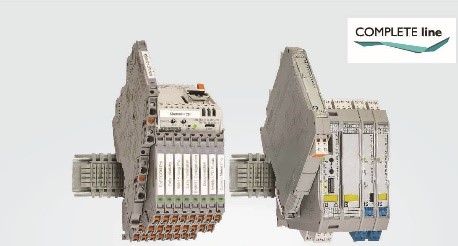
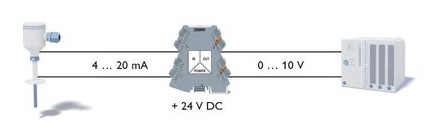
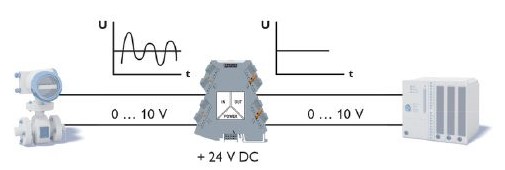
At Phoenix Contact, there is always a signal conditioner for any application, such as filtering, converting, isolating and amplifying.

Amplifying
Converting
Filtering

The portfolio also comprises of solutions for interference free signal transfer in the areas of functional safety or explosion protection.

Industries such as plant engineering, power utility and process technology will require more process signals compared in the past. This is due to process optimization or energy savings. The need for more signals will be required and space is also a factor for consideration.

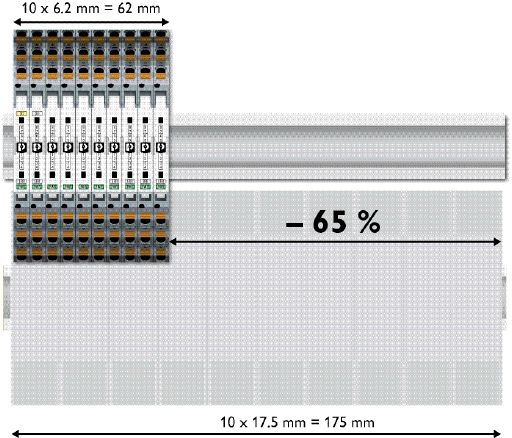
These optimized signals will go directly into the controller. Phoenix Contact’s Mini Analog Pro’s width is only 6.2mm, which makes it suitable to be installed in confined spaces.

The design makes the access points highly visible and allows simple connection of wires, therefore, saving lots of time and money.

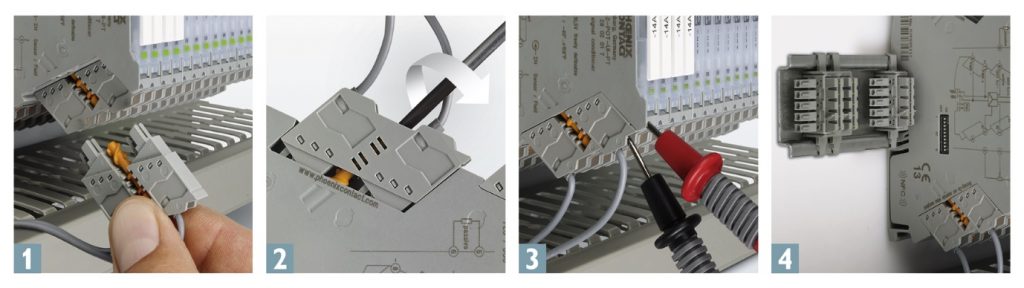
FASTCON Pro interchangeable terminals are pluggable connection terminal blocks that are available in push in or screw technology. It is also integrated with measuring points, allowing measuring of analog signals during operation without the hassle of disconnection in the circuit.

Built in Dip switches, software solution or the app function enables easy access to information. Remote configuration can be done via PC or smartphones with Bluetooth or NFC functions.

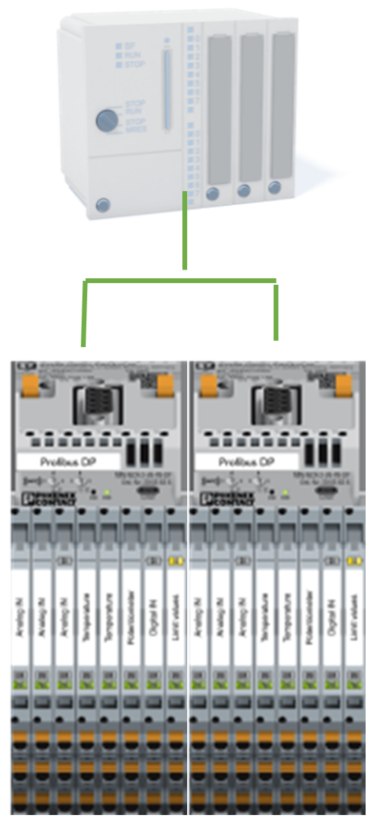
Easy and detachable gateways with plug and play solution can integrate up to 8 field signals directly into digital communication protocols and into controller level. This removes the costs and trouble of use of signal specific cards, the risk of wiring error and high space requirements in the control cabinets.

Mini Analog Pro – the Innovative Signal Conditioner

From |

The Mini Analog Pro is the latest and most innovative signal conditioner from Phoenix Contact. It replaces the proven Mini Analog series but with a slew of additional features that will benefit the user and the industry.

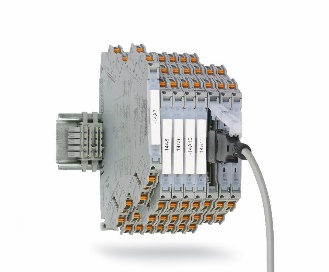
The most advanced feature over its predecessor and perhaps other makers is the introduction of communication adapter. By using the adapter, the user can replace all its hardwire connection to the the analogue cards of the controller with just a simple communication cable. No more overwhelming hardwire from each analog point to each and every signal conditioner. The protocols supported are Modbus TCP and RTU, Ethernet IP and Profibus with more to come in the near future. Besides saving cost, this can save space in the panel as there is no more need for analogue cards. Furthermore, there is also a backbone power supply accesory called the TBUS where one can power up just one of the signal conditioners and all the connecting units in the same row will be powered up. No more overwhelming power supply cables to each individual signal conditioner.

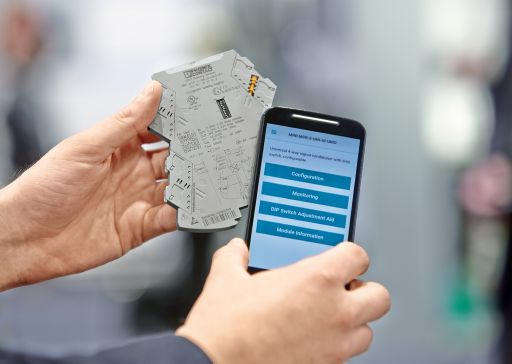
Mini Analog Pro offers additional configuration options compared to most, if not all, of the other signal conditioners in the market, which can only be configured with the laptop or dip switch setting which requires the accompanying data sheet for reference. More frequently than not, engineers are met with situations where it is inconvenient to bring the laptop to site, or worse, unable to find the configuration cable when you need it. If one is not using Mini Analog Pro, this will means one has to delay the work, thus affecting productivity. With the latest Mini Analog Pro, one can use a smartphone with NFC technology to perform the configuration. The software is easy to use and can be  pre-downloaded from the Google PlayStore in preparation for sites where internet connection is not available.

There are times when one has to measure the current values of  field devices that are in operation for verification or troubleshooting. With the previous version or with signal conditioners from other makers, one would have to disconnect the cables in order to prevent parallel connections that will affect the actual reading. This adds extra work  and effort. The user can now measure the current directly without removing the cables. This is realized technically with the Mini Analog Pro by integrating a diode into the circuit and therefore, parallel measurement is now possible with great accuracy.

Even when one has to absolutely remove the cables due to safety or space issues, the Mini Analog Pro offers an innovative alternative. Each module comes with 4 connection blocks for respective input, output or power supply connections. The connection blocks can be removed easily by using a screwdriver to twist the orange lever above or just by pulling it with moderate force. In this way, the connections are still in the individual blocks and can be reconnected back easily without any need to screw each of the individual cables again. Mistakes can also be avoided because all four of the connection blocks in the signal conditioners are fail safes. Only the right connection blocks can be fitted in its rightful place. Imagine if one does not have this feature and if all cables are disconnected, one would have to check and screw all of them back accordingly.

The Mini Analog Pro also has much improved signal quality due to the highest level of galvanic isolation. This increases the accuracy, making it more suitable for the increasingly demanding industry requirements. Furthermore, it has been subjected to 3kV test voltage and 300 V rated insulation voltage. This test ensures that the isolation properties are tried and tested before being deployed in the field. The temperature range it can operate in has also been extended. It can now perform perfectly within the range of 40C° to 70C°. This allows reliable operation in harsh environment.

These innovative features make the Mini Analog Pro one of the most advanced signal conditioners in the market now. These features not only make it easier for the user to work, but also increases the safety, performance and the overall project cost savings.


Choosing the Right Signal Conditioner

From |

Basic 4-20mA current loopSensors and other devices with 4-20mA current loop output are very popular in industrial fields. We can find them from Process Control to data logging systems. A basic current loop has parts as stated below:

  • Sensor: a device which draws current from its power source in direct proportion to the value it measures (level, pressure, etc.).
  • Power source: supplies DC power to sensors or any device in the loop.
  • Reading devices: a PLC, a controller or data logger which reads the current value provided from the sensor and uses it for the next step of controlling or data logging.

In order to isolate, convert, filter and amplify or duplicate control signals we use signal conditioners. Signal conditioner makes a simple 4-20mA current loop into a field loop and control loop like below:

The devices in both the field loop and the control loop need to be powered. They can be powered by a DC Auxiliary power supply or by another active device in the loop. That being said, we have many types of Signal Conditioners (According to how it is powered or can it supply power for other device) that can be used in this scenario.

Types of sensors

The most common 4-20mA sensors in industrial fields are 4-wires sensors and 2-wire sensors. The difference lies in how they powered.

A 4-wire sensor is an active device which has a separate power supply for itself (from DC or AC power supply).

4-wire sensor

4-wire sensor

On the other hand, a 2-wire sensor is a passive device which draws power from a DC auxiliary power supply in the loop or from other active devices in the loop (like a repeater power supply signal conditioner)

2-wire sensor

2-wire sensor

Types of 4-20mA Signal Conditioners:

  • Passive Signal Conditioner: A passive signal conditioner doesn’t need a separate power supply for itself. It draws power from the field loop or control loop. This means there are 2 types: one powered by a field loop and one powered by a control loop. As passive signal conditioners can cause a drop in voltage in the loop, if there are too many passive devices in loop it could lead to inaccuracies in the measured values. In the picture below is a field loop powered signal conditioner with 2-wire sensor, where the devices in the field loop are powered by an auxiliary power supply.

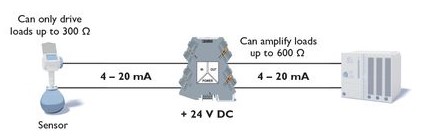
  • Active Signal Conditioner: This type of signal conditioner is powered by a separate power supply so it doesn’t cause voltage drops in the loop. It can also provide power for the control loop. For example, an active mini MCR Pro signal conditioner can drive up to a 600 Ohm load in a control loop. The field loop still needs an auxiliary power supply when using a 2-wire sensor. Pictured below is an active signal conditioner and 4-wire sensor. In the control loop is a passive analog input controller.

  • Repeater Power Supply Isolator: This type of signal conditioner is powered by a separate power supply and it can supply power for the sensor’s loop and also for the control loop (with a maximum load of 600 Ohms). It can be used for 2, 3 or 4-wire sensor without the need of a power supply for the field loop.

So depending on the type of application, we can choose the right 4-20mA signal conditioner. Based on information about the type of sensor, whether the field loop has an auxiliary power supply as well as if the control loop has a passive or active controller, we can choose the suitable 4-20mA signal conditioner.

If you have any questions, feel free to contact us!