

Tag Archives: push in

How Many Cables Can a High Density HEAVYCON Connect?

From |

It is no secret that HEAVYCON is a great way to install and uninstall control cabinets as it saves you time and money. With HEAVYCON, the time taken to install and uninstall a control cabinet is reduced by 40% while labour cost is reduced by 30%. For applications where re-terminations are required, the savings on time and labour costs are even higher.

This is especially so with HEAVYCON modular, as it provides flexibility and allows for customisation without charging premiums. You can choose any signal, data and power modules from more than 50 modules in our product portfolio and snap them in easily into the newly improved snap-in frame.

When HEAVYCON meets Push-in Technology

Push-in technology is a direct and tool-less connection technology developed by Phoenix Contact. It uses a special contact spring for easy insertion of cables. It was first used in Phoenix Contact terminal blocks. The recognisable bright orange release button enables easy disconnection of cables using simple tools like screw drivers.

Push-in Technology has since been incorporated into HEAVYCON. This is basically an installer’s dream come true as it shortens installation time even more and make HEAVYCON even easier to use.
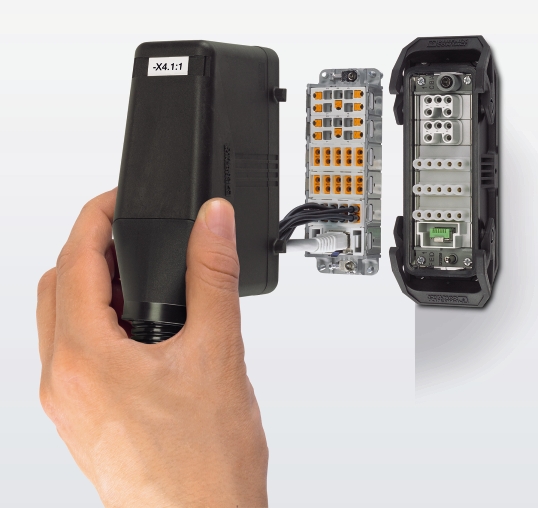
In 2018, Phoenix Contact had come up with a high density HEAVYCON module with Push-in technology.

This is the game changer as it allows for connection of up to 12 cores cable per module. Combined with a 6-slots frame, it can accommodate up to 72 cores cable in one single connector. This is the highest density heavy-duty connector with Push-in technology in the market to date. Such high density is only achievable via crimp technology in the past, which can be expensive due to investment in the special tools needed.
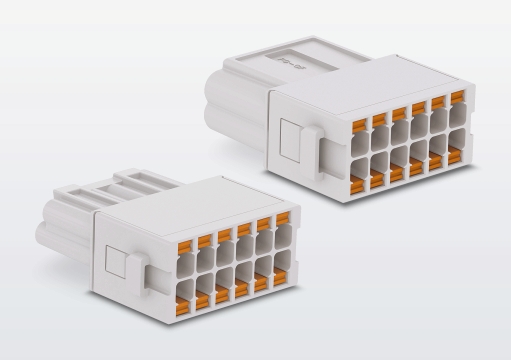
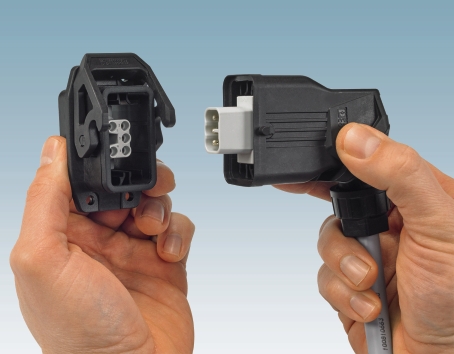
Also new, the M1 housing caters for application where only one specific module is needed. It eliminates the need for the snap-in frame which reduces the cost of ownership. Now you can get the same amount of convenience and flexibility with less amount of money.
For more information on the development of HEAVYCON with Push-in technology, stay tuned to our blog! If you have any queries, feel free to contact us at marketing@phoenixcontact.com.sg!

Building installation with push-in three-level terminal blocks

From |

Thanks to the new PTI 4 three-level installation terminal blocks with push-in connection technology from Phoenix Contact, rigid conductors up to 6 mm² can be easily and directly wired without tools. The terminal blocks are specially tailored to the requirements of the electrical installation and the distributor construction, thanks to their compact design.

freistellen mit Pfad CD-Inlay einbauen Network Interfaces fg

The snap-in, no-screw disconnect slide with status indicator makes contacting the neutral busbar easy and safe. The function shaft on each level provides for easy potential distribution, thanks to the flexible jumper system. Each terminal point can be clearly marked and, in addition to the testing facility, has its own test connection in the function shaft.

Thanks to the insertion force, which has been reduced by 50 percent, it is possible to insert solid and stranded conductors with ferrules and cross sections from 0.5 to 6 mm² without tools. The built-in actuation lever allows fully insulated release with any tool. The orange-colored button indicates the actuating element. This prevents the terminal from being activated accidentally. Flexible conductors without ferrules can also be connected, from 0.2 mm by actuating the lever.

The push-in three-level terminal blocks share all the system characteristics with the CLIPLINE complete terminal block series and are therefore compatible with all installation terminal blocks from Phoenix Contact.

Modular marshalling patchboard concept with innovative color coding system

From |

The new push-in PTMC marshalling patchboards from Phoenix Contact achieve up to 20 percent higher packing density with marshalling wiring in process technology, thanks to the modular concept and the compact design.

freistellen mit Pfad CD-Inlay einbauen Network Interfaces fg

The individual marshalling patchboard elements snap into place easily and securely and can also be coded using eleven different colors. This ensures clearly arranged and fault-free wiring. The precise number of positions and the blocked form design, ideal for various applications, create a stable patchboard construction that is resistant to warping. The 2.3 mm test connections are easily accessible, next to the connection points, enabling convenient testing with standard testing accessories. The pre-assembled marshalling patchboards are available with four or six push-in connections per element in 32, 48 and 80-pos. designs. In terms of mounting type, there is a choice of direct, 19″ rack and DIN rail mounting.

The PTRV marshalling terminal system is the most compact on the market with a length of just 100 mm. It offers additions options for easy and clearly arranged marshalling wiring. Its key features include freely selectable colors, easily accessible test connections, and large-surface matrix marking.

The marshalling terminals and marshalling patchboards are designed for use in Ex i safety circuits up to 60 V and are available as blue versions.

The marshalling patchboards, which can be self-assembled, are configured and ordered with just a click of the mouse in the product area on the phoenixcontact.net/products website.

3D Calendar 2015 – What Do You See? Contest RESULT (Jan)

From |

Thank you for for giving it a go at guessing, or ‘confirming’, what you thought you saw in our January contest. The image that was embedded in the 3D image is actually (C).

Power Station C


The winner of our January contest is Janie Chng.  Congratulations.  We will be in touch with you shortly with your prize of a pair of movie tickets.


If you missed out on our first contest, fret not! Here’s this month’s contest for you to try.

3D Calendar 2015 – What Do You See? Contest (Feb)

3D Calendar 2015 – What Do You See? Contest (Feb)

From |

In last month’s contest, many of you guessed “C” correctly.

This month, we feature our PTSM connectors.  Optimized for LED applications, it’s small size and fast push-in connection allows you to maximise the amount of components while reducing installation time, especially in small, confined spaces.

So do you think you ‘saw’ the correct image? This one is going to be tough. Make a guess!

Streetlight_1(A)

Streetlight_2

(B)

streetlight

(C)

Let us know by dropping us an email at marketing@phoenixcontact.com.sg!

Once again, for those who did not manage to get a copy of our calendar, here is the image for you to join in the fun.

streetlight_Feb

Click on the image to see a larger version.

FAME 2 – “Masuk (Enter), Tolak (Push), Pulas Atas (Twist Upwards), Pulas Bawah (Twist Downwards)”

From |

I remember when I was a kid and whenever my dad drops by a petrol station for petrol refueling everything was pretty much manual. Luckily in those days every petrol station in Malaysia you can find very helpful petrol attendants who will always ask “Penuh?” (“Full tank?”). Most of the time we as consumers never bothered to care about the refueling procedures as we know the petrol attendants will take care of the “complicated” procedures  for us.

All these “Relying on the Petrol Attendant for refueling” experience ended somewhere in 1999 where Petronas introduced the “self-service” concept for petrol refueling. It was a nightmare to a lot of Malaysians who think petrol refueling procedure is complicated but this change was necessary as Petronas was trying to have their petrol stations run more cost-effectively. To counter the fear of Malaysians towards self-service petrol refueling, Malaysians were being introduced to a revolutionary campaign of “Angkat (Lift), Tolak (Push), Masuk (Enter), Picit (Squeeze)”.

Continue reading