
Tag Archives: push in technology

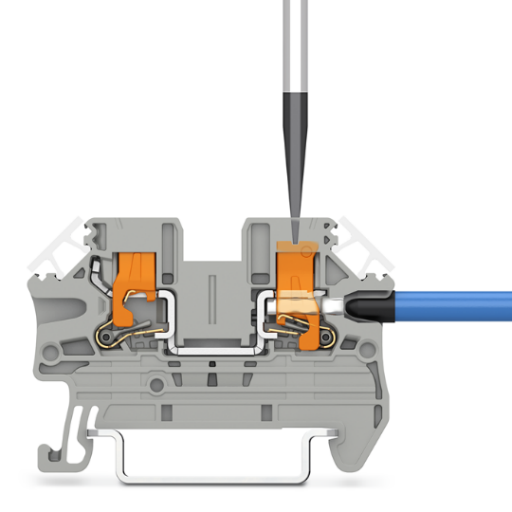
PTV Lateral Push-in Technology

From |

Push-in Terminal blocks in vertical orientation?

Yes, I am sure most of us are aware of the easy-installation technology, called Push-in Technology. If you have never heard of it, please allow me to explain it with Phoenix Contact’s history.

Phoenix Contact was the first to develop modular terminal blocks. It actually started with screw terminal blocks and then gradually innovated with newer technologies.

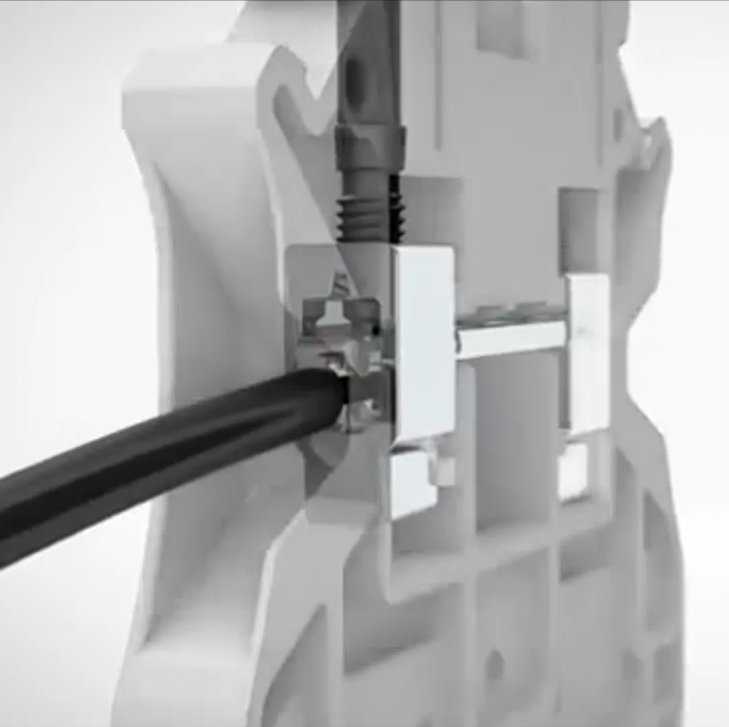
Moving on from screw terminal blocks, we came up with spring-cage terminal blocks. Using the screwdriver, the spring-cage would be opened, allowing the user to install the conductor.
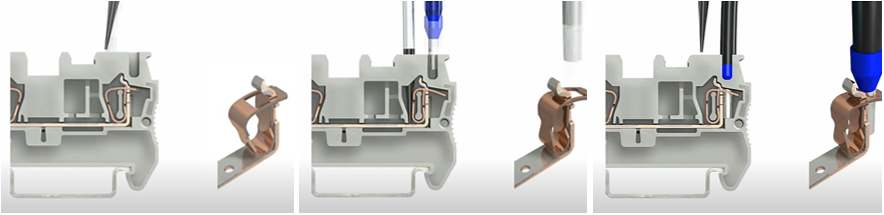
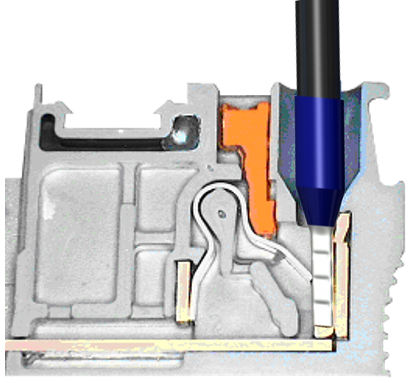
Compact ST spring-cage connection

And finally, we have Push-in technology which does not require you to get any tools to install rigid or ferrule fitted conductors. Yes, all you have to do is just slot the conductor into the hole and push it in, Voilà!

Again, with Phoenix Contact’s continuous innovation, we did not stop here. We now have lateral Push-in technology!

Instead of inserting the conductor from the top, now you can push it in from the side.

So, how does it benefit us more?
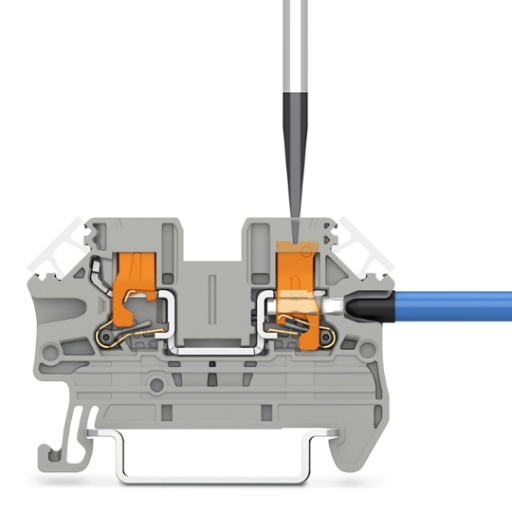
  • Best Ergonomics

Just like PT terminal blocks, you can connect rigid or ferrule fitted conductors directly without using any tools. Regardless of the listed conductor size you use, the contact spring ensures maximum contact and conductor pull-out forces with a vibration-resistant, gas-tight connection.
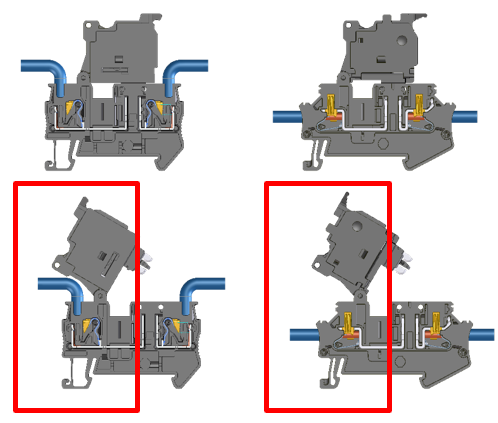
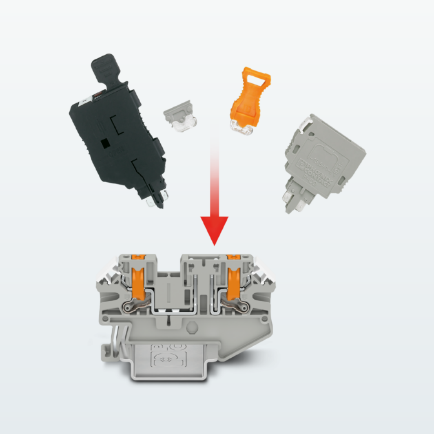
PTV, in fact, is best when it comes to a Fuse terminal block with push-in technology. If you are a user of this, you might have already faced this little situation. When you try to disconnect the fuse holder, the conductor might block you from flipping it over fully. With lateral Push-in technology, you have full freedom of flipping the fuse holder.

  • Best System compatibility

PTV, as a part of CLIPLINE complete, allows you to use the same set of accessories as other CLIPLINE complete terminal blocks with different connection technologies. The list of accessories for disconnect terminal blocks is:

  1. fuse plugs
  2. component connectors
  3. feed-through connectors, and
  4. isolating plugs

This versatility enables you to customize your switching devices.
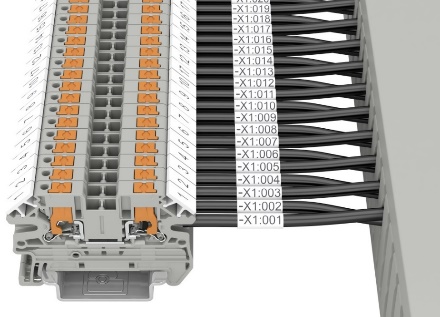
  • Best Clarity

The conductors entering from the side will not bend and cover your markings on the terminal block. This also enables easier identification of conductor markings and connection.

Today, you can find the Push-in technology in various terminal block types from normal feed-through terminal blocks to even test disconnect terminal blocks. With our new lateral Push-in technology, we can offer you an even wider range of terminal blocks!
How Many Cables Can a High Density HEAVYCON Connect?

From |

It is no secret that HEAVYCON is a great way to install and uninstall control cabinets as it saves you time and money. With HEAVYCON, the time taken to install and uninstall a control cabinet is reduced by 40% while labour cost is reduced by 30%. For applications where re-terminations are required, the savings on time and labour costs are even higher.

This is especially so with HEAVYCON modular, as it provides flexibility and allows for customisation without charging premiums. You can choose any signal, data and power modules from more than 50 modules in our product portfolio and snap them in easily into the newly improved snap-in frame.

When HEAVYCON meets Push-in Technology

Push-in technology is a direct and tool-less connection technology developed by Phoenix Contact. It uses a special contact spring for easy insertion of cables. It was first used in Phoenix Contact terminal blocks. The recognisable bright orange release button enables easy disconnection of cables using simple tools like screw drivers.

Push-in Technology has since been incorporated into HEAVYCON. This is basically an installer’s dream come true as it shortens installation time even more and make HEAVYCON even easier to use.

In 2018, Phoenix Contact had come up with a high density HEAVYCON module with Push-in technology.

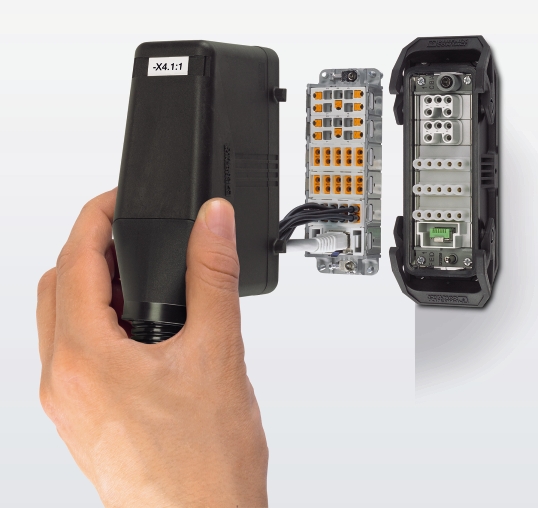
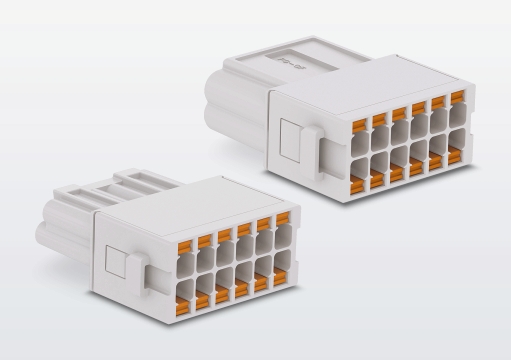
This is the game changer as it allows for connection of up to 12 cores cable per module. Combined with a 6-slots frame, it can accommodate up to 72 cores cable in one single connector. This is the highest density heavy-duty connector with Push-in technology in the market to date. Such high density is only achievable via crimp technology in the past, which can be expensive due to investment in the special tools needed.

Also new, the M1 housing caters for application where only one specific module is needed. It eliminates the need for the snap-in frame which reduces the cost of ownership. Now you can get the same amount of convenience and flexibility with less amount of money.

For more information on the development of HEAVYCON with Push-in technology, stay tuned to our blog! If you have any queries, feel free to contact us at marketing@phoenixcontact.com.sg!

An Answer to your Pain Point

From |

I believe everyone agrees with the statement: ‘There is no need to push your products to your customer. Solve their pain point’. This sentence resonates even more with me, as I was once a user of heavy duty connectors. I used this product so often that I have developed a love hate relationship with it. I LOVE it because of the convenience that this product has to offer, in terms of consolidating all wires from and into a panel. With this product, all the cables will be very organized, enough to make a person with OCD smile simply by looking at it. As for why I HATE it, it is the pain point that I am about to share.

The Art of Wiring

Before going into that list of HATEs, it is certainly useful to get the generic terms right. Otherwise everyone will start calling them their brand name, much like how I used to call them back then.

Housings and Base (with cable gland)

Housings and Base (with cable gland)

Contact Inserts

Contact Inserts

Pins/Sockets

Pins/Sockets

The NUMBER 1 in my list is definitely none other than the tedious procedure required to re-do the wrongly inserted pins/sockets. First of all, the incorrect pins/sockets have to be ejected out. This is when the ejector comes in handy, if and only if it is inside your toolbox. For my case, it was usually not inside my toolbox and I had to go through all sorts of hassle to get the pins/sockets out.

Push-in Connection Inserts

Push-in Connection Inserts

If you are a huge fan of Phoenix Contact, PUSH-IN technology is probably the most familiar term to you. YES, we incorporated that technology into our inserts and that made life easier for people like me. The only thing you need to eject out that pin/socket is just a screw-driver, or perhaps a pen.

So assume there is no wrong-doing in the wiring and everything goes smoothly until the day the panel is delivered to the end user’s place. During installation, you find that the space allocated for your panel is so limited. Worse, the space is not sufficient for the heavy duty connector because of the top cable entry direction. Squeezing it into the panel will result in over bending of the cable. This brings us to the number 2 in my list of HATEs.

Inter-changeable cable entry outlet

Inter-changeable cable entry outlet

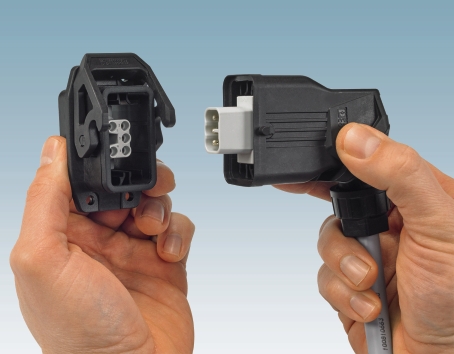
With Phoenix Contact EVO series housing, this is no longer a problem anymore. All you have to do is just twist that cable entry outlet gland and face it to the lateral direction or vice versa according to your space constraints. It provides flexibility, allowing the user to interchange the cable entry between top entry and side entry without having to remove the entire cable from the housing.

The one last thing in my list is the lack of flexibility of the contact inserts. Imagine you have different types and sizes of cables and wires that you want to consolidate into/out of a panel. In addition to that, it is just a few of every type and size of cable that you do not require the whole 16 poles or 24 poles heavy duty connector. I experienced that before in one of my projects whereby the panel requires 5 units of 1.5mm2 cable, 3 units of huge power cables, 3-4 units of Ethernet cables and finally, a few pneumatics hoses. Due to such a “high mix low volume” scenario, I was left with no choice but to make several cut-outs on the panel in order to accommodate all these cables and hoses into the panel.

This is what team-work looks like

This is no longer a hassle if different types and sizes of cable can be accommodated into one single heavy duty connector, and this is the fundamental concept that brought us to the birth of modular contact inserts. With these revolutionary contact inserts, users can now choose different contact insert modules and assemble it into a frame to make it into a contact insert. As for the housing and base, you can choose to use the standard housing or the EVO series because they are both compatible.

The above are just my pain points about this product based on my experience and Phoenix Contact Heavycon offers the right solution to every hassle that I have with heavy duty connectors. I believe you too have other problem with your current heavy duty connector, so do contact us with your feedback or queries and we will solve that pain point of yours. Cheers!

3D Calendar 2015 – What Do You See? Contest RESULT (Jan)

From |

Thank you for for giving it a go at guessing, or ‘confirming’, what you thought you saw in our January contest. The image that was embedded in the 3D image is actually (C).

Power Station C


The winner of our January contest is Janie Chng.  Congratulations.  We will be in touch with you shortly with your prize of a pair of movie tickets.


If you missed out on our first contest, fret not! Here’s this month’s contest for you to try.

3D Calendar 2015 – What Do You See? Contest (Feb)

3D Calendar 2015 – What Do You See? Contest (Feb)

From |

In last month’s contest, many of you guessed “C” correctly.

This month, we feature our PTSM connectors.  Optimized for LED applications, it’s small size and fast push-in connection allows you to maximise the amount of components while reducing installation time, especially in small, confined spaces.

So do you think you ‘saw’ the correct image? This one is going to be tough. Make a guess!

Streetlight_1(A)

Streetlight_2

(B)

streetlight

(C)

Let us know by dropping us an email at marketing@phoenixcontact.com.sg!

Once again, for those who did not manage to get a copy of our calendar, here is the image for you to join in the fun.

streetlight_Feb

Click on the image to see a larger version.

Push-In Technology – ‘Magic Eye’ 3D 2015 Calendar

From |

Push-In Technology ‘Magic Eye’ 3D 2015 Calendar

Calendar_in_box

For the first time ever, we are proud to present our ‘Magic Eye’ 3D 2015 calendar. Each month, we feature a product from our Push-In range and an accompanying 3D image of the application it was designed for.

Calendar_and-_box

Designed in-house, we thought it would be a novel idea to bring back a craze from days of yore. I am sure many of you remember the times when you used to stare for hours on end trying to see the ‘3D’ images in those Magic Eye books.  Well, have a go and let us know if you can see the images in our calendar.  Here’s a little teaser for you.

Calendar_Logo

 Click on the image to see a larger version.

Well, to add a dash of fun to this, we will be having a little contest each month to see if you really can see the image.  Guess it correctly and you get a little ‘something’.  However, get it right for each of the twelve months…let’s just say we will make it worth your while.

Well, if you do not have a copy of our calendar, we still have a limited number of copies available. Send us your request at marketing@phoenixcontact.com.sg and we will try to send it to you.

I Love….

From |

I love the way you help me simplify wiring

I love the way you help me reduce the installation time

I love the way you provide me a reliable long-lasting connection.

I love the way you make it an ideal connectivity for high-vibration applications.

I love the way you provide me easy and tool-free wiring

I love you, PUSH-IN Technology

Phoenix Contact has designed hundreds of products to make your job easier, such as products equipped with our leg-spring, push-in connection technology

a_0056633_int                    a_0056348-1

a_0055006                    a_0055168

Want to find out more? Feel free to contact us at marketing@phoenixcontact.com.sg!

Push-In Technology – Closer than You Think!

From |

Push-In Technology was developed by Phoenix Contact in 1978. The very first modular terminal block, the FK 1,5 with a direct plug-in spring connection, designed to offer installation engineers an easy and safe conductor connection method used this technology.

Due to its handling and compact design, the FK 1,5 is still found in elevator engineering, machine and system construction even today! Just like the FK 1,5, the concept of Push in Technology still exists and is going strong today – because it improves the way we do things…. even in our daily lives!

Read on to find out how.

Continue reading