Tag Archives: heavycon

How Many Cables Can a High Density HEAVYCON Connect?

From |

It is no secret that HEAVYCON is a great way to install and uninstall control cabinets as it saves you time and money. With HEAVYCON, the time taken to install and uninstall a control cabinet is reduced by 40% while labour cost is reduced by 30%. For applications where re-terminations are required, the savings on time and labour costs are even higher.

This is especially so with HEAVYCON modular, as it provides flexibility and allows for customisation without charging premiums. You can choose any signal, data and power modules from more than 50 modules in our product portfolio and snap them in easily into the newly improved snap-in frame.

When HEAVYCON meets Push-in Technology

Push-in technology is a direct and tool-less connection technology developed by Phoenix Contact. It uses a special contact spring for easy insertion of cables. It was first used in Phoenix Contact terminal blocks. The recognisable bright orange release button enables easy disconnection of cables using simple tools like screw drivers.

Push-in Technology has since been incorporated into HEAVYCON. This is basically an installer’s dream come true as it shortens installation time even more and make HEAVYCON even easier to use.

In 2018, Phoenix Contact had come up with a high density HEAVYCON module with Push-in technology.

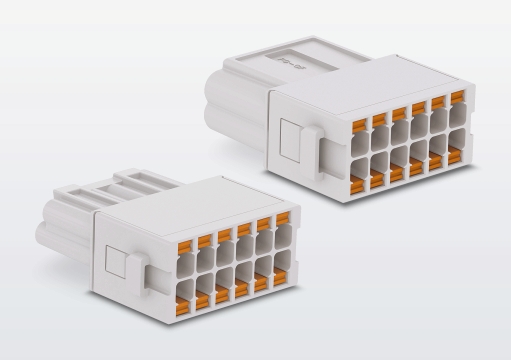
This is the game changer as it allows for connection of up to 12 cores cable per module. Combined with a 6-slots frame, it can accommodate up to 72 cores cable in one single connector. This is the highest density heavy-duty connector with Push-in technology in the market to date. Such high density is only achievable via crimp technology in the past, which can be expensive due to investment in the special tools needed.

Also new, the M1 housing caters for application where only one specific module is needed. It eliminates the need for the snap-in frame which reduces the cost of ownership. Now you can get the same amount of convenience and flexibility with less amount of money.

For more information on the development of HEAVYCON with Push-in technology, stay tuned to our blog! If you have any queries, feel free to contact us at marketing@phoenixcontact.com.sg!

Plastic VS Aluminium – Heavycon Edition

From |

Heavy-duty connectors are typically made of aluminium as it is supposed to be tough and durable. However, being an innovative company and discontented with the current industrial norm, Phoenix Contact had come up with HEAVYCON EVO in plastic.

The plastic used in HEAVYCON EVO housing is not just any normal plastic, it is made of polyamide, reinforced with glass.

So, how strong is strong? Several tests were done to the plastic HEAVYCON including basic IP and NEMA tests in accordance with DIN EN 60529, NEMA 250. This ensures that the contact inserts within the plastic housing are protected against the ingress of dust and heavy jet water. The other tests include:

Vibration test in accordance to IEC 60068-2-6

Harmonic, sinusoidal vibration is applied to HEAVYCON plastic housing to simulate rotating, pulsating or oscillating forces. HEAVYCON plastic housing fulfils these requirements, making it ideal for heavy machinery application.

Temperature shock test in accordance to IEC 60512-11-4

We simulate significant temperature changes by switching HEAVYCON plastic housing between 2 chambers of extreme temperatures within seconds. The result is affirmative – HEAVYCON plastic housing is suitable to be used in applications with ambient temperature between -40 to 125 degree Celsius.

IK shock test in accordance to IEC 62262

Shock is introduced by dropping a hammer of 1.7 kg mass from a height of 0.3m. HEAVYCON plastic housing is able to meet the mechanical requirements similar to the HEAVYCON aluminium housing.

Roll over test in accordance to DIN IEC 62196-1

This is a special test carried out on the plastic housing where a forklift truck weighing several tons rolls over it. HEAVYCON plastic housing is able to withstand high amounts of stress from heavy, moving loads without any adverse effects on its function. In fact, in Singapore, we proved it again by driving a car over the connector.

Dynamic load test

Besides the strength of the plastic housing, we have to ensure the latching mechanism is heavy-duty enough as well. In this test, we applied a force of 200N to the cable at an angle of 90 degree. This is to test the HEAVYCON EVO bayonet as well as the locking latch between the housing and panel mounting to make sure that they do not malfunction under extreme static load.

Through the tests we have done, we can conclude that plastic can be as strong as metal too, in this case aluminium. To find out more about the durability of our HEAVYCON EVO in plastic, leave us an email at marketing@phoenixcontact.com.sg!

5 Ways to Terminate Cables into an Electrical Panel

From |

There are several criteria when it comes to choosing the right cable entry method into an electrical panel, such as ingress protection (IP) rating, ease of connection/ disconnection, cost of the connector etc. In this post, we have sorted out 6 different cable entry methods that Phoenix Contact has to offer.

  1. Cable Gland

The most common way to terminate cables into an electrical panel would be to use a cable gland. It is easy to use and comes in many variants such as different sizes, materials and with additional certifications such as ATEX. Cable glands are probably one of the most affordable cable entry methods mentioned in this article.

However, cable glands have its limitations too. It is difficult and time consuming to do multiple connections/disconnections with cable glands as the cables are terminated directly into the components within the electrical panel. In addition, the pre-cut holes on the gland plate are irreversible. It provides limited flexibility for mistakes and modifications.

  1. Heavy-duty Connector

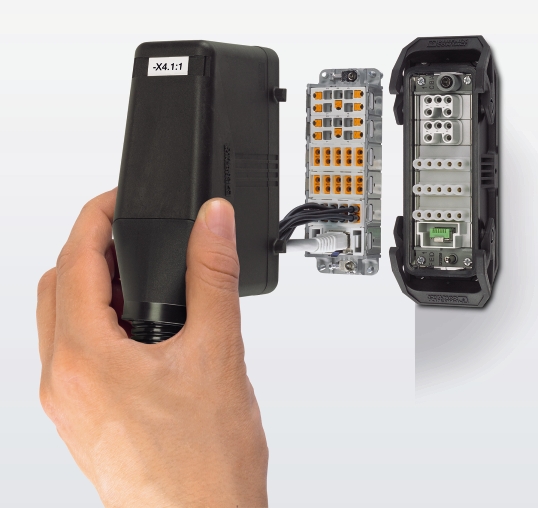
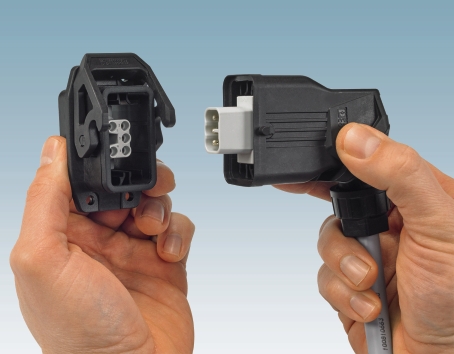
As the name suggests, it is rugged and enables fast and easy connection/disconnection to the electrical panel. Cables are prewired into the connector base, which is mounted onto the panel while the field cables are prewired into the connector hood. The hood is then plugged into the base on the electrical panel for a complete connection up to IP 69K.

Heavy-duty connector is especially useful for portable applications and testing facilities as it allows quick connection and disconnection. Although heavy-duty connectors are more expensive than cable glands, it minimises time and labour needed for onsite installation and commissioning up to 80%. It also reduces errors that could occur during onsite installation.

Heavy-duty connectors are typically made from Aluminium. However, Heavycon EVO from Phoenix Contact also comes in plastic (polyamide with reinforced fibre glass) to support applications that do not require metal housings and provides cost savings of up to 30%. Besides that, the dual entry cable gland enhances the flexibility for onsite installation. Phoenix Contact’s well known Push-in Technology is also used in Heavycon to further reduce the installation time.

  1. Cable entry system

Cable entry system (CES) is similar to cable glands. However, it helps to arrange the cables neatly and systematically into the electrical panel. By better managing the cables, the gland plate can be better utilised. It works in a modular form where the cable sleeves can be flexibly combined depending on the wiring. The slotted sleeves also allow the use of sensor actuator cabling while cone sleeves come in handy when the cable diameter is not predefined.

The cut-out of CES is the same as that of heavy-duty connectors. Thus, they are interchangeable. However, CES is not a pluggable connector. Thus, it is not suitable for applications that require frequent connecting/disconnecting.

  1. CES Multigate

Similar to CES, multigate offers great cable management. However, unlike CES, multigate has prefixed cable entry. Each cable entry is a cone-shape membrane that is able to accommodate a range of cable diameters. This is especially suitable for panels with defined cable specifications. As the cables are well arranged, it is easier to isolate faulty lines, if any.

  1. Service interface

Service interfaces make maintenance, servicing, and diagnostics easier than ever. The front plate comes in different configurations of D-SUB, RJ45 and USB, offering numerous combinations.  The mounting frame offers up to IP 65 protection with locking mechanism for extra security. This reduces the need to open up the panel during programming or configuration.

There are many factors to consider when it comes to choosing the most suitable cable entry method to your electrical panels. Let us help you with the selection by leaving us an email at marketing@phoenixcontact.com.sg!

Heavycon Evo

From |

*Sigh*

I believe that many of us have experienced similar problems with plugs and sockets as pictured above, especially while travelling. Due to poor designs, some of our bulky charging equipment for our phones, laptops or cameras may not be able to charge. This creates massive inconvenience for us as we are unable to use our devices when we need them. In times like these, being able to adjust the wall plug orientation would solve the problem.

Surprisingly, such problems also arise in factories and warehouses that usually utilise heavy machinery. However, having such problems with heavy machinery will bring about more inconvenient repercussions such as having to move your machine to another location or adjusting your wall plug so that the socket can be plugged into it. These will bring about higher costs and also more tedious work.

The Phoenix Contact team has thus come up with a solution to overcome these problems.

Our Heavycon Evo is a heavy duty connector which allows the cable gland to be connected vertically or horizontally depending on the site conditions and requirements. The housing offers range from B6 to B24 and cable gland sizes of M20, M25, M32 and M40. Because of how customisable the product is, using it reduces the inventory in stock. Heavycon Evo is particularly useful when it comes to installation of cables in rather tight spaces. This also helps create a more compact setup which saves space. In cases where the wiring and connection points between cables are in obscure and inconvenient positions, the Heavycon Evo allows the user to alter the orientation of the sleeves from horizontal to vertical or vice versa. This feature also allows the wiring to last longer as the wires will not be in positions where they are under high tension.

Besides fulfilling its original purpose, the Heavycon Evo has additional benefits. When told that the Heavycon Evo is made up of plastic, many have the impression that it is not very durable. However, the fact that the Heavycon Evo is made of plastic brings about many benefits. The Heavycon Evo is made of high grade polyamide plastic that has gone through stringent quality checks such as IP and Nema degrees of protection, vibration, temperature shock, shock resistance, roll-over test and the dynamic load special test which verifies that the Heavycon Evo bayonet locking and double latch do not open independently or malfunction even in the case of extremely high static loads. Furthermore, the high grade plastic of Heavycon Evo will drastically lessen the load of machinery as it is significantly lighter than its metal counterpart by up to 50%.

Heavycon Evo enables the multiple connections of data, power and signal in a single housing with up to six difference combinations. We have also implemented our state of the art push-in technology in our inserts to allow easy, fast and secure connections in every application. Lastly, there is a common misunderstanding that plastic sleeves cannot match the applications of metal sleeves. However, this is not true as our Heavycon Evo is compatible with all existing setups of up to 24 positions with existing metal setups.

In conclusion, Heavycon Evo is compact to be installed in tight positions, cost effective, light weight and compatible. Hence, it will be your number one choice when buying heavy duty connectors.

Interested to find out more? Feel free to contact us at marketing@phoenixcontact.com.sg!

HEAVYCON Modular for IIOT

From |

IIOT

More often than not, when people talk about Industrial Internet of Things (IIOT) or Industry 4.0, they neglect the ‘links’ between the sensors and components.

Yes, I’m talking about the connectors (the ones that connects sensors and components, what else?).

A huge part of IIOT includes data collection and analysis.

This means that a lot of sensors and cables will be used to detect, capture and transmit data. It can be really time consuming and a chore to wire these amount of cables directly into the panel on-site during installation and maintenance.

If you’re reading this, consider yourself lucky.

I’m going to show you how Phoenix Contact’s Heavycon can make connection easy, fast and smart. (Don’t be fooled by its name. It’s not heavy in weight rather, it’s heavy duty – able to withstand demanding environments).

So what’s a Heavycon?

HEAVYCON

HEAVYCON

Phoenix Contact’s Heavycon is a plug-and-play solution.

It allows the cables to be pre-wired into the connector within the panel and in the field. This makes on-site installation and maintenance fuss-free and efficient.

Simply plug and play! It eliminates the tedious process of direct wiring on-site.

It also removes the need to open up the panel during installation and maintenance which in turn reduces the risk of people meddling with the crucial components within the panel.

Pictured: Definitely not HEAVYCON. Because we don’t want people messing around with what’s already a mess.

Termination of wire is also made easy with Push-in Connection Technology. No special tool is required. Simply insert the wire with ferule into the designated slot. To remove, push the orange button and pull the cable out.

Contact inserts with push-in connection

Contact inserts with push-in connection

Heavycon also comes in modular form!

Heavycon Modular allows you to connect signal, data and power in one single connector.

Push-in connection technology is available in module form too. We also have a wide range of network modules such as RJ45, D-sub, Gigabit Ethernet Cat 6 connectors and even fibre optics and power module up to 200A.

Modular contact inserts

Modular contact inserts

The unique snap-in frame makes inserting and removing of modules a piece of cake. This provides the flexibility of changing the configuration effortlessly according to your set up.

Push-in modular contact insert

Push-in modular contact insert

Need more flexibility? Heavycon EVO enables you to change the direction of cable entry on-site depending on your desired arrangement.

HEAVYCON EVO

HEAVYCON EVO

Furthermore, Heavycon is resistant against dirt, water, vibrations and high mechanical strain and has protection up to IP69K.

Thus, it is able to withstand harsh conditions and is suitable for outdoor applications.

HEAVYCON getting sprayed by pressure jets

Looks worse than any rain I’ve ever seen

If you want to see how we torture the Heavycon, you can watch the video below:

https://www.youtube.com/watch?v=jwSJYic0CaE

With that said, it’s about time to start adopting smart connectivity as we hop onto the IIOT bandwagon.

More videos about the Heavycon:

https://www.youtube.com/watch?v=daeIaMX7o_A

Drop us an email at marketing@phoenixcontact.com.sg to request for a product sample today!

Heavy-Duty Connector Solution for Machine Building

From |

Phoenix Contact’s Heavy-Duty Connector is an ideal solution to replace conventional cable glands if you want to have an easy and quick physical disconnection of power or signal. Many machine building system integrators are facing the following problems with regards to the cable gland design:

  • Difficult to dismantle and disconnect
  • Consumes a significant amount of panel space
  • Errors during installation

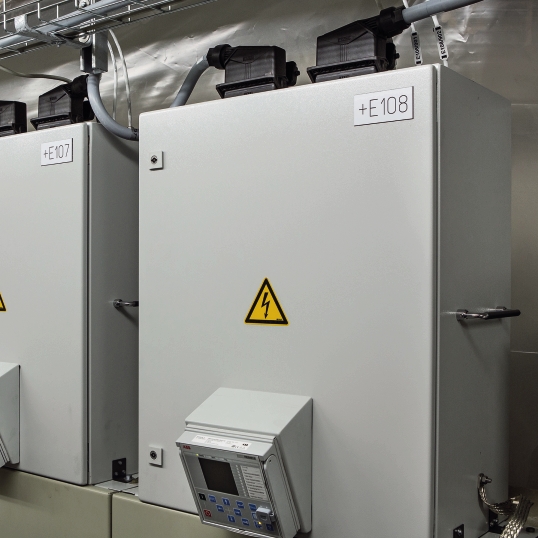
After going through the product technical information, our machine builder customer decided to replace most of the cable glands with Heavy-Duty Connectors due to their easy application. a photo of their panel is shown below.

Control Cabinet

Fig 1: Control Cabinet

Heavy-Duty Connector

Fig 2: Heavy-Duty Connector

Feature of Heavycon:

  • High corrosion resistance
  • Ensures secure power, data and signal transmission
  • Flexible single or double locking latches
  • Mounting and plug-in Compatible
  • EMC-ready
  • Ideal for operating in harsh environments

If you need any technical advice on your current project, feel free to contact us! I believe we can be your trusted partner to provide suitable solutions to fit your needs!

LV Compartment for MV Switchgear

From |

Box by box towards Smart Grid 1: LV Compartment for MV Switchgear

The gradual shift towards the much vaunted Smart Grid structure has been gathering steam in the last few years. While much of the excitement has been generated from the immense potential of what a fully completed Smart Grid system can bring (for example, higher reliability at reduced cost), Grid operators, independent power producers and their team of engineers are facing real difficulties in implementing such systems today. It is easy to talk about wanting to implement technologically advanced systems, but when it comes to actually executing the projects to implement such solutions, the complexity surrounding such implementations comes to the fore.

Much of this complexity arises because of the vast variety of applications within the industry. It is particularly difficult to find the right set of products that are suitable for the application, reliable, fast to set up and easy to manage. For example in Transmission and Distribution substations, there will minimally be systems for transformers, shunt reactors, switchboards, intrusion detection monitoring systems and each of these systems can consist of smaller sub systems. For example, in monitoring a switchboard, we can monitor downstream load current for energy balancing; micro current fluctuations for signs of partial discharge or even for predictive maintenance; door contact monitoring for physical security and the list goes on. Each of these systems will require the right set of products and will have to be linked in this web of madness. Imagine the chaos!

At Phoenix Contact, we recognise this difficulty. While we have many solutions for Energy Industry that we are always sharing with the various stakeholders, in this series of blog articles, we will be examining how we help to simplify the implementation of Smart Grid. We will do so by examining the building blocks of a system – the individual panels which form up a system; and we will do so box by box. This first article will be about LV Compartment of MV Switchgear and we will delve straight into the 3 problems switchgear builders and grid operators are facing!

Problem 1: How do I collect signals from my switchgears and transform it into IEC61850?

The completed substation topology will involve decentralised controls where IEDs are placed at high voltage equipment (on transformers and switchgears) itself. Even when it is not completed, communications from the bay control cabinets and protection devices to the substation control system are being converted to IEC61850 as IEC61850 has proved to be a superior communication protocol and standard to reduce downtime and increase reliability of the grid. Therefore, it is only a matter of time before all switchgears are converting signals from the circuit breakers and all other auxiliary signals into IEC61850 data. However, examining the LV compartment of switchgears today, the signals are still being passed out with many copper wires or connected to numerical relays. These present two clear drawbacks:

  1. There are a lot of copper wires going out of the panel or into numerical relays. The associated cost includes requiring marshalling or pilot cabinets and related components and regular maintenance to check if the connections are good. In addition, it is difficult to isolate where the fault is when there is a loss of signal. In the worst case scenario, there might even be accidental shorting resulting in severe downtime!
  2. Numerical relay and its I/O cards are expensive.

These result in higher initial cost and higher eventual maintenance cost with downtime not necessarily minimized, especially in the event of loss of signal.

Using of a Bus coupler capable of communicating via GOOSE and MMS will solve both of these problems. Using Phoenix Contact bus coupler as an example, the signals can be easily inserted and aggregated as IEC61850 data. It certainly reduces the number of cables leaving the cabinet and with the light indicators, you can see clearly which connections are good without requiring extra tests. It is also of lower cost compared to numerical relays’ IOs while communicating perfectly with them.

Problem 2: There are too many wires, how can we manage them better?

Being the founder of the original ceramic terminal block, it is already tempting to say that Phoenix Contact is the best at solving this! But in the last few years, we have developed more data connectors to put us in a better position to solve this for switchgear builders!

We have an extremely wide range of terminal blocks for every applications and needs. We have demonstrated to be able to meet each and every customers’ unique demands, be it requiring pluggable solutions, fastest connection technology, space saving, you name it, we’ve done it!

In this article, we would just like to highlight how a commonly used connector for switchgears has developed to adapt to Smart Grid. In the past, our Heavycon (heavy duty connector) was often sold to connect the LCC and Bay cabinets. This enabled quick connection on site.

However, these connectors are usually for loose copper wires only. Although you can strip an Ethernet/serial connector to use such connectors, these connectors does not cater very well for the shielding required for data connector. Therefore, Phoenix Contact has developed a modular connector, allowing you to use your data connectors directly! This modular connector even allows you to have connectors which allow for high power!

Problem 3: With more signals being collected, there will be more testing to be done. How can we ensure we are safely doing the testing all the time!

Every so often, testing needs to be done on the current transformers and voltage transformers regularly. For current transformer especially, if not done right, explosions can happen. Currently, the shorting and breaking of circuits are done manually by hand (yes you read that right) and as you can imagine, explosions lead to death.

To solve this, Phoenix Contact has developed our test disconnect system (FAME) where shorting is done automatically and it is fool-proof!

Instead of using terminal blocks that are switched manually, you can replace it entirely with FAME and from then on, every testing procedure will be done how it is meant to be done: SAFELY.

We have assembled this product into a demo box along with other products that Phoenix Contact offers for LV Compartment for MV Switchgear. If you will like to have a look at the demo box up close, do contact us at marketing@phoenixcontact.com.sg and we will get in touch!


Heavy-duty connectors for every application

From |

Heavycon complete heavy-duty connectors from Phoenix Contact offer a reliable seal up to degree of protection IP69K. There are matching plug-in connections for every requirement with housings from three series types and matching contact inserts which can be combined.

4727

The standard series offers a wide range of robust metal housings with various different cable outlet directions and locking mechanisms. The flexible, swiveling bayonet locking of the EVO series allows the cable outlet direction to be freely selected and reduces the number of versions and thereby the warehousing costs by up to 70%. Not only does the direct screw locking without panel mounting base result in cost savings, it also means that the Advance housings are particularly durable and robust.

All components can be individually combined and flexibly modified, extended or exchanged. The standard and EVO housing is pin-compatible with the market standard and the Heavycon metal housing is “EMC-ready” thanks to conductive surfaces and seals. Combined with shielded cable glands, they offer you reliable protection in electromagnetic surroundings. All housing series fit standard panel cutouts.

Using Heavy-Duty Plug Connectors on the Mounting Rail

From |

Phoenix Contact’s Heavycon CIF (Connector Installation Frames) mounting frames make it possible to snap Heavycon contact inserts onto a mounting rail quickly.

The increasing use of cable entry systems for control cabinets and switch boxes results in a rising need to contact preassembled plug connectors and contact inserts directly on mounting rails.

Continue reading