A few years back before I joined Phoenix Contact, I attended a training course conducted by this reputable company situated in the Central Business District. Right from the moment I stepped into the office, I was absolutely awed by the office environment. It is so spacious, neat and tidy, with full length glass windows, and every cubicle is separated by a piece of beautifully crafted glass.
Category Archives: General
Is Surge Protection Necessary?
From |According to Wikipedia, Singapore has one of the highest rates of lightning activity in the world. Did you know that our tiny island is struck by lightning every other day? Therefore statistically speaking, the odds of getting hit by lightning are exceptionally high, which makes the use of Surge Protection Devices or SPDs in most electrical installations, essential. However, to my surprise, many of us do not install SPDs as we have this belief that our electrical infrastructure (underground cables) is safe and reliable.
Phoenix Contact SEA’s Own Soccer Heroes – Part 2
From |Phoenix Contact SEA’s Own Soccer Heroes
From |With all the hype of the 2010 World Cup, it is easy to get drawn into all the revelry. It permeates into all aspects of our daily life and it certainly has influenced my designs at work.
Being tasked with designing an identity for our Business Development Team, I drew on the idea of using the strategy board soccer mangers used to plan their attacks and defense.
Each member has a part in strategizing and contributing to the success of the team. Each strategy is a precise execution of individual and team play. So in my design, each member is represented by a 3D lego minifig dressed in Phoenix Contact SEA’s own soccer jersey. I’ll be sharing images of these figures over the next few days.
Here’s the first of the figures.

Any guesses who might this be?
Why Is It That Birds Can Land on Electrical Wires Without Getting Shocked?
From |During the recent Surge Protection Seminar which I attended in Thailand , a question was posted to the 60 participants, who were mainly maintenance engineers from the PTT group, “Why is it that birds can land on electrical wires without getting shocked?”
I remember vividly asking myself this question in my head when I was a child and I always thought that it was the wadding on the wires that kept the birds away from contacting those high voltage wires. I realized that I was wrong all these while when one brave soul stood up and stated his answer, loudly:“It is not the insulation. It is the nature of electricity at work!”
The speaker, Mr. Holger Heckler, went further elaborating that when a bird rests on the live wire, its body will be charged to the same voltage as the wire. From the standpoint of electrical reactions, electric current flows from a point with higher voltage to one with lower voltage. As a result, electric current will not pass through the bird’s body via the live wire since they are on equal voltage charge. However, imagine if a bird accidentally comes into contact with both an electrical ground and the power line at the same time, it completes an electrical circuit, and therefore an electric shock is inevitable!
This is why power lines are constructed with wide gaps between the conducting and grounding wires, to minimize this risk.
This is also the reason why we were always told to keep our feet close together when we have no other places to hide during a thunderstorm. Cows are unfortunately less likely to survive thunderstorms as the step potential between its two feet is higher.
From an electrical system stance, this is why engineers adopt proper grounding and bonding techniques to prevent damages to the electrical devices during a breakdown. Surge protection devices are always added to reinforce the protection of the electrical system from lightning and switching magnetic surges.
One of the things I liked about Mr. Holger Heckler’s approach to speaking at such seminar was that he managed to spur the interests of the audiences and got them all connected instantly with his brilliant insights. He did not fly all the way from Germany to Thailand just to make this statement. He made sure that what he delivered was stimulating enough to keep the participants awake throughout the entire day.
A big salute to Mr. Holger Heckler who made it possible!
Elevator Speech – “What is the nature of your business?”
From |Imagine this, you are entering the elevator after a meeting with your client at his office. You are on the 12th floor. The client is with you and his CEO happens to enter the elevator. Your client introduces you to him. The CEO asks, “What is the nature of your business?” By now, the elevator would probably have reached the 6th floor. You are left with 10 seconds to explain it as impressively, and as comprehensively as possible. What do you say?
“Where do you work?” and “What does your company do?” Do you get these questions often? I do, and sometimes it gets really frustrating. For some companies, explaining their scope of work is easy. For example, if your employer is Apple, it does not take a genius to know what your company does.
Don’t get me wrong. Answering the question of “what your company does ” is, in itself, not frustrating. However, as it happens at times, the lack of time to explain the nature of our business that is frustrating, such as when you are in an elevator with your client’s CEO. The answer to this frustration is, be prepared. For those of you who are not working in Microsoft, Nokia or any other top 10% of the Fortune 500 companies, my advice is, start to draft your elevator speech , and memorise it. You never know when you will need it.
As a rule of thumb, an elevator speech adopts KISS – Keep It Simple and Sweet. One that is not more than 15 seconds to recite it.
Now, back to the question of “what is the nature of my (Phoenix Contact) business?”
“Phoenix Contact is a German-based manufacturer. We provide innovative solutions to the world of Industrial controls and automation with our range of products such as PLC, power supplies, industrial and PCB connectors,wireless and surge protection systems”
Railroad – Is it Sunrise or Sunset industry in the world largest economy?
From |
‘All-in bet’ – Warren Buffett, one of the most successful investors in the world with a net worth of US$47 billion, obviously does not need a single dime for the rest of his life. But why is the Oracle of Omaha betting on the railroads? Fulfilling his childhood dream of having a train company – like the recent $34.5 billion BNSF acquisition? (Burlington Northern Santa Fe, BNSF is a railway company that operates one of the largest railroad systems in North America with approximately 32 000 route miles of track in 28 states and two Canadian provinces)
‘Railroad productivity, our priority’ – Two merchants were given 10 litres of fuel each to transport one ton of goods from point A to B. Merchant A decided to transport the goods by truck and realized that the 10 litres of fuel served only ‘one-shot’, however Merchant B who preferred to transport the goods by train got ‘three shots’ (10 litres fuel for three trips). Merchant B will definitely be more productive from freight train as compared to Merchant A.
With limited fuel supplies (making it worse from the ongoing Gulf of Mexico oil spill), inflating fuel cost (crude oil consistently trading north) and mother earth getting warmer, investment in railroad system deserves the priority focus. Barack Obama’s US$8 billion budget plan to reduce travel time and increase mobility, reduce congestion and boost productivity, reduce destructive carbon emission and improve environment affirms the need to invest a more efficient railroad system.
References: Berkshire Hathaway Inc, ‘RailwayAge’ by Simmons-Boardman Publishing Corp
The Day Orchard Road Flooded
From |
Wednesday, the 16th of June 2010 will be remembered as the day when torrential rains flooded the most renowned road in Singapore, Orchard Road. I was not even aware of it until the next morning when I read the papers. I live and work in the east where the rain was mild that day. First reaction? Surprised, but no big deal, or so I thought. I brushed it aside as I left my house for work that morning.
It was on Thursday that I realized the impact of this news. It had traveled far, across the Straits of Malacca to the most populous country in South East Asia, Indonesia. I was in Jakarta on a one-day business trip. Business aside, the talk of the town was the flood in Orchard Road. Every one of the 7 business acquaintances I met that day was mocking the flood. I was surprised. Even more so when I heard that it was headline news in the local newspaper that morning. Wow…, I thought.
At that moment, I realized that we, the second youngest country in South East Asia, after East Timor, had established for ourselves a rock-solid reputation for our infrastructure. Our neighbours hold us in such high regards that they had never imagined flooding of such a magnitude occurring at all, much less in the heart of Orchard Road.
So, what are my thoughts on this flood? Singapore is not impervious to failure but our strength lies in learning from our mistakes. We remedy, we grow, and we improve. We change.
From this flood, I also see opportunities. I can almost visualize that more ‘horsepower’ will be added to the control system – IP67 industrial plug connectors will be needed to withstand the harsh outdoor environment, surge protection to guard against the failing of the control system due to lightning strikes, an array of data communication and protection devices for reliable transmission from CCTV systems, a robust SMS relay will sending an SMS (to the PUB) when triggered by the remote sensors, and many more!
Regrettably, I was not able to witness with my own eyes, the last flood in Orchard Road.
Indians, A ‘Can-do’ Attitude
From |India had always been one of the countries that I, or rather, my left brain wanted to visit. On the contrary, it is also a country that the logical side on me, least wants to visit. Let me explain the conundrum.
I think, I like India because it is a country filled with rich history and culture, compiled from the roots of Indians, Persian, British and the Middle East (as far as I know). It is also where the magnificent symbol of love, The Taj Mahal sits.
To feel the cold white marble of the Taj, one of the Seven Wonders of the World, sits right at the top of my to-do list. Authentic Indian food is another pull factor to India. To try the true-blue Chicken Masala, Chicken Tikka and Chicken Tandoori will be a great pleasure to my taste buds, I imagine.
On the other hand, my right brain is afraid of the environmental conditions. The heat that literally sears your skin in the open (more than 40 degree Celsius of dry heat from March to June); the air pollution that sets your whole respiration system into a “4-wheel drive mode”; the contaminated water that churns your stomach faster than any of those roller coasters ride in Magic Mountain; the number of power cuts/losses that exceeded the counts of your fingers, and the noise pollution – the incessant blaring of horns on anything that comes with wheels, could possibly wakes the dead. Adding up all of these factors, would you give up your hard-earned money in exchange for a trip to India? No chance, India is probably one of the last places on earth you would want to visit.
Coincidently, I was given the opportunity to experience India for myself. I was to attend a business meeting in New Delhi. And so I went, taking my wife, my “Supreme Court judge”, along for an extended trip after the meeting.
True enough, my left brain was correct, but so was my right. What surprised me was not the weather conditions or the physical place itself, but the People.
I noticed that Indians (most) are really friendly and show great hospitality, with sincerity. I was lavished with tip-top service throughout my stay. I was most impressed that a cell-phone that I had absent-mindedly left in the hotel restaurant was found a few hours later. Even in Singapore, the odds of having your lost phone returned are near zero.
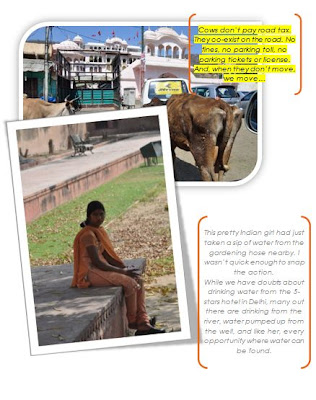
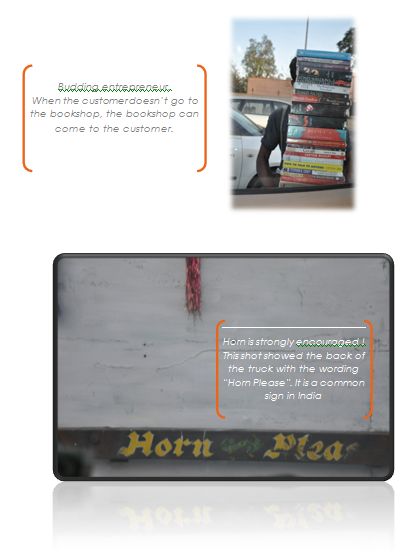
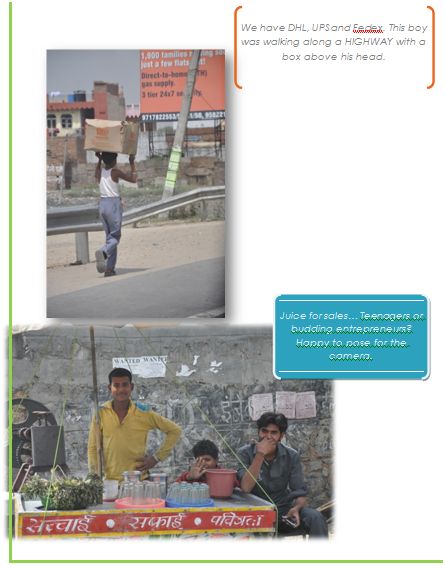
Other than the friendliness, the daily life of the Indians, showed me the other side of life that many of us, as Singaporeans, have forgotten -the survival instincts and never-say-die attitude. Looking back, I have taken many things in life for granted. I am no photographer and had no interest with carrying a bulky camera around. However, on this trip, the urge of capturing these moments was so great that I cannot stop clicking away. I have selected a few pictures to share with you.
When life does not bend in your favour, do not wait for someone to come by and do it for you. Do-It-Yourself(DIY), within a ‘right frame’. I guess such a ‘can-do’ attitude is where entrepreneurship begins; where creativity starts.
Many Singaporeans are blessed without having to experience the harshness of life, as they do in India. Yet, this harshness has probably shaped the toughness of character within – the instinct of survival, the ‘ever-ready’ will power, the creativity, and the guts of risks-taking. While many of us are found wanting in these virtues, I believe, with a little effort to re-focus our energy and fine-tune our mindset, we can evolve, stronger.
For a start, I believe that the first change that we can all make, is to stop wasting negative energy on why and how it cannot be done (cannot-attitude). Mr Lee Kuan Yew once said, “Focus on what works”. Concentrate on developing the ‘can-do’ attitude, and start asking “How do I do it?” instead of “Can it be done?”. With a leap of faith, even in an environment such as in Singapore, I believe, we can also groom a ‘can-do’ attitude.
Someone asked, “Will you come back to India again?” I hesitated. I guess, it is my left and right brain trying to outdo each other again. I took a few blinks of my eyes as if to shut off all the thoughts process and said, “maybe…yes..”
10 items to bring along for your India trip:
1. Power plug converter (EU type)
2. Cap to block the sunlight
3. Sunshade to block the sunlight
4. Sun-block lotion
5. Torchlight in case of power trip
6. Charcoal pills for stomach upset
7. Lots of small notes for tips
8. Bottles of mineral water
9. Wet Tissues
10. Respiratory mask

Market Observations, the future of Europe?
From |Market Observations, the future of Europe?
One of the big financial news stories of 2010 has been the near insolvency of Greece and its impact on the euro.
Without a doubt, the big currency story so far in 2010 deals with the solvency of Greece and other nations. To understand the nature of the problem and its possible solution, we will look at three main factors – credibility, fairness and moral hazard.
The Credibility Factor
About a month or two ago, Finance Minister George Papaconstantinou has indicated that Greek government doesn’t need a bailout. The euro popped higher on this news. Many analysts are skeptical because Greek government has a serious credibility problem.
The details are short in supply, further to that word is now circulating that Greece engaged in deception through currency swaps to make their balance sheet look better than actually it was.
Reports in Germany indicated that Goldman Sachs raised about US$ 1 Billion through currency swaps that were not recorded in the country’s budget. The report alleged that “fictional” exchange rate was used to boost the country income. Worse still, the Greek government has denied the use of currency swaps to mask its deficit problem when confronted with the issue in September 2008.
The Fairness Factor
It has recently been noted that many German citizens do not want to offer assistance because the German retirement age is 67, while Greece’s average retirement age is only 61. “ Why should Germans work so that Greeks can retire ?”, they asked. They have a point, don’t they ?
Recent polls indicated that 53% of Germans would prefer to expel Greece from the Eurozone rather than offer a bailout. Greece will undoubtedly raise its retirement age, as well as taxes, but the specifics of any plan have been lacking.
To give you some background, Germany increased its retirement age from 65 to 67 back in September 2007 to deal with a pension funding crisis. This was a tough and painful choice for the benefit of its future economic stability. This illustrates the type of problem that will continue to arise in the future. Unless the European Union(EU) is truly unified with individual countries enjoying similar benefits and playing by similar rules, it is clear that similar disagreements between countries will occur in the years ahead
The Moral Hazard Factor
Even if bailout agreement can be reached, it may not necessarily be good news for the Euro. There is a saying that there is never one cockroach. Witness last year’s bailout mania in the US, with one company after another coming to the Federal government. Would we see a similar situation in Europe if Greece is bailed out? With 8 countries in the Euro zone having budget deficit of more than 10% of their GDP, the answer is almost certainly ‘yes”. Only when the terms of such a bailout are so onerous that the receiving party would agree to participate only as a last resort.
What will be the future of Europe? Many believe that the European Union will actually become stronger, not weaker, due to the problems it is facing today. A stronger EU, with or without Greece, will send a message to other members that fiscal irresponsibility will not be tolerated.
PS : You should ride on the weak Euro for your memorable holiday.