
Author Archives: sonny

Grounding System Types According to IEEE Standard

From |

Grounding (Earthing) is a system of electrical circuits that are connected to the ground that functions when a leakage current can discharge electricity to the earth.

According to Institute of Electrical and Electronics Engineers (IEEE) Standard 142 ™ 2007, the purpose of the grounding system is to:

  1. Limit the amount of voltage to the earth to be within the allowed limits
  2. Provide a path for current flow that can provide detection of the occurrence of an undesired relationship between the system conductor and the earth. This detection will result in the operation of automatic equipment that decides the supply of voltage from the conductor.

Characteristics of an Effective Grounding System

Based on the IEEE standards, the grounding system is divided into:

  1. TN-S (Terre Neutral – Separate)
  2. TN-C-S (Terre Neutral – Combined – Separate)
  3. TT (Double Terre)
  4. TN-C (Neutral Terre – Combined)
  5. IT (Isolated Terre)

Terre originates from the French language and means earth.

The first letter is the connection between ground and the power supply, while the second letter shows the connection between ground and electronic equipment supplied with electricity. The meaning of each letter is as follows:

  • T (Terra) = Direct connection to ground.
  • I (Isolation) = There is no connection to ground (even if there is a high impedance)
  • N (Neutral) = Connection directly to neutral power supply cable (where this cable is also grounded in the power supply)
  1. TN-S (Terre Neutral – Separate)

In a TN-S system, the neutral part of the electrical energy source is connected to the earth at one point, so that the neutral part of a consumer installation is directly connected to the neutral source of electricity. This type is suitable for installations that are close to electrical energy sources, such as for large consumers who have one or more HV / LV transformers for their own needs and if the installation / equipment is adjacent to the energy source (transformers).

  1. TN-C-S (Terre Neutral – Combined – Separate)

A TN-C-S system, has a neutral channel from the main distribution equipment (power source) connected to the earth and earthing at a certain distance along neutral channels leading to consumers, usually referred to as Protective Multiple Earthing (PME). With this system, a neutral conductor can function to restore the earth fault current that might arise on the consumer’s side (instation) back to the power source. In this system, the installation of equipment in the consumer only connects the ground to the terminal (channel) provided by the power source.

  1. TT (Double Terre)

In the TT system, the neutral part of the electricity source is not directly connected with neutral earthing on the consumer side (equipment installation). In TT systems, consumers must provide their own connection to the earth, namely by installing an earth electrode that is suitable for the installation.

  1. TN-C (Neutral Terre – Combined)

In the TN-C system, the neutral channel of the main distribution equipment (power source) is connected directly to the consumer’s neutral channel and the frame of the installed equipment.

With this system, a neutral conductor is used as a protective conductor and a combination of neutral and earthing side frames of the equipment is known as a conductor of PEN (Protective Earthing and Neutral).

This system is not permitted for conductors less than 10 mm2 or for portable equipment. This is because if a fault occurs, then at the same time the PEN conductor carries the phase unbalance current and the third level harmonic current and its multiples.

To reduce the impact on equipment and living things around the equipment, then in the application of the TN-C system, the PEN conductor must be connected to a number of electrode rods for earthing on the installation.

  1. IT (Isolated Terre)

From the first letter (I) it is clear that, in this type of IT system, neutral is isolated (not connected) to the earth. The PE point is not connected to the neutral channel but directly connected to the earthing.

In its application, the neutral point of the IT system is not really isolated from the earth, but is still linked to the Zs impdedance which has a very high value of around 1000 ohms to 3000 ohms. This serves the purpose of limiting the level of voltage overload when there is interference in the system.

TT IT TN-S TN-C TN-C-S
Earth fault loop impedance High Highest Low Low Low
RCD preferred Yes N/A Optional No Optional
Need earth electrode at site Yes Yes No No Optional
PE conductor cost Low Low Highest Least High
Risk of broken neutral No No High Highest High
Safety Safe Less Safe Safest Least Safe Safe
Electromagnetic interference Least Least Low High Low
Safety risks High loop impedance (step voltage) Double fault, overvoltage Broken neutral Broken neutral Broken neutral
Advantages Safe and reliable Continuity of operation, cost Safest Cost Safety and cost

Feel free to contact us at marketing@phoenixcontact.com.sg to find out more!

Lightning Protection Systems

From |

Lightning is the process of discharging the electrical charge in a cloud. Lightning energy released can produce a series of light, heat, and a very strong sound, it can damage buildings, kill humans, blow up trees and impair electrical equipment. The average speed of lightning is 150,000 km/sec and it usually arrives with a jarring sound.

The process of the lightning occurring is due to differences in electrical charges between the clouds with the earth or between other clouds. As the electrical charge in the cloud moves continuously and on a regular basis, during its movement it will interact with other clouds so that the negative charge will congregate on one side (top or bottom), while the positive charge is assembled on the opposite side.

In the event of such a large potential difference between the cloud and the earth, as well as clouds with clouds, there will be a discharging of electricity from cloud to earth or vice versa to achieve the balance of electrical charge (discharge).

In accordance with IEC 61024-1 standards concerning protection against lightning strikes and IEC 1312 on protection against electromagnetic impulses, the general concept of a lightning protection system according to IEC 1024 – 1 and IEC 1312 standards is as follows.

A functional protection system consists of 2 parts:

  1. External Protection System
  2. Internal Protection System

Integration Ring Grounding with Bare Copper (BC) 50 mm2

External Protection System

External protection systems are tools installed on the outside of the building which serve to protect buildings and people against direct lightning strikes.

3 parts of an External Protection System:

  1. Finial (air terminal/copper tapered rod) mounted at the top of the building which serves to catch the lightning strike directly.
  2. Down Conductor (minimal conductor cable BC 50 mm2) mounted on the outer wall of the building which serves to distribute the flow of electrical charges from the finial to grounding.
  3. Grounding of copper installed in the ground serves to discharge an electrical charge from the conductor cable to the copper rod embedded in the ground. All grounding should be connected directly, or Spark Gap can be used. The smaller the grounding value is, the more quickly the discharge of electric charge from lightning to the ground will be absorbed into the ground (maximum grounding value = 1 Ohm)

Bounding Grounding

Internal Protection System

Internal protection system is a device installed on the inside of a building which serves to protect electrical equipment (electronics) against lightning induction (a momentary but large spike in voltage)

Internal protection system consists of 2 parts, namely:

  1. Equipotential Bonding (EB) is the connecting of all metal/grounding cables to the internal copper plate (PEB = Potential Equalizing Bar), which is to be connected to the main grounding outside the building. This is useful for removing the potential difference in the equipment when they are exposed to lightning induction.
  2. Installation of Arrester in Main Distribution Panel (MDP) with Arrester type Over Current, Sub Distribution Panel (SDP) with Arrester type Over Voltage and in equipment with Arrester type Fine Protector

Lightning protection zone concept

The lightning protection zone concept described in international standard IEC 62305-4 has proved to be practical and efficient. This concept is based on the principle of gradually reducing surges to a safe level before they reach the terminal device and cause damage. In order to achieve this situation, a building’s entire energy network is split into lightning protection zones (LPZ = Lightning Protection Zone). Installed at each transition from one zone to another is a surge arrestor for equipotential bonding. These arrestors correspond to the requirement class in question.

Lightning protection zones concept according to IEC 62305-4 (EN 62305-4)

Lightning protection zones concept according to IEC 62305-4 (EN 62305-4)

  • LPZ 0A: direct lightning strikes & high electromagnetic fields occur
  • LPZ 0B: no direct strike but high electromagnetic field
  • LPZ 1: without direct strike, the electromagnetic field is weak
  • LPZ 2: areas with weak electromagnetic fields
  • LPZ 3: protection area inside equipment

Any electrical, telecommunication, data, and other equipment undergoing a zoning change should be equipped with an arrester. 

Lightning protection zones and comprehensive protection measures

Surge protection devices are classified into lightning current arresters, surge arresters and combined arresters according to the requirements of their installation. Lightning current and combined arresters which are in LPZ 0A to 1/LPZ 0A to 2 fulfill the most stringent requirements in terms of discharge capacity. These arresters must be capable of discharging partial lightning currents of 10/350 μs wave form several times without destruction, thus preventing injection of destructive partial lightning currents into the electrical installation of a building.

Surge arresters are installed at the transition from LPZ 0 to 1 and downstream of LPZ 1 to 2 and higher. Their function is to mitigate the residual currents of the upstream protection stages and those generated in the installation.

Choosing the right surge protection devices

The classification of surge protection devices into types can be matched to different requirements with regard to location, protection level and current-carrying capacity. The table provides an overview of the zone transitions

Zone transition Surge protection device and
device type
Product example
LPZ 0 B to LPZ 1 Protection device for lightning protection equipotential bonding in accordance with VDE 0185-305 (IEC 62305) for direct or close lightning strikes.
Devices: Type 1 (Class I), e.g. FLT-SEC
Max. protection level according to standard: 4 kV
Installation e.g. in the main panel/at building entry

FLT-SEC Item no.: 2905421

FLT-SEC Item no.: 2905421

LPZ 1 to LPZ 2 Protection device for lightning protection equipotential bonding in accordance with VDE 0185-305 (IEC 62305) for direct or close lightning strikes.
Devices: Type 2 (Class II), e.g. VAL-MS 230
Max. protection level according to standard: 1.5 kV
Installation e.g. in the distributor panel/at building entry

VAL-MS 230 Item no.: 2838209

VAL-MS 230 Item no.: 2838209

LPZ 2 to LPZ 3 Protection device, designed for surge protection of portable consumers at sockets and power supplies.
Devices: Type 3 (Class III), e.g. MNT-1D
Max. protection level according to standard: 1.5 kV
Installation e.g. on the end consumer

MNT-1D Item no.: 2882200

MNT-1D Item no.: 2882200

Arrester type over current (level 1) is an arrester that serves to cut a very large lightning current (maximum 100 kA) and quickly (100 ns) directs its flow to grounding, but there is still a return voltage generated.

Installations of level 1 arresters are typically on the outer side of the power grid (before the meter PLN/parent panel or Genset)

Arrester type over current (level 2) is arrester that serves to cut over voltage (20 kA) from lightning induction and reverse voltage and even more quickly (20 ns) drain it by grounding, Metal Oxide Varistor (MOV) has the ability to cut the lightning voltage inversely with its sensitivity level.

Arrester type Fine Protector (level 3) is an arrester that serves to cut the remaining voltage from the 2nd level arrester (3 kA) and directs its flow to ground within 25 ns.

If you would like more information on the products we have to offer, feel free to contact us and we will be in touch!

Solar Power Energy – Standalone System (PLTS)

From |

A solar power plant, also known as Pembangkit Listrik Tenaga Surya (PLTS) in Indonesian, is a power generation system that uses solar cells (photovoltaic, PV) to convert sunlight into electrical energy.

Indonesia has vast landmass, a lot of which are remote areas. Thus, it is not possible for all to be connected to the grid (PLN = Perusahaan Listrik Negara = State Electricity Enterprise). However, with abundant sunshine all year round, Indonesia has the ideal setting with a high potential for solar power.

Currently, there are hundreds of small islands in Indonesia that have been installed with a Centralized PLTS. For islands or remote areas that receive general government assistance, the standalone PLTS have an output capacity of 5, 10, 15 and 30 kWp.

Solar Power Energy – Standalone PLTS

Example of a 2KW standalone solar power system

Image by Free Sun Power (http://freesunpower.com)

Called a standalone System or Off-Grid System because the system relies solely on solar energy as the main energy source. It utilizes a solar module circuit to generate electrical energy in accordance with the needs that have been planned.

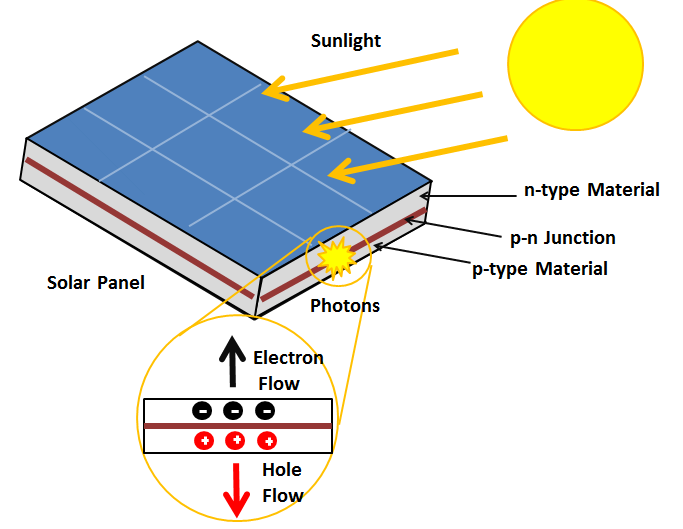
Solar energy can be converted into electrical energy through the use of solar cells (photovoltaic). Solar cells are components that can convert solar light energy into electrical energy using the principle of the Photovoltaic effect.

The working principle of the photovoltaic effect is the emergence of an electric voltage due to the connection or contact of two electrodes connected to a solid or liquid system when obtaining light energy.

Image by University of Calgary – Energy Education (http://energyeducation.ca/wiki/images/1/11/Photovoltaiceffect.png)

Benefits of using Solar Energy :

  1. Solar energy is abundant and free
  2. Environmentally friendly
  3. Long life time period of use around 25 – 30 years
  4. Cheap maintenance costs
  5. Not Noise (Silent)

Disadvantage of using Solar Energy :

  1. Dependency on the weather
  2. Requires large area for installation of solar modules
  3. Big investment for initial installation solar energy

Efficiency of the PLTS (commonly around 80% – 93%) is determined by the degree of irradiation of the sun (the greater the irradiation value, the greater the power it can generate), the environmental (mountain or sea) temperature, dust and type of solar module, controller, inverter, losses of long cables.

So what makes up a PLTS Standalone System/Off-grid system:

  1. Solar Module
    Solar ModuleThe main function of a solar module is to convert solar energy into electrical energy. A Solar module consists of a number of silicon cells which when illuminated by the sun, will produce photons that can generate electrical current. A set of Solar Panels in one system is called an Array. Generally the most widely used solar modules are crystalline type either Monocrystalline or Polycrystalline. While thin film solar modules are still rarely used (in Indonesia). A solar cell can produce a voltage of approximately 0.5 volts. So a 12 volt solar cell consist of about 36 cells.PLTS Off-grid will consist of several solar modules according to their capacity. For example, a 10 kWp PLTS will consist of 50 units of 200 Wp solar modules or 100 units of 100 Wp solar modules. These solar module is arranged in series and parallel with certain configuration.
  1. Combiner Box
    Combiner BoxIn a solar power plant, solar panels can be arrayed in parallel to produce a larger current. Combiner boxes are  used to connect the positive foot of solar panels to one another. Similarly, for negative legs. The positive foot end of the solar panel is connected to the positive charge controller leg and so is the negative leg. The resulting solar panel voltage will be used by the charge controller to charge the battery.
  2. Fuse
    The fuse is a component to protect PLTS / PV network system. In the event of a short circuit or over-current on the circuit or other load, it cuts the flow of electricity.
  3. Charge Controller
    A tool to regulate the current and voltage both to the incoming current and voltage of the PV panel as well as outflow / used load currents. The voltage and current entering the battery should be as intended. When either is larger or smaller than the specified range, then the battery or other equipment will be damaged. In addition, the charge controller also serves as a guard to ensure the resulting output power remains optimal, in order to achieve Maximum Power Point Tracking (MPPT).
  4. Inverter
    Inverter is a converter that will change the DC voltage (48VDC, 24VDC or 12VDC) on the battery into AC voltage (220VAC or 120VAC) at the output will be channeled to the load. Off-grid inverter can adjust the amount of output power based on the amount of load. so it can be used to turn on household electricity such as lamps, fans, television, etc.
  5. Battery
    In a standalone system , the battery serves to store the solar energy generated during the day so that the energy can be used both in the day and night.The voltage on the battery bank PLTS is generally 48VDC, 24VDC or 12VDC. The battery type that is widely used for such applications is usually a Lead-Acid type, either OPzS (wet battery) or OPzV (dry battery). Batteries used in the PLTS system are a deep cycle type  which means the battery can be discharged up to 80% capacity (80% DOD).In addition to Lead Acid, the other battery type that can be used on a PLTS system is the  Lithium battery. As with any battery on our mobile phone, lithium batteries are known as batteries with high energy density which means the same volume of energy that can be stored by lithium batteries larger than other batteries.
  6. AC Breaker
    The AC Breaker is required to limit the power of the inverter so that the power being injected does not exceed the existing load, resulting in a fire.
  7. KWH Meter
    To measure the amount of electrical energy that has been produced by solar panel can be used kwh meter.

If you would like to know more about which of our products are suited for solar applications, leave us your contact and I will be in touch shortly.