
Category Archives: Safety Relay

Annunciator Relays – MR11 / MR21

From |

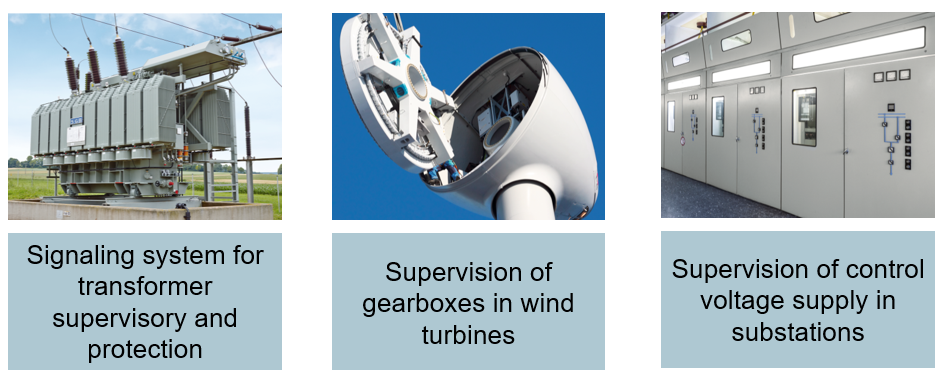
Annunciator relays are used to indicate dangerous states and operating states in control rooms, on control panels, and in mimic diagrams. The annunciator relays from Phoenix Contact feature a convenient display area and ensure reliable operation thanks to their robust construction. They are therefore also suitable for use under harsh ambient conditions.
Semi-automatic annunciator relay
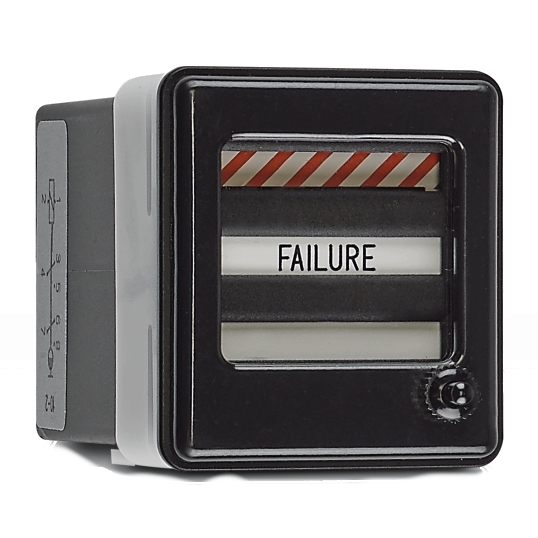
The Mauell MR 11 annunciator relay is a semi-automatic relay. Apart from the coil excitation voltage, no other auxiliary voltage is required for the visual display. This is particularly important in voltage monitoring applications. The indicator flag area is black during normal operation. The white text field appears when the relay has been triggered. The contacts also switch to the operating position. The message is acknowledged by pressing the reset button on the device front. Once the message has been acknowledged, the text field remains visible, and an additional red-white hatched indicator flag is displayed. The contacts return to the normal position. Once the malfunction has been cleared, the indicator flag automatically returns to the normal operation position. In addition to the contact function described, additional contacts can be switched directly. These contacts operate independently of the acknowledgment function. The required switching action – normally open or normally closed – is set at the factory and can be changed later.

Fully automatic annunciator relay
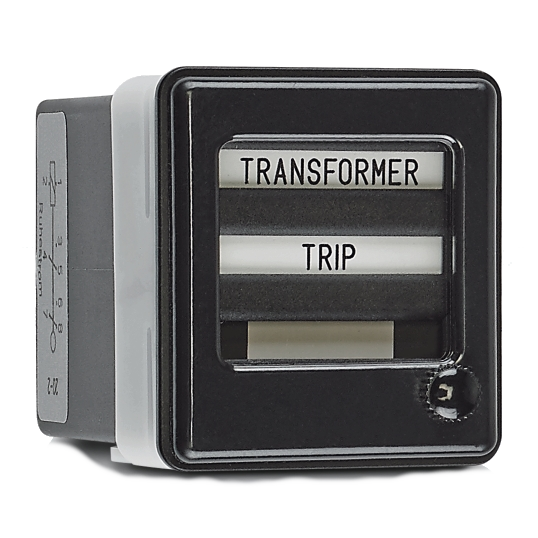
The Mauell MR 21 annunciator relay is also used to indicate dangerous states and operating states. It is fully automatic and there is no manual reset function. Depending on the switching action, the relay switches to the triggered position when energized/de-energized. This switches the contacts and the indicator flag marking appears. Once the malfunction has been cleared, the indicator flag automatically disappears. The contacts also return to the normal position. The required switching action – normally open or normally closed – is set at the factory and cannot be changed later.

Designs

A general distinction is made between the three designs: surface-mounted, flush-mounted and combination:

Surface-mounted

The relay includes a DIN rail fastener (35 mm) with connector plate and clamp.

Flush-mounted

This design is for switch panel mounting with clamping frame. The contact protective cap conforms to BGV A3.

Combination-mount
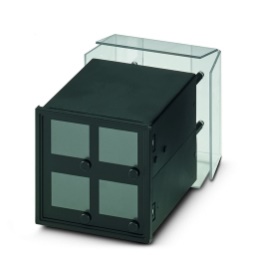
This design is for annunciator relays to be accommodated in one combination housing.
Differences between ESD and F&G Safety Relays

From |

There are 2 main applications of safety relays in the process industry. Phoenix Contact describes them as the Emergency Shutdown (ESD), and Fire & Gas (F&G) applications. Across the industry, there are many terms used to describe these 2 applications. In this article, we will have a look at the different terms and understand the uniqueness of each application.

Application AApplication B
Emergency Shutdown (ESD)Fire & Gas (F&G)
De-energized To Safe (DTS)Energized To Safe (ETS)
De-energize To Trip (DTT)Energize To Trip (ETT)
Normally Energized (NE)Normally De-energized (ND)
Terms to describe the 2 applications

Emergency Shutdown Application

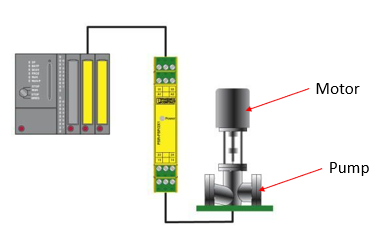
Under normal operating conditions, a load like an electrical motor, must be continuously powered. The ESD safety relay which is used to power up a load must also be continuously powered and is described as Normally Energized (NE).

During a safety incident (e.g. the electrical motor is overheated), the load needs to be switched off to achieve a safe state. As the power status of the safety relay and load has a direct relationship, switching off (de-energizing) an ESD safety relay, will result in the load being switched off as well. Thus, the terms, De-energized To Safe (DTS) and De-energize To Trip (DTT) are used to describe this phenomenon.

Example of ESD relay application drawing

Fire & Gas Application

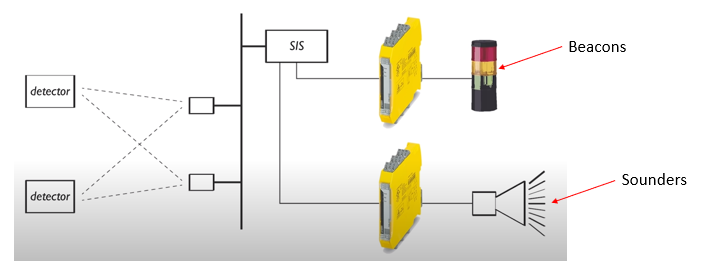
Under normal operating conditions, a load like a sounder and a beacon is not powered. The F&G safety relay is only required to be powered up during a safety incident and to allow the sounders and beacons to sound off the alarm and provide light signals. Under normal operating conditions, the F&G safety relay is Normally De-energized (ND).

During a safety incident (e.g. a gas leak or fire incident), the load needs to be switched on to achieve a safe state. As the power status of the safety relay and load has a direct relationship, switching on (Energizing) an F&G safety relay will result in the load being switched on as well. Thus, the terms, Energized To Safe (ETS) and Energize To Trip (ETT) are used to describe this phenomenon.

Some people might be confused by the term, Energize To Trip (ETT). This is because the word “Trip” is commonly used on circuit breakers, where “Trip” here refers to power down. However, the word “Trip” has a deeper meaning and can be used to describe the powering up and down of a load. A similar word for “Trip” is “Trigger”, and you can think of it as “Energize To Trigger”.

Example of F&G relay application drawing

Summary

The key differences between the ESD and F&G safety relays are the type of load they are connected to, the definition of a safe state and the energy state under normal operating conditions. For ESD, the loads are usually machines used in production; the definition of the safe state is to switch off the relay / load and is normally energized under normal operating conditions. For F&G, the load are usually sounders and beacons, the definition of the safe state is to switch on the relay / load and is normally de-energized under normal operating conditions.

In Phoenix Contact, we provide smart solutions for functional safety, from non-contact safety switches to complex controllers. Our applications range from machine building, the automotive industry, and the process industry. Our products are also SIL certified, which allows you to meet your project requirements easily.

Example of PxC Functional Safety Products