Category Archives: Photovoltaic (PV)

PV Monitoring

From |

PV installations are usually installed at remote areas, requiring maintenance teams to spend vast amounts of time to travel to the site. Furthermore, if the cause of problem could not be identified during the first visit or if the personnel did not bring the right spare parts or tools, another trip would be needed. This can be extremely time consuming, causing loss of productivity.

With Phoenix Contact’s PV monitoring system, this can help to minimise the downtime as we are able to monitor the PV plant in real time and obtain comprehensive data. Examples of equipment and readings that can be monitored are: inverters, energy meters, weather condition and even down to every string of the PV panel. If there is any anomaly, an alarm notification would be send to personnel via SMS or email. This is made possible by incorporating a 3G/4G router which can also allow access to the system from other parts of the world.

Samples of data tables

Another reading which has been requested by many owners of solar plants is historical trends with regards to the efficiency of their plant. To store such a large amount of data at the local controller is not a good idea, furthermore security and performance issues which would possibly affect the local controller could arise.  By having the data pushed to cloud storage, it is possible to send the entire plant’s data into the cloud. From the cloud’s database, the data can then be re-organised into trends for further analysis.  The historical trends are useful for optimising the productivity of the solar energy plant. For example, we could see the amount of energy generated with respect to the weather condition. From these sets of data, we will be able to tell if the PV Panel is generating the expected energy output. Any anomalies in the respective PV Panels can then be identified immediately.  With the implementation of such data, the inefficiency of the solar plant would be minimised.

Samples of trend data

Interested to find out more? Feel free to contact us at marketing@phoenixcontact.com.sg!

Solar String Combiner Box Selection Criteria

From |

“I would like to have a quotation for a solar string combiner box. Please give me the quote ASAP.”

Two of the many possible options

This is the request that we always receive from customers when they want our proposal on solar string combiner boxes (SCB). Unfortunately, we will not be able to offer anything with such a brief statement like this. With that being said, we would like to take this chance to explain to the customers what information is required in order to help us to propose the right SCB for you.

  1. Maximum open-circuit voltage (Voc)
    First, we need to know the maximum open-circuit voltage (Voc) of your solar system design, whether it is 600 / 1000 / 1500V DC. The most common Voc in the market now is 1000V DC and we are also moving towards 1500V DC in Malaysia. This Voc is totally dependent on the system design.
  2. Maximum short-circuit current per string
    So where can we find this info? We are able to know what is our maximum short-circuit current by identifying the short-circuit current of the individual solar module that you have selected, and then multiplying it with the maximum short-circuit current multiplier. Every country has their own specific requirement for the maximum short-circuit multiplier; it can be 1.25 or 1.5 and etc.
  3. Input and Output
    Input here is referring to the number of solar strings going into the SCB and output is referring to the number of MPPT (Maximum Power Point Tracker) involved. You will be able to find the info on the number of MPPT from the inverter that you are using in your system. Once this is confirmed, we will know the configuration you need for your SCB.
  4. Fuse holder Polarity
    We need to also find out from the customer whether they would like to have fuse holder at positive polarity only or at both positive and negative polarity. From protection point of view, we encourage our customers to have fuse holder at both positive and negative polarity because this will give higher protection to the SCB on the incoming side. However, it is still fine to have fuse holder at only positive polarity to fulfil the local standard requirement.
  5. String termination at SCB
    Sunclix Connector

    Sunclix Connector

    Phoenix Contact SCB always comes with Sunclix plug-in connectors instead of normal cable glands. This is because our Sunclix connectors make string cable installations fast and efficient. No additional tools are required to connect our Sunclix connectors. Our SCB are customizable, if the customers are more comfortable with cable glands, we can always revert back to using them.

  6. Monitoring features
    Our SCB is able to monitor both voltage and string current if these are required using our Solarcheck modules, which uses Hall’s effect.

Other than the above, our SCB comes with many other great features that will help you in your solar PV system. If you are interested in our solar string combiner boxes, please feel free to contact us at marketing@phoenixcontact.com.sg!

Solar Power Energy – Standalone System (PLTS)

From |

A solar power plant, also known as Pembangkit Listrik Tenaga Surya (PLTS) in Indonesian, is a power generation system that uses solar cells (photovoltaic, PV) to convert sunlight into electrical energy.

Indonesia has vast landmass, a lot of which are remote areas. Thus, it is not possible for all to be connected to the grid (PLN = Perusahaan Listrik Negara = State Electricity Enterprise). However, with abundant sunshine all year round, Indonesia has the ideal setting with a high potential for solar power.

Currently, there are hundreds of small islands in Indonesia that have been installed with a Centralized PLTS. For islands or remote areas that receive general government assistance, the standalone PLTS have an output capacity of 5, 10, 15 and 30 kWp.

Solar Power Energy – Standalone PLTS

Example of a 2KW standalone solar power system

Image by Free Sun Power (http://freesunpower.com)

Called a standalone System or Off-Grid System because the system relies solely on solar energy as the main energy source. It utilizes a solar module circuit to generate electrical energy in accordance with the needs that have been planned.

Solar energy can be converted into electrical energy through the use of solar cells (photovoltaic). Solar cells are components that can convert solar light energy into electrical energy using the principle of the Photovoltaic effect.

The working principle of the photovoltaic effect is the emergence of an electric voltage due to the connection or contact of two electrodes connected to a solid or liquid system when obtaining light energy.
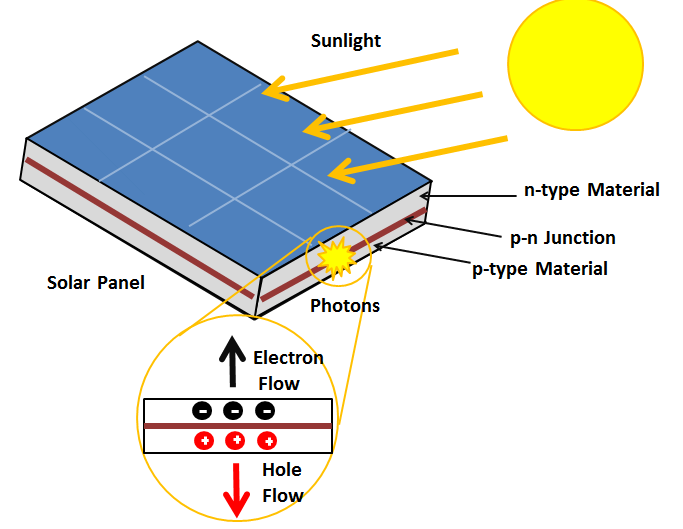
Image by University of Calgary – Energy Education (http://energyeducation.ca/wiki/images/1/11/Photovoltaiceffect.png)

Benefits of using Solar Energy :

  1. Solar energy is abundant and free
  2. Environmentally friendly
  3. Long life time period of use around 25 – 30 years
  4. Cheap maintenance costs
  5. Not Noise (Silent)

Disadvantage of using Solar Energy :

  1. Dependency on the weather
  2. Requires large area for installation of solar modules
  3. Big investment for initial installation solar energy

Efficiency of the PLTS (commonly around 80% – 93%) is determined by the degree of irradiation of the sun (the greater the irradiation value, the greater the power it can generate), the environmental (mountain or sea) temperature, dust and type of solar module, controller, inverter, losses of long cables.

So what makes up a PLTS Standalone System/Off-grid system:

  1. Solar Module
    Solar ModuleThe main function of a solar module is to convert solar energy into electrical energy. A Solar module consists of a number of silicon cells which when illuminated by the sun, will produce photons that can generate electrical current. A set of Solar Panels in one system is called an Array. Generally the most widely used solar modules are crystalline type either Monocrystalline or Polycrystalline. While thin film solar modules are still rarely used (in Indonesia). A solar cell can produce a voltage of approximately 0.5 volts. So a 12 volt solar cell consist of about 36 cells.PLTS Off-grid will consist of several solar modules according to their capacity. For example, a 10 kWp PLTS will consist of 50 units of 200 Wp solar modules or 100 units of 100 Wp solar modules. These solar module is arranged in series and parallel with certain configuration.
  1. Combiner Box
    Combiner BoxIn a solar power plant, solar panels can be arrayed in parallel to produce a larger current. Combiner boxes are  used to connect the positive foot of solar panels to one another. Similarly, for negative legs. The positive foot end of the solar panel is connected to the positive charge controller leg and so is the negative leg. The resulting solar panel voltage will be used by the charge controller to charge the battery.
  2. Fuse
    The fuse is a component to protect PLTS / PV network system. In the event of a short circuit or over-current on the circuit or other load, it cuts the flow of electricity.
  3. Charge Controller
    A tool to regulate the current and voltage both to the incoming current and voltage of the PV panel as well as outflow / used load currents. The voltage and current entering the battery should be as intended. When either is larger or smaller than the specified range, then the battery or other equipment will be damaged. In addition, the charge controller also serves as a guard to ensure the resulting output power remains optimal, in order to achieve Maximum Power Point Tracking (MPPT).
  4. Inverter
    Inverter is a converter that will change the DC voltage (48VDC, 24VDC or 12VDC) on the battery into AC voltage (220VAC or 120VAC) at the output will be channeled to the load. Off-grid inverter can adjust the amount of output power based on the amount of load. so it can be used to turn on household electricity such as lamps, fans, television, etc.
  5. Battery
    In a standalone system , the battery serves to store the solar energy generated during the day so that the energy can be used both in the day and night.The voltage on the battery bank PLTS is generally 48VDC, 24VDC or 12VDC. The battery type that is widely used for such applications is usually a Lead-Acid type, either OPzS (wet battery) or OPzV (dry battery). Batteries used in the PLTS system are a deep cycle type  which means the battery can be discharged up to 80% capacity (80% DOD).In addition to Lead Acid, the other battery type that can be used on a PLTS system is the  Lithium battery. As with any battery on our mobile phone, lithium batteries are known as batteries with high energy density which means the same volume of energy that can be stored by lithium batteries larger than other batteries.
  6. AC Breaker
    The AC Breaker is required to limit the power of the inverter so that the power being injected does not exceed the existing load, resulting in a fire.
  7. KWH Meter
    To measure the amount of electrical energy that has been produced by solar panel can be used kwh meter.

If you would like to know more about which of our products are suited for solar applications, leave us your contact and I will be in touch shortly.


Electrical Safety Starts from the Connector

From |

High Voltage WarningDo you know one common challenge for devices used in areas such as filter and inductor construction, energy distribution and power supply production is Electrical Safety i.e. how to lead the high power through the panel wall safety.

Finding the right wall feed-through terminal block to address electrical safety is a challenge as there are not many suitable solutions for high current and large wire cross-section. It is also unlikely that the manufacturers  will choose the feed-through terminal blocks as early as the design stage. This often leads to manufacturers designing their customized solutions out of sheer necessity; thus resulting in problems such as maintaining touch protection or insulating the current bar from the device housing.

The device manufacturers may also face problem obtaining the necessary certification for their devices. If the device is to be used worldwide, IEC 61800-5-1 and UL 1059 certifications are required. Many solutions in the market are unfortunately not adequately certified.

High Current Feed-through Terminal Blocks

Phoenix Contact offers an extensive range of high-current feed-through terminal blocks for various applications. You can find both pluggable feed-through terminal blocks and feed-through terminal blocks for permanent connections. The pluggable feed-through terminal blocks permit quick replacement and are thus service-friendly. In addition, the conductors can be preassembled. However, feed-through terminal blocks for permanent connections are more economical.

https://www.youtube.com/watch?v=jCv-bhu7Hzg

Do you know Phoenix Contact has been providing these feed-through terminal blocks for almost three decades?

https://www.youtube.com/watch?v=hQro-OA3pNE

Device manufacturers can choose the connection option to fit the application: fast push-in connectors, T-lox, conventional screw connectors, or simple bolt connectors. The connection areas range from 4 to 150 mm2 and the current-carrying capacity is up to 309 A.

These connectors come in standard and moulded designs, either with horizontal or vertical connection directions. The moulded version ensures high leakage resistance, even when a small amount of moulding compound is used. The product range provides various connection options for space-saving connections in all installation locations. This means that device manufacturers can flexibly select the connection type, direction, and cross section.

Interested to find out more? Get in touch with us at marketing@phoenixcontact.com.sg!

Remote Monitoring via the Mobile Network

From |

Mobile Network Architecture

We are all available 24 hours a day. We have at least one cell phone, use the Internet on the go every day, and learn about the latest global news through our communication media. Having information at one’s fingertips is now essential to us all and nobody wants to give it up.

Think about the global competition in industrial production, which calls for us to continuously optimize our systems. As a production manager, you need to know at all times what is being produced worldwide on each machine, at what quality level and when the next maintenance interval is due. Such new systems are hardly imaginable today without efficient communication networks, which are essential for reliable system operation. This rapid development in the exchange of information and data that we have experienced in the telecommunications industry in the last few years is about to break into the industrial sector.

Indeed, many of these M2M (machine to machine) applications will be implemented over telecommunications networks. Now is the perfect time to consider these topics, applications, and technologies in the industrial sector.

Therefore I would like to share with you one of our success story implementing remote monitoring over the mobile phone network. The idea is to monitor remotely several paramaters on the oil well that is scattered in locations remotely using the GSM modem.

By doing this customer can get data more effective and efficiently compare to previously that one must go to every site locations and get information on the pressure and temperature at the oil well.

Solar-powered RTU

In this project we even integrate a solar system to power up the RTU and GSM modem since the location is remote and there is no power available. System architecture can be seen in the picture below:

RTU and Solar Power

Our GSM modem has a feature with dual sim cards which means when it detects low signal reception from one provider it can automatically transfer the communication to the other sim card. This is to maintain data availability.

We also set up a VPN tunneling in order to get a secure data transmission.

With this configuration, now customer is able to monitor oil wells data from office directly. They just need to select which location they want to monitor.

If you would like to know more on the remote communication using GSM modem, please do not hesitate to contact us. Thank you.

Solar Technology 1500VDC

From |

Today, solar technology in the Philippines still revolves around 1000VDC, which is more or less 5 years old already.

However, due to increasing number of foreign investors in Solar projects in the country, this has resulted in a growing demand for the latest developments in Solar technology . With this we had received numerous request from System Integrators, local end users, and electrical contractors for 1500VDC technology.

1500 VDC systems will allows installers to reduce installation time, string size, wire costs etc.

Being a provider for solutions and products in the solar energy area for many years, Phoenix Contact has been keeping abreast on this demand.

The 1500VDC string combiner boxes from Phoenix Contact meet these requirements of collecting and distributing string currents, protecting the individual modules against damage from lightning and surge voltages, and monitoring the performance of the system.

Solar Seminar 2017

Solar Seminar Philippines

We decided to conduct a Solar Seminar featuring Phoenix Contact’s new 1500VDC technology to address this demand. Held recently at Luxent Hotel in Quezon City, Philippines, our speaker highlighted and focused on 1500VDC Technology and its derivative products like our String Combiner box.

Solar Seminar Main Group Photo

Solar Seminar Phillipines Group Photo 1

Solar Seminar Philippines Group Photo 2

If you missed out on our seminar and would like to be informed of future seminars or would like to find out more about Phoenix Contact’s 1500VDC Technology, do leave us your contact at marketing@phoenixcontact.com.sg and we will get in touch with you soon.

Electric Power and Renewable Energy 2016 Myanmar

From |
Exhibition Image

Electric Power and Renewable Energy 2016 Myanmar

We will be participating at the 4th International Electric Power and Renewable Energy 2016 Myanmar Exhibition from the 13th – 15th of October at the Myanmar Event Park (MEP) in Yangon.

Come down and join us to find out more about what we can do for you in the area of Power generation and transmission and solar. We are located at G16, Singapore Pavilion.

Click here to register at the event’s website.

Photovoltaic Monitoring System With Visualisation – A Project with ITE College East

From |

Photovoltaic (PV) Monitoring System With Visualisation

The Photovoltaic (PV) monitoring system was designed to monitor the performance of the PV panels’ output versus the temperature on the PV panel. There were two different types of PV panels used for monitoring, namely the mono-crystalline and amorphous silicone (Thin Film). The data that was collected were the DC output and the temperature on the PV panels.

Continue reading