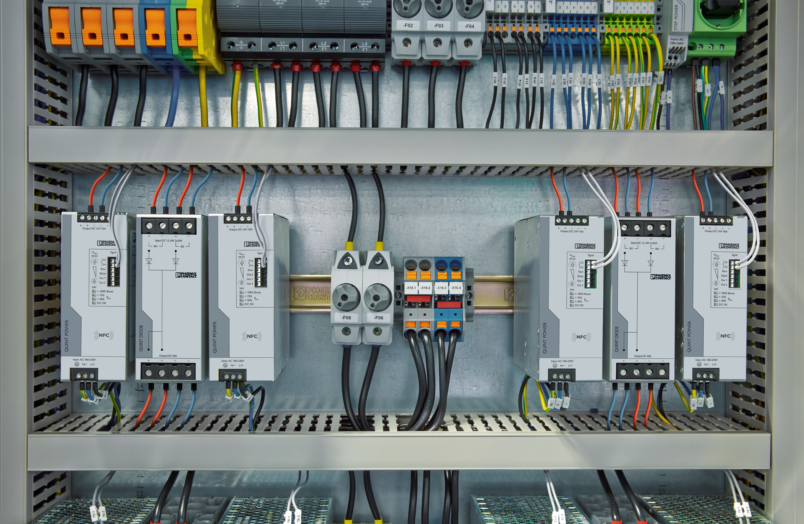
In the course of my work, I deal with Power Supply which is the heart of the whole electrical operation. While not all operations are the same, they cannot function without electricity, which is what makes Power Supply units indispensable.
The new Phoenix Contact’s Quint 4th Generation Power Supplies feature an integrated NFC interface for parameterization via mobile devices or PCs. This allows the commissioning engineer to closely match signaling thresholds and characteristic curves to the plant’s requirements. More than 40 parameters can be configured on an individual basis. Once the power supply has been parameterized, it is a simple task to transfer the settings to other devices via the app or other software, which will save effort and time for the user. Moreover, the front-panel buttons for adjusting the output voltage, as well as all other configured parameters, can be protected with a password to prevent unauthorized access and tampering.
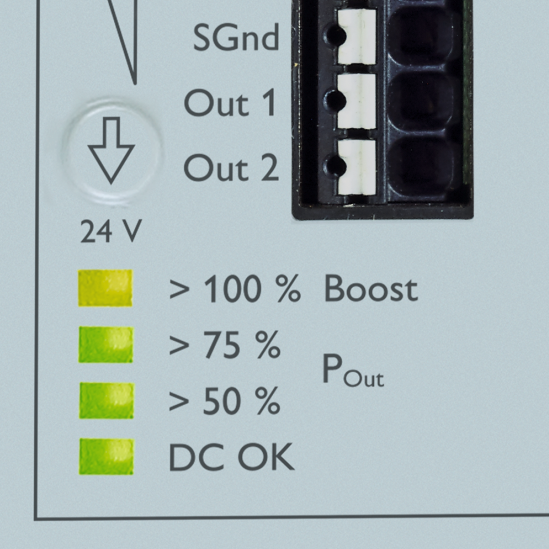
The power supply offers preventive function monitoring to allow the plant operator to run remote diagnostics on the unit to optimize plant availability. The power supply permanently monitors the output voltage and current. Critical situations are visualized using front-panel LEDs, floating relay contacts, and active signal outputs; the monitoring data is signaled to the control system before a fault actually occurs.
When the power supply unit is supplying more than the specified rated current, it is operating in boost mode. The power supply and the connected loads continue to operate normally, and the output voltage remains at 24 V DC. Preventive signaling allows early detection before a fault like this actually occurs. For instance, once a motor with a mechanical problem has been identified, it can be repaired before other loads are subjected to voltage dips.
Such preventive capabilities of our power supply units work just like how we manage our heart health to ensure we can function smoothly in our everyday operations. It is thus pivotal to ensure that we have a reliable and intelligent “heart” in the form of our trusted power supply units for our businesses.
Cybersecurity has become an increasingly prevalent subject in the last decades. While the focus has been largely on IT infrastructure and online safety, more attention has now been placed on Cybersecurity for industrial processes such as factory automation, water/wastewater plants, power generation and power T&D. This can be attributed to the increased awareness that cybersecurity required for IT is very different from cybersecurity efforts needed for industrial processes.
The main difference is the priority for these two information infrastructure. In IT, it is possible to focus heavily on cybersecurity, such that emails, applications, documents can be blocked with minimal impact on a companies’ P&L. On the other hand, downtime can result if files are stopped from being passed from one device to the other for Industrial processes. Downtime for Industrial processes is very costly as one can observe below.
The are explicit costs due to downtime. In the case of concerted attack on Nuclear Power Plans (stuxnet incident) or Power T&D systems (recent Ukraine cyberattack, causing mass blackout affecting at least 200,000 citizens), prolong system downtime can lead to life being lost, severe inconveniences amongst other non-monetary, immeasurable outcomes.
With such different requirements, it is then common sense that plant owners should look beyond IT cybersecurity devices for protection of industrial processes. While firewalls, VPNs, VLans, subnet etc. works for both IT and Industrial processes; IDS/IPS (Intrusion detection system/Intrusion protection system) is not ideal for Industrial processes because they are actively monitoring the data passing through. This not only slows down data transfer and cause delays (again, not damaging in IT network) but often results in false alarms: There can be unusual data passing through which might not be malicious but are essential to operations. IPS/IDS will stop these data and can potentially lead to down time.
In particular, IPS/IDS are used to protect against zero-day attacks/advanced persistent threats where an external party remains in contact with malicious code after they infiltrate systems. These external parties then manipulate these codes further to target specific loopholes. As such, anti-virus cannot detect these codes (no known signature) and firewalls/VPNs are bypassed.
At Phoenix Contact, we recommend MGuard with CIFS Integrity Monitoring that is tailored for Industrial Processes Protection against Zero-day attacks and advanced persistent threats:
Discover Malware on Day Zero: Integrity Monitoring
Due to the general problems with the deployment of antivirus software on industrial PCs and the timely provision of malware signatures, alternative techniques of integrity assurance are gaining relevance for the protection of industrial systems.
One solution is the CIFS Integrity Monitoring feature offered on Phoenix Contact’s FL mGuard security devices. CIFS, or Common Internet File System, is a file-sharing protocol used by Windows and other operating systems. Viewing files on network file servers and using shared network drives are common activities that utilize CIFS. With Integrity Monitoring, the user can monitor configurable sets of files for unexpected modifications of executable code. When initialized, Integrity Monitoring computes a baseline of signatures for all monitored objects and then periodically checks them for any deviations. This process works without any external supply of virus signatures, without the risk of disrupting operations through “false positives,” without installation of software, and with only a moderate load on the monitored PCs, while primarily utilizing the resources of an mGuard security appliance. The mGuard thus discovers suspect file modifications promptly, and reports them via SNMP and e-mail to network
management systems or responsible administrators.
In a test study performed at the University of Ostwestfalen-Lippe in Lemgo, Germany, researchers from the independent inIT institute for industrial IT (www.hs-owl.de/init/en/) have been able to verify that mGuard CIFS Integrity Monitoring would have recognized infections with Stuxnet on day zero as unexpected manipulations and warned asset operators against it long before any antivirus product. The device drivers installed by Stuxnet, as well as the modifications performed by the worm on the pivotal SIMATIC Manager DLL,
would have been discovered in the process.
Some other features that makes mGuard ideal:
Stealth mode – fast retrofitting without the need to configure/reconfigure IP addresses
OPC Inspectors – ability to track random ports opened by OPC Classic, which render firewall useless
3G remote access
If there are deviations detected with CIFS integrity monitoring, SMS alarm can be sent to system engineers.
Although regular CIFS scan can be scheduled, in the event of known cyberattacks, engineers can simply SMS into mGuard to start an adhoc scan
With 3G, mGuard or devices connected to mGuard can be remotely accessed from anywhere around the world
To find out more about how mGuard can help to secure your industrial systems:
Click here to download a white paper on Post-stuxnet Industrial Security
or contact us at marketing@phoenixcontact.com.sg for a demo on MGuard configuration.
Wireless technology has improved by leaps and bounds over the last decade. Intermittent, unstable and slow wireless connections are gradually becoming a thing of the past. At the same time, wireless technology brings about tremendous convenience to everyone, reducing clutter caused by messy wires and making hard to reach places reachable. Continue reading →
The new Valvetrab-SEC from Phoenix Contact, the world’s narrowest type-2 surge protective device, offers impressive features such as durability and high performance, thanks to the use of Safe Energy Control (SEC) technology.
The powerful disconnect device and the high short-circuit current rating of up to 50 kA offer protection for each small distribution panel at just 12 mm per channel. The type-2 protective device provides safe protection against severe voltage fluctuations and high stresses caused by lightning currents. Downstream components experience less stress, thanks to the low voltage protection level.
An additional advantage is that main system fuse can be used for up to 315 A without additional backup fuses. This saves space and money in the control cabinet. The basic element and the plug can be rotated by 180° to one another. This enables a connection with shorter cable lengths with the label remaining legible. All type-2 protective device product versions are pluggable and can be tested with the test device for the Checkmaster 2 surge protective devices
In keeping with the Uno Power power supply range, the UnoUPS uninterruptible power supply is now available with a 60 W output power and integrated power storage in a compact housing.
The UPS operates flexibly at input voltages of 23 to 30 V DC. The integrated lead AGM power storage ensures long buffer times of 45 minutes at 0.5 A, for example. When combined with a Uno Power power supply from the 100 W performance class, the overall dimensions are just 160 x 90 x 90 mm. This means that this space-saving APS is also suitable for small control and distributor boxes.
The high MTBF (mean time between failure) value of over 1.9 million hours and the large temperature range of -15 to +50°C are superb features for a device of this performance class. The device also has LED status indicators for signaling and function monitoring, as well as active 24 V DC switch outputs for forwarding to a higher-level control system.
Energy-efficient data logger for telecontrol and remote maintenance solutions
Its energy-saving technology makes the new PSK RTU 50 stand-alone data logger from Phoenix Contact especially suited to stand-alone telecontrol and remote maintenance solutions associated with decentralized automation.
The module simplifies data logging with its many interfaces and supported protocols and requires no additional power supply. It combines an SMS/GSM/GPRS modem and interfaces in a compact device and provides an opportunity for saving space when used with small control cabinets.
The device can function as a data logger, gateway, and alarm manager and supports the IEC 60870-5-101 and IEC 60870-5-104 protocols and Modbus. User-friendly software makes the data logger quick and easy to parameterize. The especially energy-saving technology ensures low-maintenance, long-term employment with standard batteries.
The Flashtrab-SEC-T1+T2 protective device combination consists of line-follow-current-free type 1 lightning arresters on the basis of a spark gap and varistor-based type 2 surge protective devices. This combination, in just one device, is the only one on the market worldwide.
Thanks to Safe Energy Control technology (SEC), the products are durable and powerful. The load of the entire installation is reduced to a minimum in the event of lightning. The lightning arrester combination provides specific protection for installation environments with frequent switching operations. High lightning currents are safely controlled from the spark gap free of line follow current and temporary surge voltages are reliably limited by the varistors. The resulting low voltage protection level and fuse-free use in 230/400 V power supply systems are further advantages of this product range.
The compact arrester reduces the effort required for installation and maintenance. All products are pluggable and can be tested with the test device for the Checkmaster 2 surge protective devices.
The Flashtrab SEC-PLUS type-1 lightning current arresters from Phoenix Contact, which are particularly durable and powerful thanks to Safe Energy Control Technology, have just been complemented by two product variants:
The Flashtrab SEC-PLUS 440 product variant is particularly suited to special industrial applications with 440/690-V networks or 400-V power supply systems. The products impress with their strong shock and vibration resistance. This compact variant can be used up to 400 A without an additional backup fuse.
The Flashtrab SEC-PLUS 350 variant is used in the pre-metering area of the main feed, or in industrial applications. High voltage fluctuations and lightning current loads are no problem for the type-1 arrester. The good protection level and backup fuse-free use up to 315 A deliver additional advantages.
Both variants are pluggable and can be tested with the CheckMaster 2 test instrument for surge protection devices. Like any other SEC family type-1 arrester, the Flashtrab SEC-PLUS devices are also type-2 arrester tested and certified.
Thanks to low noise emission in compliance with EMC Class B and its mechanical robustness, the Axioline F I/O system from Phoenix Contact fulfils the stringent requirements for automation in shipbuilding. As a result, the I/O system has now obtained the approval of all major maritime safety testing associations, including, in particular, the attainment of the BSH certificate and passing the compass test. This certificate allows an I/O station to be installed only a few centimeters away from sensitive standard solenoid compass units.
The new XC variants of the I/O system also offer an extended operating temperature range from -40 to +70 °C as well as varnished PCBs. They are therefore ideally suited for use in harsh engine room environments.
The new class 1000 Ethernet media converters from Phoenix Contact are designed for industrial applications with basic requirements. They offer a simple and cost-effective entry into optical transmission technology.
Data transmission via fiber optics optimizes Ethernet applications in terms of performance and transmission reliability. In addition to a higher range, the benefits of electrical isolation are also reaped. The compact units in robust metal housings bridge distances of up to 9.6 kilometers. Multi-mode glass-fibers are used, optionally with SC duplex or B-FOC (ST) plugs.
Start-up is simplified by auto negotiation and auto crossing. In addition, data rates of 10 and 100 Mbps can be firmly set. Besides numerous diagnostics LEDs, the media converters are equipped with LFP function (Link Fault Pass-through). This ensures permanent and continuous monitoring of the connection. In the event of a connection loss, redundancy mechanisms can take over operation immediately.


 A reliable, intelligent and powerful “heart”
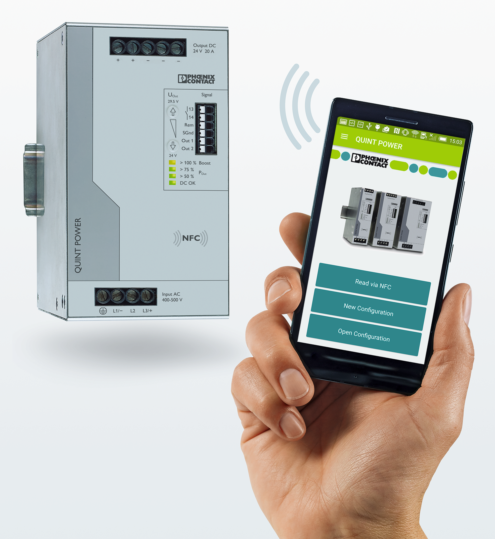 The new Phoenix Contact’s Quint 4th Generation Power Supplies feature an integrated NFC interface for parameterization via mobile devices or PCs. This allows the commissioning engineer to closely match signaling thresholds and characteristic curves to the plant’s requirements. More than 40 parameters can be configured on an individual basis. Once the power supply has been parameterized, it is a simple task to transfer the settings to other devices via the app or other software, which will save effort and time for the user. Moreover, the front-panel buttons for adjusting the output voltage, as well as all other configured parameters, can be protected with a password to prevent unauthorized access and tampering.