
Monthly Archives: August 2026

SPP Surge Protection System: End-to-End Protection for High Availability

From |

Lightning strikes and switching operations in the power grid can create surge voltages capable of disabling sensitive electronic systems. Routers, heat pumps, controllers, servers, photovoltaic inverters, and even complete production facilities may be affected. Although damaged hardware can be replaced, production downtime and data loss often create greater disruption and expense. The SPP surge protection system from Phoenix Contact provides a coordinated approach to protecting critical electrical and electronic infrastructure from lightning strikes and surge voltages. As modern buildings, industrial facilities, and photovoltaic systems become increasingly dependent on sensitive electronics, a single surge event can result in equipment damage, costly downtime, and data loss. The SPP family is designed to help ensure high system availability through end-to-end protection.

Two Coordinated Product Lines

The SPP family consists of two complementary product lines. FLT-SPP provides type 1+2+3 combined lightning current and surge protection, while VAL-SPP covers type 2 AC applications and type 1 or type 2 protection for photovoltaic systems. Their consistent design and safety concept simplify planning and help coordinate protection from the main distribution system through to sub-distribution.

SPP surge protection system with FLT-SPP and VAL-SPP devices
Continue reading

Energy Monitoring: Identifying Potential Energy Savings

From |

The energy sector is undergoing a profound transformation. Increasing demands on sustainability, security of supply, and efficiency make smart solutions indispensable. Modern products and services for the energy management of the future combine technological innovations with a clear goal: using energy more intelligently, conserving resources, and improving cost-effectiveness. An energy management system must also be easy to implement. Coordinated sensor and measurement technology reduce the effort involved in energy data acquisition, while communication solutions and digital services help integrate, manage, and process measurement data. Companies are increasingly turning to intelligent hardware that provides transparency regarding energy flows and actively manages them.

Energy monitoring solution showing connected measuring devices, communication networks, software, and cloud-based energy management.
Smart products, measurement technology, and digital services work together to provide transparency regarding energy flows and support intelligent energy management.

Measurement Technology as the Basis of Energy Management

In industrial and building structures, energy measurement technology forms the foundation for efficiency, cost transparency, sustainability, and electrical safety. In industry and production, measuring systems enable transparent monitoring of system operation, load management, predictive maintenance, and high system availability. Data centers use measurement technology to optimize power usage effectiveness (PUE) and improve failsafe performance through residual current monitoring.

Smart buildings rely on real-time data to network heating, ventilation, and lighting systems while supporting ISO 50001 energy management requirements. Measurement technology is also essential for charging infrastructure and renewable energy applications, where accurate measurements ensure both reliable billing and stable grid operation. Without measurement data, achieving decarbonization targets and identifying potential energy savings would not be possible.

Energy monitoring topology connecting measuring devices, communication interfaces, monitoring software, and cloud services.
Figure 1: Topological representation of an energy monitoring solution.

Continue reading

Improving Control Cabinet Building Efficiency with Smart Factory Planning

From |
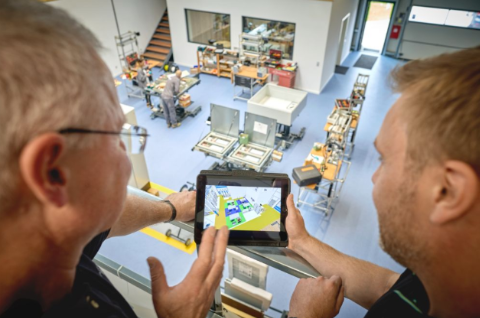
3D layout supporting control cabinet building efficiency
A 3D production layout forms the basis for structured, future-proof factory planning.

Control cabinet building efficiency has become a key priority for manufacturers. Rising demand, shorter delivery times, and increasing complexity put pressure on production teams. As a result, companies need production environments that are both flexible and efficient.

To address this challenge, Phoenix Contact and PGA partnered to modernize control cabinet manufacturing. Their project focused on two areas: factory planning and workstation design. Together, these improvements increased quality, reduced production times, and enhanced ergonomics.

Continue reading