

Reduced effort and higher availability with NearFi technology
Physical connections in moving factory applications are now obsolete no more downtime from worn contacts. Goods distribution systems, robots, and AGVs communicate wirelessly and efficiently. This isn’t the future; it’s happening now with Phoenix Contact’s NearFi technology.

Driven by Germany’s automotive industry, the vision of modular, scalable factories is spreading to sectors like plastics, electronics, and food. These flexible setups require frequent machine relocation, but existing data transmission solutions have been unreliable, error-prone, or costly to maintain.

Contactless power and data exchange across an air gap offers a wear-free, maintenance-free alternative even through glass or non-conductive materials. Phoenix Contact’s NearFi technology enables real-time transmission across centimeter-wide gaps, making it ideal for dynamic production environments.
Close to latency-free transmission of real-time Ethernet protocols
NearFi couplers offer a major leap in real-time transmission with protocol-independent Ethernet communication. Acting as physical media converters, they bypass standard protocols and avoid latency issues common in packet-based methods like WLAN or 5G. Instead, NearFi uses bit-oriented transmission over dual 60 GHz links, uplink and downlink on separate bands, enabling full duplex Ethernet communication with ultra-low latency (<1 μs).
The rise in WLAN systems for machine and AGV communication is crowding frequency bands, requiring complex planning and risking interference and downtime. NearFi avoids this by operating in the near-field range over just a few centimeters, eliminating local interference and allowing multiple systems to run in parallel. It coexists seamlessly with WLAN, Bluetooth, and even withstands industrial noise like arc welding. Data exchange needs only a base and remote coupler, with automatic pairing and a visible LED ring confirming connection no setup.
Reliable forwarding of safety data
Automated processes succeed only when intelligently connected. This means integrating automated transport systems into production workflows, enabling materials to move between stations without human input. AGVs must communicate with machines to transfer items—such as via workpiece carriers—seamlessly across the system.
When AGVs dock with machines, they become part of the system and must exchange safety-critical data. For instance, an emergency stop on either side must trigger a safe state in both. Safety and non-safety data are transmitted via Ethernet-based protocols like Profinet/Profisafe or Ethercat/FSOE. AGVs typically host a Profinet/Profisafe device to receive enable signals from the machine. Any interruption in this safety communication halts both systems, reducing plant availability and causing economic losses. Current solutions rely on WLAN technology.
Various advantages compared to WLAN communication
In production halls, WLAN networks are often congested by other applications like forklift systems. Disruptions such as smartphone hotspots can affect AGV docking and data exchange with machines. WLAN’s half-duplex limits cause delays, requiring Profinet cycle times to increase from 4 ms to 32 ms, which extends safety watchdog times. For safety protocol transmission, WLAN must be state-of-the-art and meet IT security standards.
NearFi enables full-duplex Ethernet-like communication at 100 Mbps with just 4 ms Profinet cycle time, keeping safety watchdogs short. Data transmits reliably across a 100 mm air gap, unaffected by WLAN interference, ensuring high availability. Its precise coupling prevents accidental connections to nearby machines, eliminating the need for complex network planning or special IT security. NearFi also supports data exchange between interlinked vehicles.

The couplers do not need to be precisely centered
Workpiece carriers are key components in automation technology applications, designed to hold and transport workpieces through various production stations, including assembly, processing, and testing.
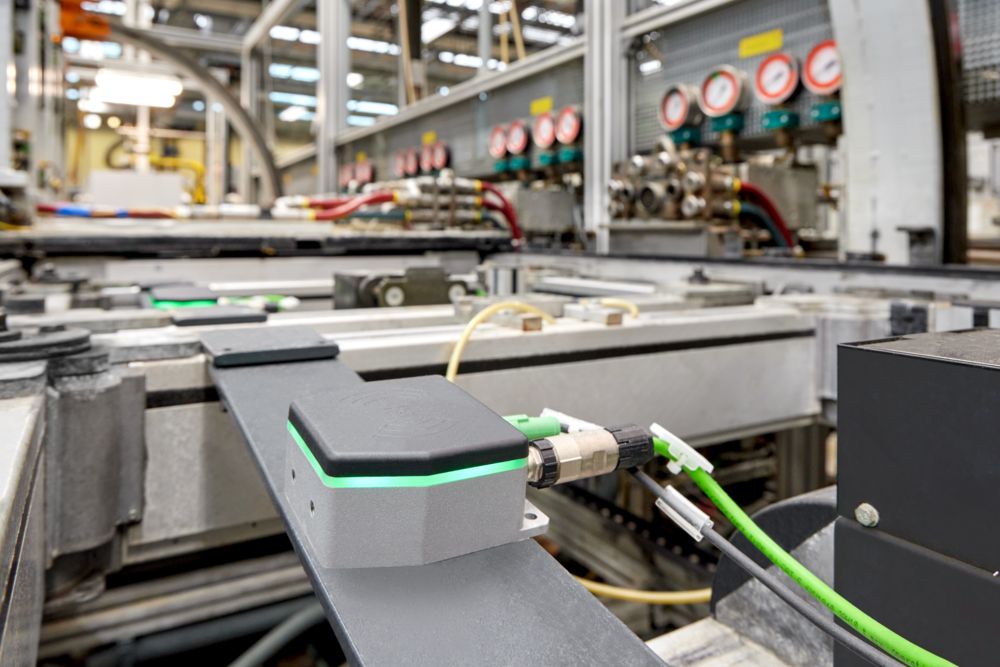
Their design adapts to the product and facility, enabling direct handling by robots or operators. Equipped with sensors, actuators, and hydraulics, they connect to I/O modules or valve terminals, transmitting data to controllers via Ethernet-based protocols.
Flexible automation technology improves cycle times and lowers production costs, but increased movement causes wear, especially in Ethernet connectors between moving parts, leading to unpredictable downtime.
Unlike traditional connectors, NearFi base and remote couplers can align from any direction, rotate, or connect with offset angles, reducing mechanical precision requirements. Conventional connectors demand exact alignment, risking damage to sensitive pins.

Distributed solution with passive safety
NearFi couplers power I/O modules connected to sensors and actuators for workpiece clamping, while transmitting Ethernet protocols wirelessly with zero latency or wear. When actuators are present, a safety concept is often required.
Passive safety is a distributed concept that safely switches off actuator group voltage during critical events, unlike classic systems with separate safe outputs per actuator. It’s more cost-effective and requires isolating sensor (US) and actuator (UA) voltages.

Using two parallel NearFi coupler paths, electrically isolated 50 W US/UA voltages can be transmitted, enabling a safe signal path. Actuators are shut off by upstream safety relays, regardless of their state. NearFi couplers reduce service calls and eliminate maintenance costs, boosting system availability and shortening device amortization through lower expenses and optimized processes.
Learn more about industrial wireless and NearFi technology.
