

Sustainable and energy-efficient operation
The Köterhof building in Oldenburg, Germany, operated by CapitalReal GmbH & Co. KG, demonstrates that even a five-year-old extension can be energy-optimized with building-specific expertise, inclusive collaboration, an innovative controller, and a clear visualization system.
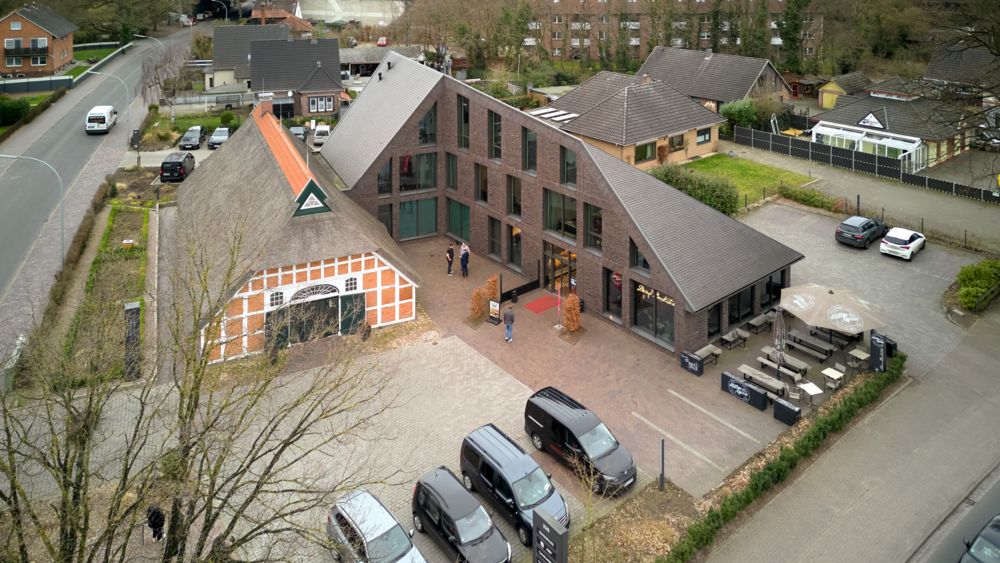
Every city has its landmarks—Paris with the Eiffel Tower, New York with the Statue of Liberty. In Oldenburg’s Ohmstede district, it’s the Köterhof building, a listed structure from 1807. Originally built as an agricultural residence with stables, it changed functions over time, eventually serving as a service station and used-car showroom before standing vacant. Recognizing its prime location and potential, Oldenburg businessman Dennis Poelmeyer—owner of CapitalReal GmbH & Co. KG, a firm specializing in real estate projects across Oldenburg and the Weser-Ems region—acquired and extensively renovated the building. Today, the restored half-timbered house hosts a high-end restaurant and wine shop. In 2020, the team added a modern extension, creating a harmonious blend of old and new.
Heating and cooling cannot be optimally adjusted

CapitalReal’s offices in the extension provide a pleasant atmosphere, with floor-to-ceiling windows that turn frosted in sunlight. Modern, functional rooms feature rotating art exhibitions. Initially, heating and cooling fell short—employees couldn’t set individual temperatures, and bulky control panels clashed with the upscale interior.
With this in mind, Dennis Poelmeyer sought a new installation company and found the ideal partner in EPM GmbH from Lindern, Germany. Founded in 1978, EPM specializes in electrical installations, control cabinet building, automation technology, and engineering, with a strong focus on efficient building automation. For the Köterhof retrofit, EPM collaborated with their long-time partner Phoenix Contact, known for its extensive building-sector products and services.
Laying new cables was not an option
Work on the Köterhof extension began in spring 2024, with EPM tasked to modernize and automate heating and cooling while preserving the original architecture and cabling. Sebastian Holterhaus, EPM’s master electrical engineer, noted that while the systems were in place, the clay-plastered walls prevented new cabling, and the lack of wiring plans meant they had to locate free wires manually to connect the Catan controller. A creative solution from the painting company replicated the clay plaster for the new, compact KNX-based panels, which now let employees adjust room temperatures to their preferences.
Technicians installed the circulating air conditioners, temperature sensors, and I/O devices for heating and cooling in the false ceiling. At night, the system lowers the building temperature and raises it to a standard value in the morning, while employees adjust their room temperature individually. Finn Sundermann, CapitalReal’s Construction Manager, explains that Phoenix Contact’s Emalytics system offers floor-by-floor visualization and centralized control, while a separate building network ensures strong cybersecurity by separating IT and OT levels.
Controller in a compact design with a wide range of interfaces
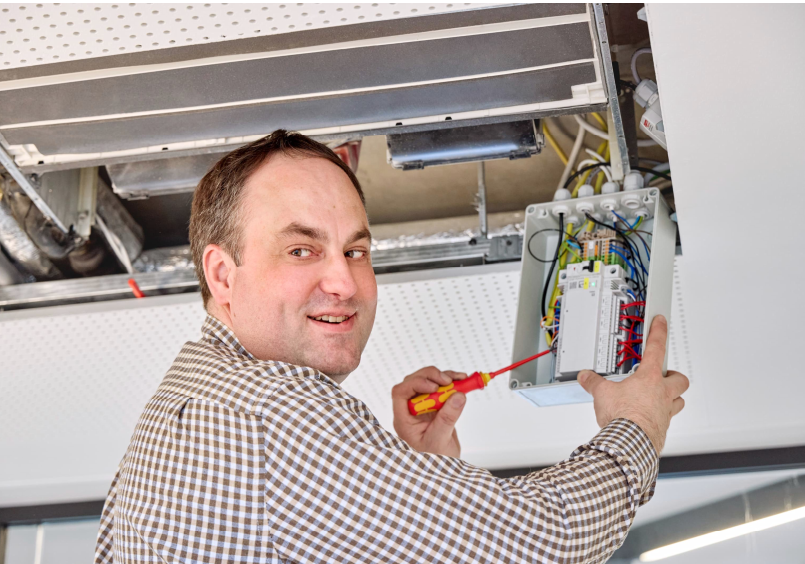
Compact distribution boards with limited space are common in building automation, including CapitalReal’s Köterhof project. On the first floor, one distributor box is discreetly hidden behind a desk. EPM selected Phoenix Contact’s Catan C1 EN controller for its compact DIN rail design and versatile communication interfaces. It features a managed Ethernet switch, 14 configurable I/Os—including eight universal inputs for temperature sensors, 0–10 V interfaces, and meters—and two universal plus four digital channels usable as inputs or outputs. Connectivity includes three Ethernet, two RS485, two USB-C ports, and two SPE interfaces for extension modules. As the first Niagara Framework-based controller, it also supports KNX TP.
Each floor of CapitalReal’s Köterhof building has a dedicated controller. On the first floor, it’s expanded with a Catan DOR6 UI8 module to connect relay contacts for the fan, heating, and cooling, according to Finn Sundermann. The controller also handles diagnostics and firmware updates for I/O modules in the false ceiling. The distributor box includes a DIN rail-mounted Phoenix Contact power supply and a plug-in control panel for local commissioning, operation, and maintenance.
Changing settings via notebook
Emalytics and the Niagara Framework offer a powerful environment for programming and visualization, integrating management, operations, and energy monitoring. This IoT-based platform enables control, evaluation, and processing of data across all relevant subtrades. “The browser-based Emalytics View provides a versatile toolbox for building custom dashboards,” says Sebastian Holterhaus. With Phoenix Contact’s support, EPM tailored visualizations to CapitalReal’s needs, allowing them to monitor, compare, and optimize trade-specific data. Prebuilt libraries within the framework also speed up configuration.
The visualization runs on a web server, allowing authorized users to check current temperatures via smartphone. Administrators Dennis Poelmeyer and Finn Sundermann can adjust settings remotely via VPN, while other users only have local access. In the initial phase, the goal is to identify measures to reduce energy use outside office hours, while employees continue to adjust room temperatures to their preferences.
Read more about the new Catan C1 EN controller.
