

How connector coding increases safety
The star fits in the star, the circle in the circle. This motor skills exercise teaches that only matching shapes connect. Similarly, mechanically coded connectors prevent mismatches, protecting both devices and users.

Whether plugging in a toaster at home, a USB-C phone charger, or an industrial PC, each system uses specific connector patterns to protect users. These patterns prevent incompatible connections, especially for power, signals, and data. While mismatched signal or data lines may fail to work, mixing them with power can damage devices and pose a danger to the user.
Preventing mismatching for hybrid inverters
Battery storage systems have become increasingly relevant in private rooftop setups to boost self-consumption of self-generated power. Many photovoltaic inverters now support battery integration. Hybrid inverters convert DC from solar panels to AC and store surplus energy in batteries, combining inverter and energy management functions.
For smaller systems (up to ~40 A), photovoltaic DC connectors are often used. However, using similar-looking “compatible” connectors poses a risk. If PV panel and battery connections are mixed up, it can cause malfunctions or damage. The risk increases during battery module installation—if equipped with PV connectors, incorrect wiring can lead to short circuits and fires.
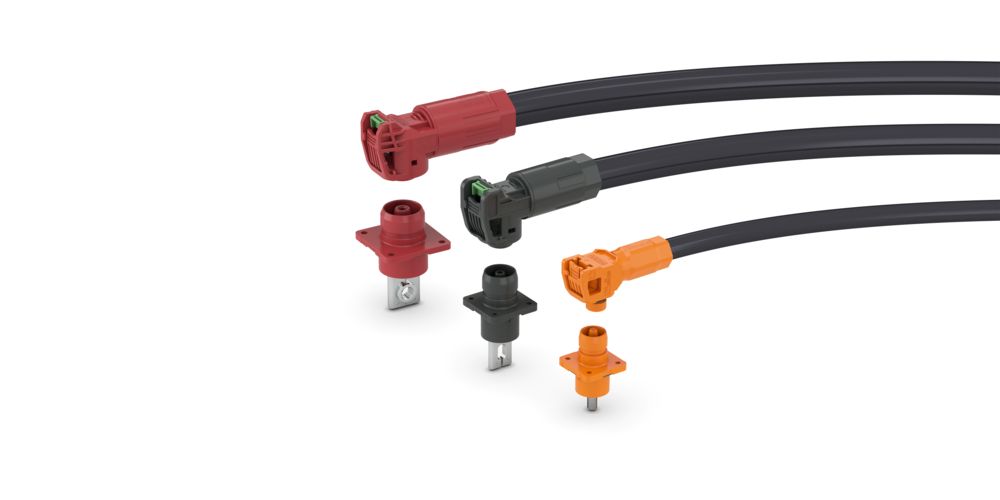
To prevent this, manufacturers offer mechanically and color-coded battery connectors that are incompatible with PV connectors. For example, Phoenix Contact’s ESS connectors feature a distinct pin pattern and tongue-and-groove design, with blue/red color coding, making mismatches easy to avoid.
Protection against polarity reversal for battery-based energy storage systems
Battery-based energy storage systems (BESS) offer scalable solutions for storing surplus energy and rapid retrieval. They’re used in residential setups with solar panels, industrial systems to buffer peak loads, and commercial environments to support grid stability.
Polarity reversal protection is crucial in all applications. In private setups, using storage units and modules from the same manufacturer ensures compatibility and smooth expansion with uniform connectors.
In industrial and commercial settings, systems can reach up to 1,500 V, making correct connector polarity critical, especially during installation or battery replacement. Coding connectors to prevent mixing up plus and minus helps skilled workers avoid dangerous mistakes.
Using two colors, typically black for minus and orange or red for plus helps visually distinguish connectors. Combined with mechanical coding like unique pin sizes or shapes, this prevents incorrect connections, protecting users from electric shock and systems from damage. These systems can include a locking mechanism to prevent accidental disconnection, activated after successful electrical commissioning.
Pin connector pattern coding for industrial machines and installations
Pin connector pattern coding offers key benefits for industrial and building installations. It allows manufacturers to clearly separate signals, which is especially useful in modular systems. Prewired, preassembled connectors enable even nonexperts to make correct connections. Since industrial setups often use both AC and DC voltage levels, coding helps prevent electric arcs by reliably distinguishing power, signals, and data both visually and physically.
Color-coded and mechanically coded connectors simplify fault detection and tracing. Since cable strands are bundled, faults can be costly to investigate. Clear markings, like distinct colors for each strand, help identify issues faster and with fewer resources.

Pin connector pattern coding also enhances aesthetics, giving systems a uniform, professional look across all signal types.
Safety and reliability, even when disconnecting connectors
Coded connectors ensure only compatible connections. While signal and data lines can be safely disconnected during operation, power lines must be de-energized. Removal tools help prevent accidental disconnection, reducing risks of electric shock and short circuits, especially in high-voltage DC systems and ensure precise, damage-free removal for long-term reliability.
Read more about PV connectors,
