

The electrification of road traffic is key to meeting climate goals, with innovative technologies efficiently transforming the utility vehicle sector economically.
Developments in the e-utility vehicle market
Ulrich Aschenbroich, SVP at Phoenix Contact E-Mobility, says the electric utility vehicle market is growing fast. In 2024, it reached a record market share. This reflects rising demand for eco-friendly transport. The growth is driven by better batteries, stricter emission rules, and government incentives.
The role of charging infrastructure
Charging infrastructure is key to electrifying utility vehicles. Battery size and charging power are crucial. Ulrich Aschenbroich highlights the Charx Connect Professional. It’s a CCS megawatt charging cable for large utility vehicles. This innovation supports faster, efficient charging. It helps make electric utility vehicles more practical and accepted. Over time, they are expected to be the most cost-effective option due to lower running and maintenance costs.
Industry challenges
Logistics companies are concerned about vehicle electrification. High costs, limited truck range, and few available models are key issues. A strong charging infrastructure is essential. Broken or missing stations can cause costly delays. Ulrich Aschenbroich stresses the need for reliable products. Long-distance logistics depend on dependable charging networks. Large batteries must recharge quickly during mandatory breaks. For example, a 45-minute charge after 4.5 hours of driving is required.
Technological advances
Ulrich Aschenbroich remains optimistic about the future of electric logistics, underscoring the flexibility provided by their CCS megawatt charging connectors. The HPC upgrade facilitates 1 megawatt transmission in boost mode for a 5-minute span at 40°C. This capability is essential for swift recharging of large e-truck batteries during mandated breaks, ensuring reliability at charging stations that logistics companies rely on. Consequently, Charx Connect Professional, developed by Phoenix Contact, emerges as an ideal solution.
HPC charging on a new level
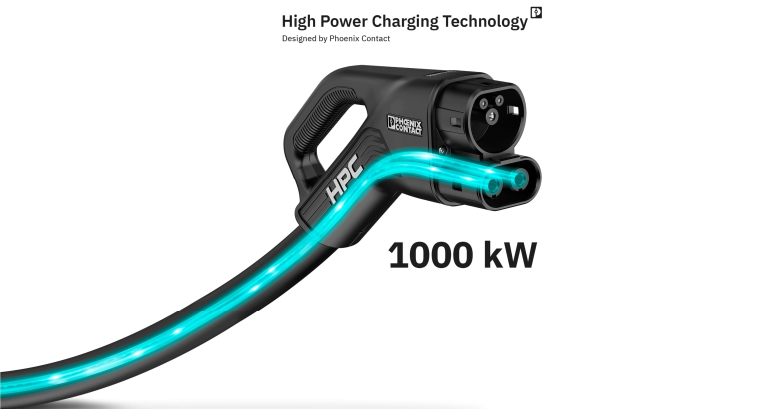
Phoenix Contact has achieved notable improvements in HPC technology by leveraging innovative cooling methods, optimizing cable structures, and incorporating real-time temperature monitoring. As a result, the second-generation Charx Connect Professional CCS charging connectors, equipped with liquid cooling, now support ultra-fast HPC charging by delivering 1,000 kW in boost mode and consistently maintaining 800 kW power output.
Cooling reinvented
Aschenbroich describes Phoenix Contact’s advanced cooling concept. Specifically, it uses insulated cooling lines wrapped directly in copper to improve contact with the cooling medium. As a result, this setup—featuring insulating foil on the contacts—efficiently removes heat from the hottest areas. Moreover, it uses an eco-friendly, low-maintenance water-glycol mixture. This marks a successful continuation from the previous generation of Phoenix Contact’s cooled HPC connectors.
Practical and sustainable maintenance
The new HPC charging connector is designed to facilitate practical and sustainable maintenance by allowing on-site replacement of the mating face frame and contacts (DC+, DC-, PE, CP, PP) directly at the charging station. Contacts can be replaced individually or collectively without having to open the housing or drain the coolant, simplifying the process for service technicians. Aschenbroich emphasizes that this design enables cost-effective maintenance, and since the calibration capsule remains untouched, there is no need for recalibration after repairs.

Safety features
The CCS megawatt charging connector from Phoenix Contact offers reliability and safety through its durable design and integrated temperature monitoring. It features Pt 1000 sensors to prevent overheating, ensuring safe operation for both users and operators. Ulrich Aschenbroich emphasizes an additional safety feature: an insulation monitor that detects coolant leaks at the charging station before charging begins. This essential safety measure requires no extra costs or added electronics, allowing potential issues to be identified and addressed early, preventing them from becoming safety risks
Precise billing compliant with calibration laws

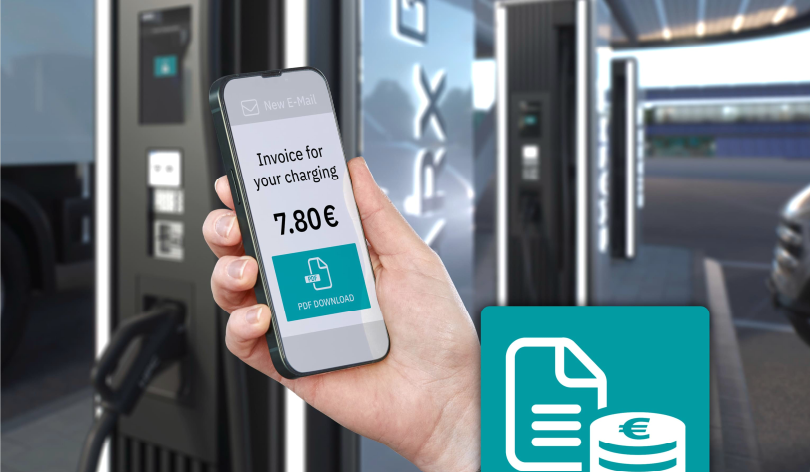
Phoenix Contact employs a four-wire measurement technique to enhance resistance measurement accuracy, crucial for precisely recording power dissipation in charging cables. This ensures the accurate determination of energy transmitted to vehicles, fundamental for a billing system compliant with the Measurement and Calibration Act. The approach satisfies all legal requirements necessary for reliable billing of charging processes, ensuring customers are correctly charged for the energy they use.
Future prospects and upgrades
Fast charging is key in the passenger vehicle industry. Manufacturers aim for megawatt-level charging to boost EV adoption. The Charx Connect Professional CCS connector enables quick charging for electric and utility vehicles. It allows fast battery recharging during breaks. Future upgrades to the Megawatt Charging System (MCS) will support higher power. Phoenix Contact’s CCS cables have matching connectors. They are designed for easy replacement with MCS cables. This makes the system flexible and ready for future needs.
Read more about CCS charging inlets.
